How to Measure Social Media Performance: 3 Metrics
How to measure social media performance without drowning in data: three metrics that show what works, one-variable tests, and turning winners into templates.
Pick three metrics that matter
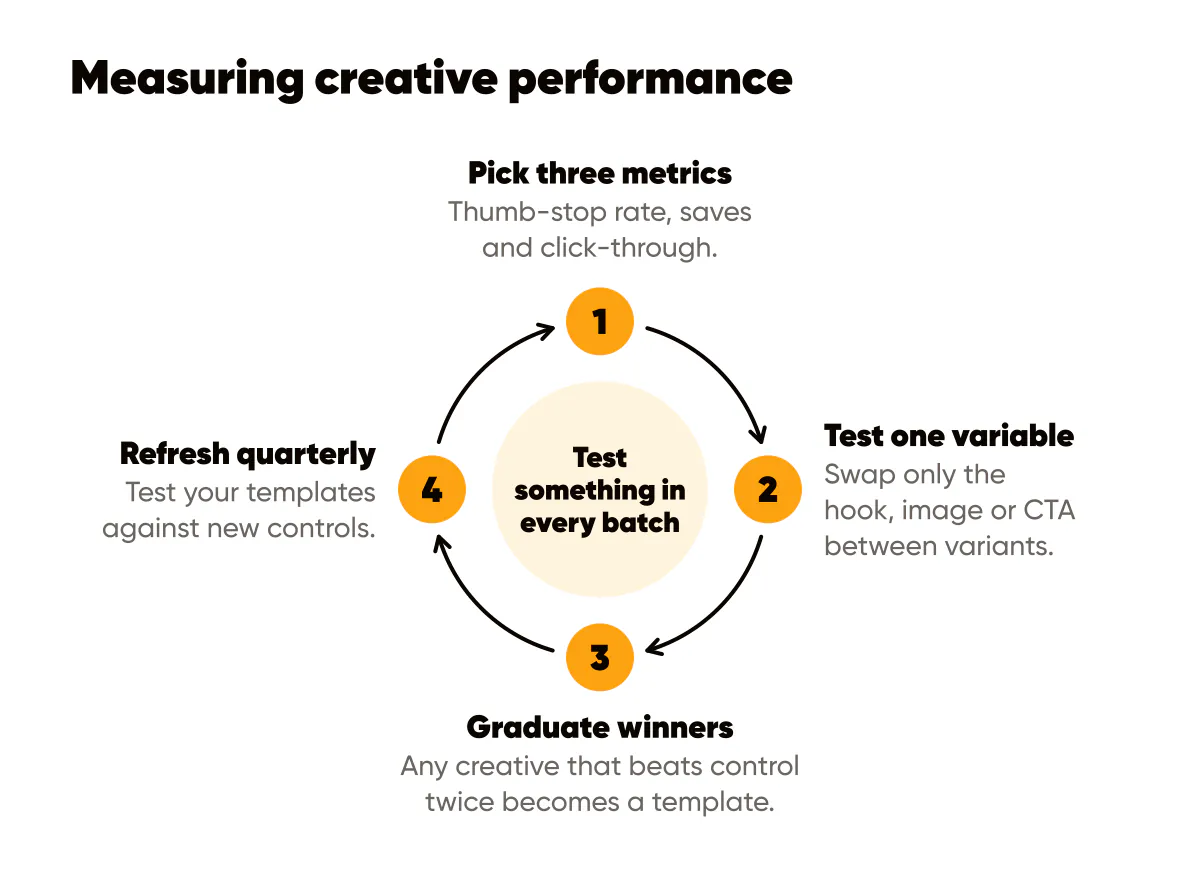
Track thumb-stop rate, saves, and click-through. These reveal creative resonance faster than raw impressions. Impressions tell you reach, but these metrics tell you impact. Focus on what drives action, not just views.
Thumb-stop rate measures how many people paused on your content. High thumb-stop means your visuals and hooks are working. Low thumb-stop means you need to improve your opening. This metric is especially important for video and carousel content where the first frame determines engagement.
Saves indicate content people want to reference later. High saves mean your content is valuable and reference-worthy. This is a quality signal: people are bookmarking your content because it's useful, not just entertaining. Track which topics drive the most saves to guide future content.
Click-through rate measures how many people took action. High CTR means your CTAs are compelling and your content delivers on its promise. Low CTR might mean your hook overpromises or your CTA is unclear. This metric directly ties to conversions, so optimize for it.
Don't get distracted by vanity metrics. Likes and comments feel good, but saves and clicks drive business results. Focus your optimization efforts on metrics that matter to your goals. If you're trying to drive traffic, prioritize CTR. If you're building authority, prioritize saves.
Test one variable at a time
Swap only the hook, image, or CTA between variants. Keep your brand settings the same across every variant, so you can isolate what actually moved the needle, whether that's swapping in a different hook formula or a new CTA. Testing multiple variables at once makes it impossible to know what caused the difference.
Create a control version: your current best-performing post. Then create variants that change only one element. Test hook variations while keeping everything else the same. Test image variations while keeping copy the same. Test CTA variations while keeping content the same.
Run tests for at least 10-20 posts to get statistical significance. One post doesn't prove anything. You need enough data to see patterns. Track results in a spreadsheet: variant, variable changed, and key metrics. Over time, you'll see which variables drive the most improvement.
Keep your brand settings fixed, change one element, and make the variant. This speeds up test creation and ensures consistency. The faster you can test, the faster you can learn and improve.
Document your learnings. When you discover that question hooks outperform statement hooks, write it down. When you find that warm colors drive more clicks than cool colors, note it. Build a knowledge base of what works for your audience so you can apply it systematically.
Graduate winners into templates
Any creative that beats control twice becomes a saved template, following the same logic as templates that convert. This builds a proven library instead of random one-off hits. One win might be luck, but two wins suggests a pattern worth repeating.
When you identify a winning variant, save it as a template you reuse. Lock in the elements that worked: layout, colors, typography, CTA placement. Leave flexible the elements you'll customize: headline text, images, specific CTAs. This gives you a proven structure to work from.
Build a library of proven templates organized by use case. Educational posts template, product launch template, testimonial template, etc. When you need to create new content, pick the appropriate template and customize. This speeds up production while maintaining quality.
Refresh templates quarterly. What worked six months ago might not work today. Test your templates against new controls periodically to ensure they're still performing. Don't let proven templates become stale. Keep them fresh while maintaining what made them work.
Create a testing culture
Make testing part of your content process, not a special project. Pair this with a regular content audit so testing and cleanup happen on the same cadence. Test something in every batch of content. Even small tests compound over time. The goal isn't perfection. It's continuous improvement.
Share test results with your team. When you discover something that works, document it and apply it broadly. When something doesn't work, learn from it and move on. A culture of testing creates a culture of learning and improvement.
Put it into practice
Turn this into posts designed for your feed
Paste your website. Creobee reads what you sell, then plans, writes and designs your posts about it as one feed in your logo and colors, captions included, and on Autopilot it posts them for you.
How the AI social media post generator works