Marketing Frameworks for AI Captions: 4 Examples
Marketing frameworks for captions: StoryBrand, Purple Cow, Hook Point and the Value Ladder, each explained, turned into an AI prompt and shown as a caption.
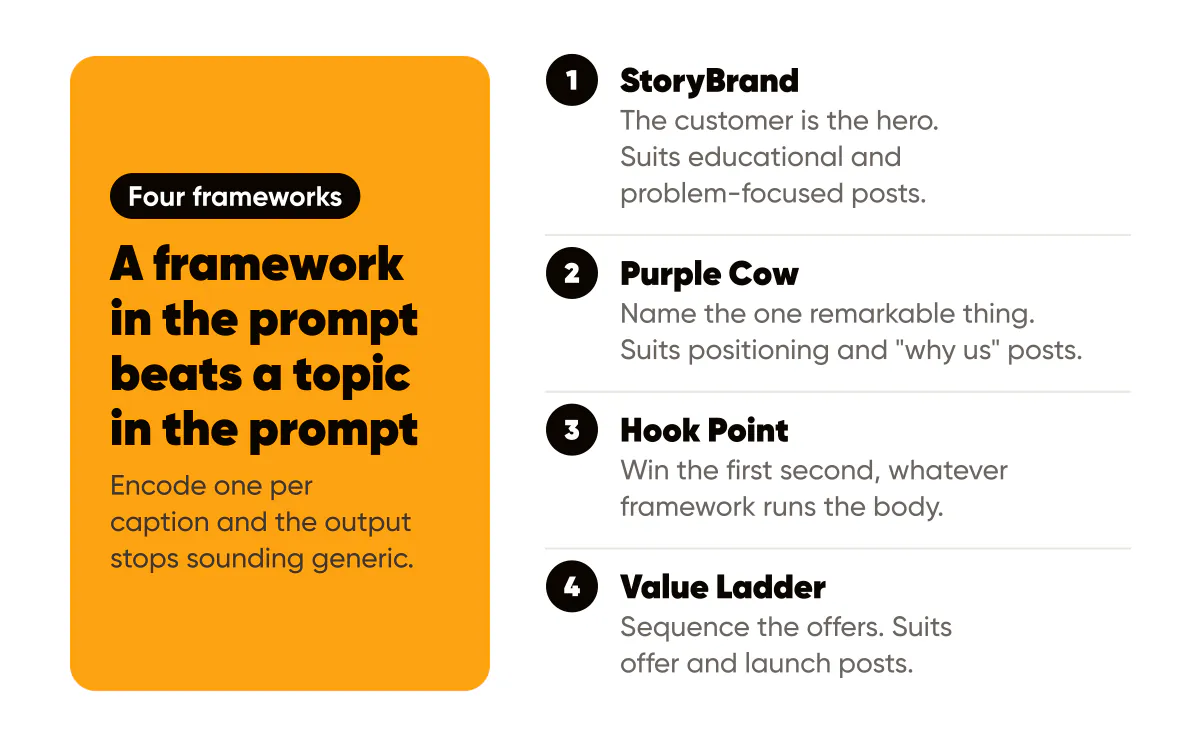
AI captions get persuasive when the prompt carries a framework, not just a topic. Four frameworks do most of the work for small brands: StoryBrand makes the customer the hero, Purple Cow demands something remarkable, Hook Point wins the first second, and the Value Ladder sequences offers. Encode one per caption and the output stops sounding generic.
Why a framework belongs in the prompt
"Write a caption about my coaching program" gives a model nothing to reason with, so it produces the average of every coaching caption it has seen. A framework gives it a structure to fill: who the customer is, what they want, what stands in the way, what to say first. The model is good at filling structures. It is bad at inventing them.
I learned this the slow way: my early AI captions were grammatical and forgettable, and adding a framework changed them more than any tone setting did. Three of the four frameworks below, StoryBrand, Purple Cow and Hook Point (listed as Brendan Kane's hook-first option), are options you can select in Creobee's AI Instagram post generator, each with its own short set of fields. The Value Ladder is not a selectable option; you encode it in the brief yourself, and I will show how. The point is not the tool. The point is that a framework in the prompt beats a topic in the prompt, whatever tool you use.
StoryBrand: the customer is the hero
Donald Miller's StoryBrand framework is a story structure borrowed from film: a character wants something, meets a problem, finds a guide with a plan, takes action, and either succeeds or avoids failure. The brand is the guide, never the hero. Most small-business captions fail this test immediately because they start with "we" and "our."
How do you encode StoryBrand in a caption prompt?
Give the model the four story slots explicitly and forbid the brand from being the hero. A prompt shape that works: "Write a caption where the customer is the hero. Customer: HERO. External problem: PROBLEM. What they really want: DESIRE. Our role: the guide who offers PLAN. End with one clear action. Do not start with we or our."
For a bookkeeper serving freelance designers, the filled prompt might produce: "You did not become a designer to spend Sunday nights in a spreadsheet. Every invoice you chase is an hour you are not designing. I keep the books for twelve freelance studios so they can keep their weekends. Reply BOOKS and I will send the three-step onboarding." Customer first, problem named, guide with a plan, one action. More worked examples for that kind of practice are in social media posts for accountants and bookkeepers.
Purple Cow: be remarkable or be invisible
Seth Godin's Purple Cow, which he still writes around on his blog, argues that in a field of brown cows nobody notices another brown cow. Safe, average, competent marketing is invisible by design. The only thing worth making is something a specific group of people will remark on, and the strategy is to serve that group so well they tell others.
The prompt asks for the remarkable element and the specific tribe, and it refuses the general audience. "Write a caption for TRIBE, a specific group of people, about the one thing that makes OFFER remarkable enough to mention to a friend: REMARKABLE ELEMENT. No claims that every competitor could also make."
For a neighborhood bakery: "We bake exactly 40 sourdough loaves a day and when they are gone we close the bread counter. Not a stunt. The oven is the size it is. If you want one, the list opens at 7 and fills by 7:20." That is remarkable because it is specific, slightly inconvenient and true. A caption saying "fresh bread daily" is a brown cow.
Hook Point: win the first second
Brendan Kane's Hook Point work is about the opening seconds of attention in a feed that scrolls past three seconds at a time. The hook is not the whole message. It is the pattern interrupt, curiosity gap or bold claim that earns the next line. Everything after the hook can be calm; the hook cannot.
To prompt for a hook without clickbait, name the hook type, the emotion, and the promise the body must keep. "Open with a HOOK TYPE that triggers EMOTION in the first line, under 12 words. Then deliver PROMISE plainly. The hook must be true and the body must fully pay it off." The last sentence is what separates a hook from bait, and the model respects it when you write it down.
A personal trainer might get: "I stopped counting calories with clients two years ago. Weight loss did not slow down. What replaced it: three meals with protein first, a ten-minute walk after each, and a weekly check-in. Boring works." Bold first line, honest body. The viral hook formulas post has three more openers that clear the same bar.
Value Ladder: sequence the offers
Russell Brunson's Value Ladder is a sequencing idea: people rarely buy the expensive thing first, so you arrange offers from free to low-cost to core to premium, and each step earns the right to offer the next. For captions, this means every post should know which rung it is selling and never skip rungs.
How does the Value Ladder change a caption?
It tells the model what to ask for. A caption pushing a 2,000 dollar package to a cold audience is a rung-skipping caption, and it reads as pushy because it is. A prompt that encodes the ladder names the rung: "This caption sells the RUNG offer, which is FREE OR LOW COST. The audience has not bought before. Ask only for the next small step: ACTION. Mention the bigger offer only as context, not as the ask."
For a web designer: "Before you pay anyone to redesign your site, run this five-minute check: does the top of your homepage say who you help and what happens next? Most sites I audit fail that in the first sentence. Free 12-point audit checklist in my bio. Full redesigns come later, if you need one." The free rung is the ask; the core offer is mentioned, not sold. The offer posts guide covers what to write once someone is ready for the higher rung.
Which framework for which post? Do not pick a favorite and use it forever. Match the framework to the job of the post. A rough rule from my own weekly batches:
- Educational and problem-focused posts suit StoryBrand, because the customer's struggle is the natural opening.
- Positioning and "why us" posts suit Purple Cow, because they force you to name the one remarkable thing.
- Any post competing for attention in a crowded feed benefits from a Hook Point opener, whatever framework runs the body.
- Offer and launch posts need the Value Ladder, because the failure mode of offer posts is asking for too much too early.
Mixing frameworks across a week also solves the monotony problem. Ten StoryBrand captions in a row all start with "You," and readers notice. The caption frameworks guide covers structural templates that pair well with any of these four.
Do this this week
Take one topic you post about often. Write four prompts for it, one per framework, using the shapes above with your own details filled in. Generate a caption from each and read them side by side. One will be obviously stronger for that topic, and that tells you which framework that topic wants. Add the result to your brand voice file as a note, so next week's batch starts with the right structure instead of rediscovering it.

Put it into practice
Turn this into posts designed for your feed
Paste your website or say what you do. Creobee plans, writes and designs your posts about it as one feed in your logo and colors, captions included, and on Autopilot it posts them for you.
How the AI Instagram post generator works