Storytelling Ads That Don't Feel Like Ads
Storytelling ads for small businesses: open on a relatable moment, show the change fast, close with proof, and test formats so paid social earns cheaper clicks.
Hook with a relatable moment
Start with the emotional beat before the solution appears. Show the frustration in a single visual and line of copy. People don't buy products. They buy solutions to problems they feel. Your ad should start where your audience is, not where you want them to be.
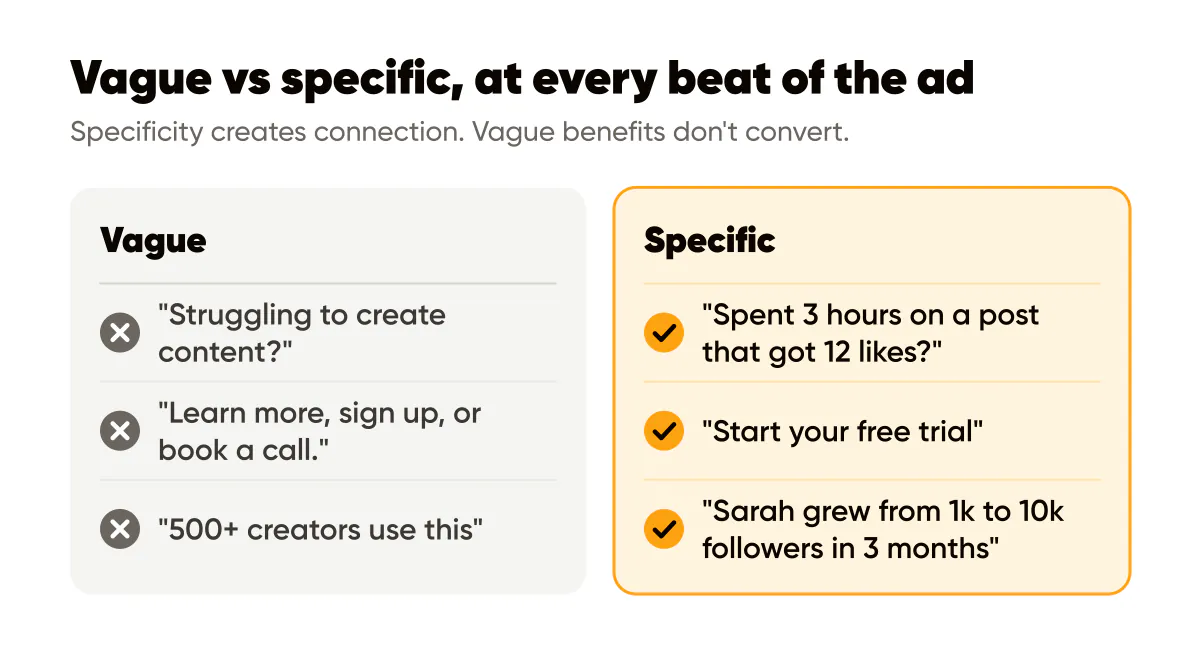
The relatable moment should be specific, not generic. "Struggling to create content?" is vague. "Spent 3 hours on a post that got 12 likes?" is specific and relatable. Specificity creates connection because people think "That's exactly my problem," the same principle behind our viral hook formulas.
Use visuals that reinforce the emotion. If you're addressing frustration, show someone looking stressed or overwhelmed. If you're addressing aspiration, show someone achieving the outcome. The visual should amplify the emotional hook, not distract from it.
Your opening line should make viewers think "They understand me." This creates instant rapport and makes them want to keep watching. The hook isn't about your product. It's about their problem. Once you've established that connection, you can introduce your solution.
Slide into transformation quickly
Frame the product as the bridge between pain and relief. Highlight the "after" with bold contrast and a single CTA. Don't spend too long on the problem. Show the solution quickly so viewers can see what's possible.
The transformation should be visual and clear. Use before/after comparisons, show the outcome, highlight the key benefit. Make it obvious what changes when someone uses your product. Vague benefits don't convert. Specific outcomes do.
Keep your CTA simple and singular. One clear action beats multiple options. "Start your free trial" is better than "Learn more, sign up, or book a call." Decision fatigue kills conversions. Make it easy to say yes.
Make visuals that show the transformation clearly. Bold typography for the outcome, contrasting colors to draw attention, and clear hierarchy that guides the eye. The visual should make the benefit obvious at a glance.
Close with social proof
End every ad with a testimonial chip or usage stat. Proof lowers CPMs because viewers trust the story arc, the same restraint covered in social proof posts. When people see others achieving results, they're more likely to believe they can too. Social proof bridges the gap between "sounds good" and "I'll try it."
Use specific, credible proof. "500+ creators use this" is okay. "Sarah grew from 1k to 10k followers in 3 months" is better because it's specific and relatable. Real results from real people build more trust than vague numbers.
Feature testimonials that address common objections. If people worry about time commitment, feature someone who achieved results quickly. If people worry about complexity, feature someone who found it simple. Match your proof to your audience's concerns.
Rotate your social proof to keep ads fresh. Use different testimonials, different stats, different angles. This prevents ad fatigue and keeps your messaging dynamic. But always include proof: it's essential for conversion.
Test ad formats systematically
Not all ad formats work for all audiences. Test single images, carousels, videos, and stories to see what resonates. Track cost per click, conversion rate, and return on ad spend for each format, using the same scorecard from measuring creative performance.
Build each test around one core idea so the formats are comparable. The same idea can become a single image, carousel slides, and story frames. Test which format drives the best results, then double down on what works.

Put it into practice
Turn this into posts designed for your feed
Paste your website. Creobee reads what you sell, then plans, writes and designs your posts about it as one feed in your logo and colors, captions included, and on Autopilot it posts them for you.
How the AI Instagram post generator works