Testimonial Posts That Don't Sound Like Bragging
Testimonial posts that read as evidence, not boasting: asking permission, specific quotes, honest before and afters, a quote card template and the FTC rules.
Social proof posts stop sounding like bragging when they carry four things: permission from the person quoted, a specific detail that could not be invented, the context of who they were and what they were trying to do, and a design that treats the quote as evidence rather than decoration. Do that, and a testimonial reads as a receipt.
Why social proof posts feel like bragging, and why they do not have to
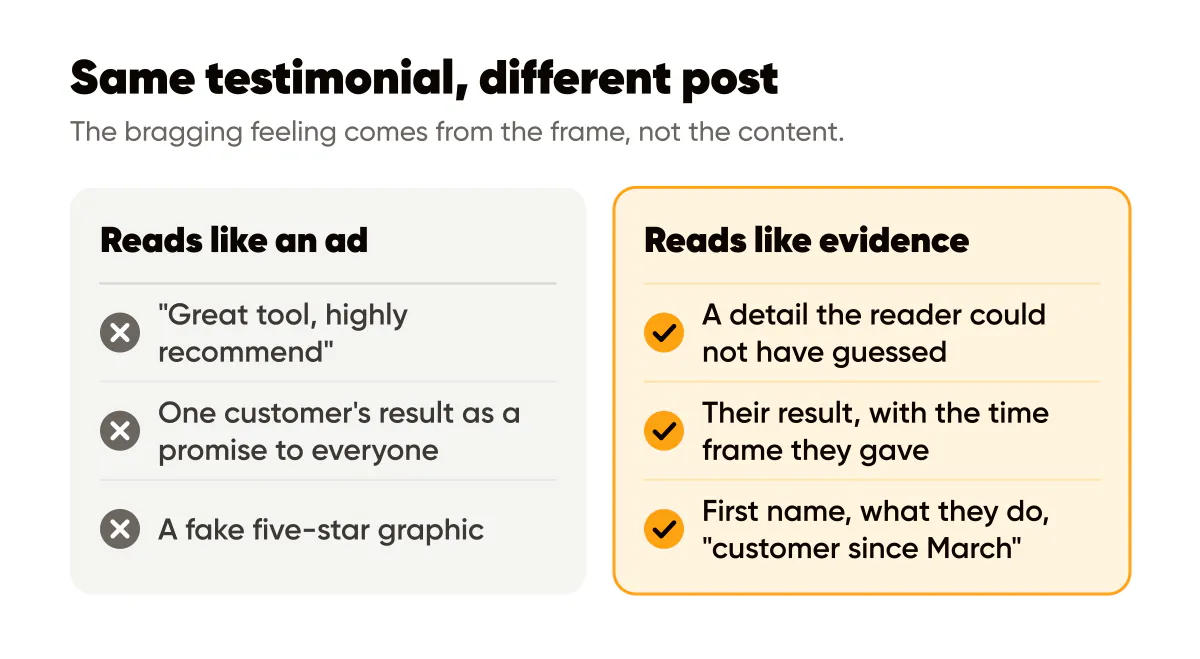
The bragging feeling comes from the frame, not the content. "Look how great we are" is a brag. "Here is what happened for one specific person, in their words, with the messy parts left in" is a report. Same testimonial, different post.
I resisted posting testimonials for Creobee for months because every version I drafted sounded like an ad. What fixed it was treating each one the way I treat proof of experience in any other content: named context, real numbers with time frames, and the failed first attempt if there was one. The same logic that makes E-E-A-T work for a solo creator makes a testimonial believable.
The four ingredients of a proof post that works
How do you ask a customer for permission?
Directly, in writing, and with the exact words you plan to use. My message is usually one sentence: "Would you be okay with me sharing this line from your email on our Instagram, with your first name and what you do?" Then I paste the line. Most people say yes; some ask to trim a detail; a few say no, and that is fine.
Keep the reply. Permission you cannot find later is permission you do not have. If you plan to use a screenshot of a DM or a review, ask for that specifically, because a screenshot shows more than the words: a photo, a handle, a timestamp.
What makes a testimonial specific enough to believe?
A detail the reader could not have guessed. "Great tool, highly recommend" tells me nothing about the customer or the product. "I made the whole month of posts for my bakery on a Sunday afternoon and finally stopped designing at midnight" tells me who they are, what changed and when.
When you ask for a testimonial, ask for the detail rather than the praise: "What were you doing before, and what does a normal week look like now?" People answer that question with stories. Stories carry the specificity for you, and they make the reader picture themselves in the same seat.
Context is the third ingredient and it is the one most people cut for space. Who is this person, roughly? A yoga teacher with a studio, a freelance bookkeeper, a two-person agency. Without context the quote floats; with it the reader knows whether it applies to them.
Framing results honestly: before and after, with time frames
Results claims are where proof posts get dangerous. If a customer says "my saves doubled," you can share it as their statement, with the time frame they gave you, and it stays honest. What you cannot do is turn one customer's result into a general promise: "double your saves" is a claim about everyone, and you have evidence about one person.
The FTC's Endorsement Guides FAQ is worth reading in full if you sell anything. In general terms, endorsements have to reflect the honest opinion of the person giving them, and results shown should be what a typical customer can expect or be clearly qualified. If someone received a free plan or a discount for their feedback, that relationship should be disclosed, and the Disclosures 101 guide covers how plainly that has to be done. This is not legal advice, it is the reason I write "customer since March, on the Autopilot plan" under a quote and never edit their numbers upward.
The before-and-after frame is the strongest version of this. Slide or line one: what their week looked like before. Line two: what it looks like now, in their words, with a date. The gap between the two is the proof; you do not need to add an adjective to it.
The quote card template
The design job is to make the quote read as evidence, so I keep the template plain and consistent. A quote card that changes style every time looks like a stock graphic; one that looks the same every time looks like a series of receipts from the same brand.
- The quote goes in your brand's text font at a size that stays readable when the 4:5 post is a thumbnail, usually two to four short lines, never a paragraph.
- The attribution line sits directly under it in a smaller weight: first name, what they do, and a time marker such as "customer since March."
- Contrast comes first, so a dark or muted background behind light text or the reverse, tested against the WCAG minimum contrast ratio rather than eyeballed.
- Your logo sits in the same corner as on every other template, small, so the card is recognisably yours in a stranger's feed.
- No stars, no confetti, no fake five-star graphic unless it is a real screenshot of a real rating.
I make these in one sitting with the same template so a month of proof posts reads as one family. The readability rules for the text itself are the same as for any post with words on it, covered in text over images readability rules.
Screenshots, UGC and what not to do
A screenshot of a customer's own post or story about you is the most credible format there is, because it was made without your template. Ask before resharing beyond a Story, crop out other people's names, and add a line of your own context. Getting more of that content in the first place is a prompt problem, and UGC prompts that work covers how to ask.
What not to do, without exception: invent a testimonial, composite two customers into one, or attach a stock photo to a real quote as if it were the person. If your business is new and you have no testimonials yet, post your own process and results instead. That is proof too, and it is yours. If writing those feels like a chore, done-for-you social media posts can be planned from a description of how you work, and you approve each one before it goes out. If you use AI to help draft the caption around a real quote, the disclosure question is worth a minute of thought, but the quote itself must be the customer's exact words.
Do this this week
Find three messages from customers that contain a specific detail, and send each person a one-line permission request with the exact words you want to use. Build one quote card template with your brand font, an attribution line and your logo in its fixed corner. Post the first one with the context line and, if there was any free product or discount involved, the disclosure. Then schedule the other two across the month rather than in a row. Three honest proof posts in a consistent template will do more than thirty vague ones, and they will still be true next year.
Put it into practice
Turn this into posts designed for your feed
Paste your website or say what you do. Creobee plans, writes and designs your posts about it as one feed in your logo and colors, captions included, and on Autopilot it posts them for you.
How the AI Instagram post generator works