Dental Instagram Post Ideas and the HIPAA Rules
How Creobee's planner splits a dental practice's week of posts, what to put in each slot, and the HIPAA, ADA and FTC rules for patient photos and reviews.
A dental feed is built almost entirely without patients in it. You cannot post the smile you finished on Tuesday without a signed form, and a careless reply to a review can be a privacy problem. That leaves tips, plain answers, your team, your rooms and your hours, which happen to be the posts a nervous person reads before they call.
This post does two things. First it shows how Creobee, the tool I build, divides a dental practice's week of posts, read from its own planner, and what a practice can put in each slot. Then it covers the rules for patient photos and reviews, each one checked on the regulator's own page on November 4, 2026. That part is general information, not legal advice; your state dental board and your own counsel have the last word.
How Creobee's planner splits a dental week
On November 4, 2026 I ran Creobee's week planner, the code that decides what each post is before any words are written, for an account set up as "Clinic or dentist". That kind of account starts on the "Be seen as the expert" goal, whose content mix is Build authority. I planned the Regular pace 200 times with a different random seed each time.
The split never changed. The nine feed posts were always four Educate posts and one each of Engage, Inspire, Behind the scenes, Social proof and Promote. The seven stories follow their own fixed mix: two Engage, two Promote, and one each of Behind the scenes, Inspire and Educate. What changes from run to run is the format inside each pillar (a FAQ one week, a myth put right the next) and which day it lands on.
The days and times come from a fixed table, counted from the day the week starts:
| Day | 10:00 | 12:30 | 17:00 |
|---|---|---|---|
| 1 | Animated post | Story | |
| 2 | Carousel | Story | |
| 3 | Animated post | Story | Single post |
| 4 | Carousel | Story | |
| 5 | Animated post | Story | |
| 6 | Carousel | Story | Single post |
| 7 | Animated post | Story |
The animated posts are short videos made from the post's own design. If you answer no when the week page asks about them, those four slots become single posts. The 16 items a week come to about 70 a month, stories included, which the Autopilot plan, $39 for 100 posts, covers.
The same account also gets a post formula on its plan, one line per pillar: patient questions answered in plain words (FAQ), honest answers to the worries before a first visit, how to book and what to expect, and everyday moments patients will recognize. The ideas below are written to fit those slots.
What a practice can put in each slot
The four Educate posts
These carry the week, so give them the questions your front desk hears most. Keep the advice to what the profession says in public: the ADA's patient site, MouthHealthy, says to brush twice a day with a soft-bristled brush and replace the brush every three or four months, or sooner if the bristles are frayed (checked November 4, 2026). Anything more specific belongs in the chair.
- What the hygienist is doing during a cleaning, step by step, as a carousel.
- How instruments are cleaned and sterilized between patients, in plain words.
- When to replace a toothbrush, and the frayed-bristle sign that says sooner.
- What happens at a child's first visit, and how to talk about it at home.
- Which insurance plans you accept, and who to call with questions.
- What counts as a dental emergency at your practice, and the number to ring.
Engage, Inspire, Behind the scenes, Social proof and Promote
One of each a week, so rotate through these:
- Engage: mint or bubblegum toothpaste, electric or manual brush. Keep replies general and move anything personal to a call.
- Inspire: the one thing the team wants every nervous patient to know, or why the dentist chose dentistry, in three sentences.
- Behind the scenes: the treatment room before anyone sits in the chair, the front desk team with each person's written okay, the waiting room at opening.
- Social proof: degrees and continuing education stated exactly as earned, or a review card, which needs the signed form described below.
- Promote: new patient exams and what they include, evening or Saturday hours, booking online.
The ADA sponsors National Children's Dental Health Month every February (checked November 4, 2026), which gives a family practice a month of ready themes.
The seven stories
Stories are for what is true today: a cleaning slot that opened at 3:30, holiday hours with the emergency number, a this-or-that between two of your services. The two Promote stories are the place for the gap in today's book. Keep names, charts and screens out of frame, because a story is still public.
The free first week for a practice
A new account's first three posts are not drawn from the mix. The planner gives every business a fixed set, and for a "Clinic or dentist" account it is: a story on day 1 at 12:30 that asks people to choose between two of the practice's own services, a FAQ carousel on day 2 at 10:00 about choosing or using what the practice offers, and on day 3 at 17:00 a single post that spotlights one service by the name the practice's own description gives it. The planner's instructions forbid an invented story, client or figure in any of them.
Patient photos, reviews and the rules behind them
Everything in this section links to the official text and was checked on November 4, 2026. HIPAA applies to covered entities, which the CMS page Are You a Covered Entity? says includes providers "who submit HIPAA transactions, like claims, electronically", dentists named among them. A practice that does not bill electronically should confirm its own status; state privacy law can apply either way.
A patient in the frame is health information
The ADA's guide to dental marketing and advertising says: "A photo or video of a patient, even just sitting in the waiting area, may constitute PHI." It adds that "even merely revealing that an individual is a patient may violate privacy laws."
Cropping to the teeth does not settle it. HIPAA's de-identification rule lists "full face photographic images and any comparable images" among the identifiers to remove, plus "any other unique identifying number, characteristic, or code", and the practice must have no actual knowledge that what is left could identify the person. A distinctive smile, a caption, a date or a patient tagging themselves can each put a name back on the photo.
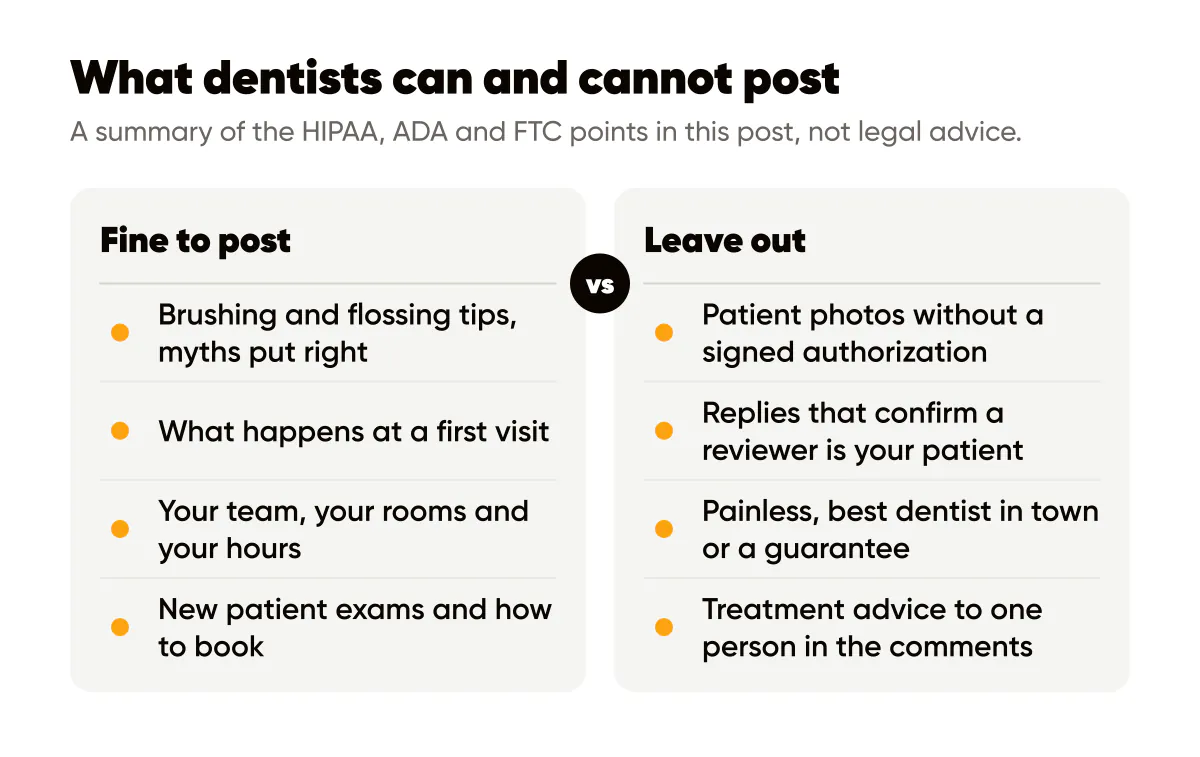
What the signed form has to say
HHS's Office for Civil Rights put it plainly when it announced its settlement with Cadia Healthcare Facilities on September 30, 2025: "Generally, a valid, written HIPAA authorization from an individual is necessary before a covered entity or business associate can post that individual's PHI in a website testimonial or through a social media campaign." Cadia had posted patients' "success stories" without one and paid $182,000.
Under 45 CFR 164.508, a valid authorization:
- describes the photos or video "in a specific and meaningful fashion";
- names who discloses them (your practice) and who receives them (the public, on the accounts you name);
- states the purpose and has an expiration date or event;
- is signed and dated;
- tells the patient they can revoke it in writing and how, that treatment does not depend on signing, and that what is posted can be redisclosed by others.
It "may not be combined with any other document to create a compound authorization", so it is a separate page, never a checkbox in the intake packet, and the patient gets a copy of what they signed. A verbal "sure, post it" at checkout is none of this.
Replying to reviews
A reply that confirms someone is your patient, or explains their care, discloses health information. Three dental practices are on HHS's own enforcement pages for it:
- New Vision Dental in California paid $23,000 and agreed to a corrective action plan after disclosing patient information in response to online reviews.
- Dr. U. Phillip Igbinadolor, D.M.D. & Associates in North Carolina disclosed a patient's PHI on a webpage in response to a negative online review and received a $50,000 civil money penalty.
- Elite Dental Associates in Dallas agreed to pay $10,000 and adopt a corrective action plan over social media disclosures of patients' information.
A reply that stays inside the line, for a bad review: "Thank you for taking the time to write this. We can't discuss anyone's care in public. Please call our office manager so we can listen properly." For a good one: "Thank you, this made the whole team's day." Neither says "your crown" or "your visit on Tuesday".
Advertising claims and testimonials
The ADA Code, section 5.F, says no dentist shall advertise "in a manner that is false or misleading in any material respect", and its advisory opinion names statements likely "to create an unjustified expectation about results the dentist can achieve" and claims of superior quality without "reasonable substantiation". "Painless", "best dentist in town" and guarantees fall here, and many states add their own rules on testimonials.
The FTC's Endorsement Guides questions and answers add four points that matter for a practice:
- A review from an employee or a relative is misleading unless the connection is made clear.
- You can't condition an incentive, such as a discount, on a review being positive.
- Asking only the patients you expect to be happy is misleading if it "substantially skews the favorability of the reviews."
- A testimonial with an exceptional result needs proof it is typical, or a clear statement of what people can generally expect. "Individual results may vary" does not change how it reads.
The FTC's Consumer Reviews and Testimonials Rule, in effect since October 21, 2024, lets courts impose civil penalties for knowing violations, fake reviews and incentives tied to a sentiment included.
Honest limits: what Creobee makes and what your own photos do
Your own photos and short videos still do what a designed post cannot: a real welcome from the dentist, the actual waiting room. Creobee makes no filmed video; Reel ideas for small business has angles to film yourself.
Creobee covers the planned half. Describe your practice once, from your website or a few words, and it plans, writes and designs your month of posts, carousels and 9:16 stories in your logo and colors as one feed, with optional short animated versions of posts. There are no AI-generated images: AI writes the words, set on preset art or a photo of your practice you upload, so keep patients out of what you give it. It makes no HIPAA or other compliance claim and does not know your state's rules, so read every post and leave out any that says more than you would. On Solo you download the posts; on Autopilot and Pro they are scheduled after your OK, stories to Instagram. Your first 3 posts are made free, with no card needed.
The AI social media manager for dental practices page shows a full week for a fictional practice, and Instagram feed design explains how the grid keeps one look as it grows.
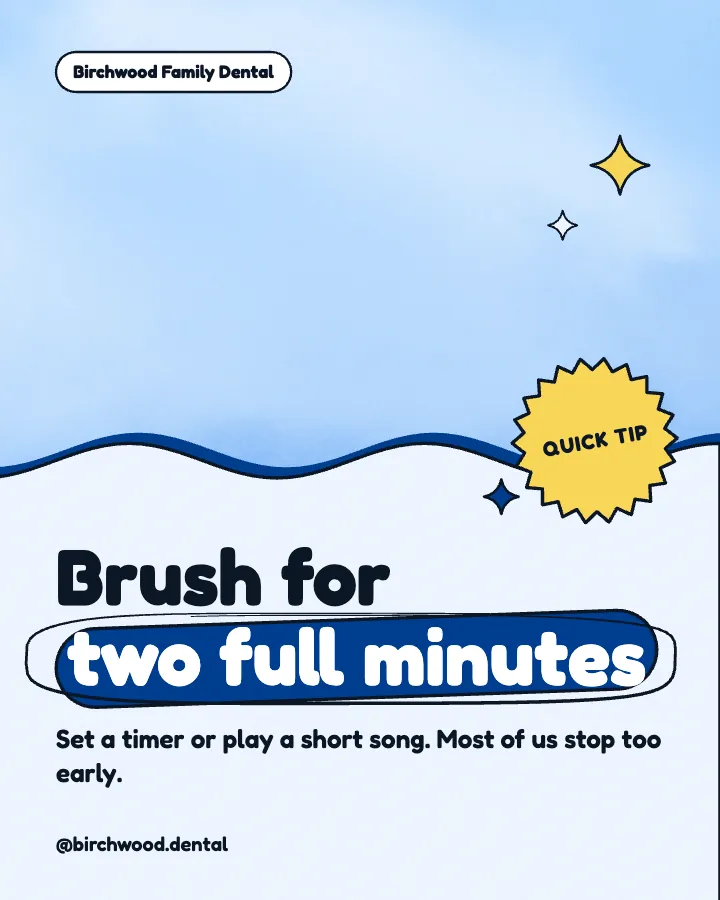
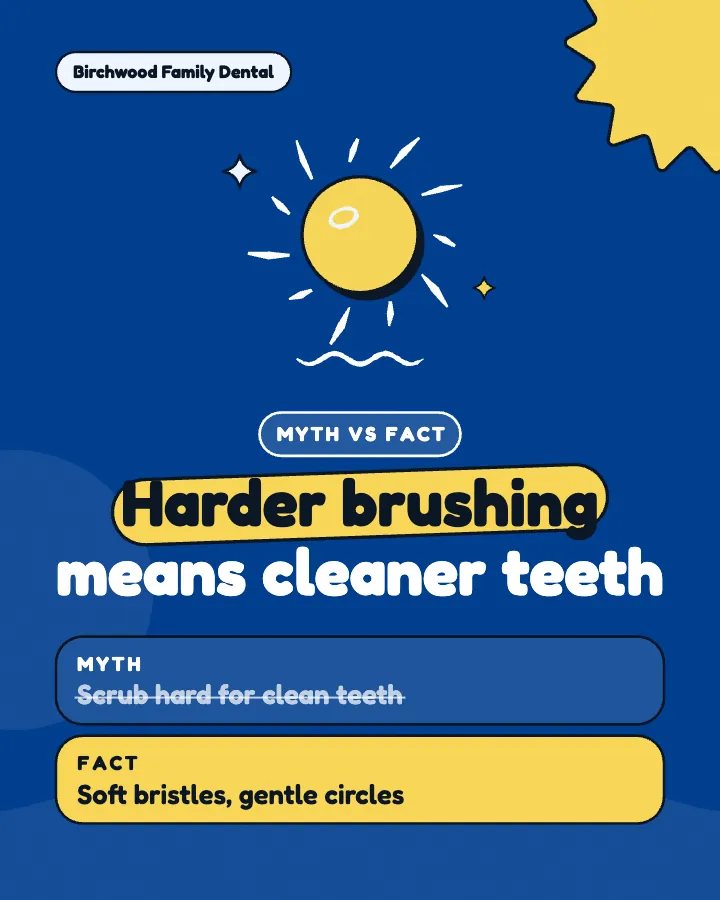
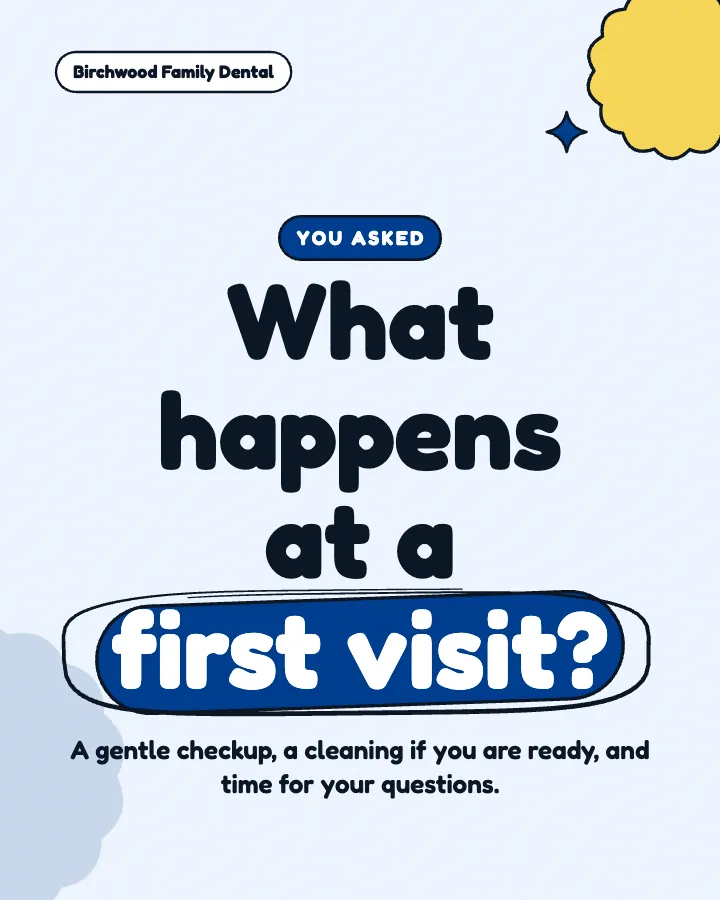
A brushing tip, a myth put right and a first-visit answer, with nobody's teeth in them. Type your website or one line about your practice, and your first posts start from it. To have the approved week posted for you, social media autopilot does that on Autopilot and Pro.
Put it into practice
Turn this into posts designed for your feed
Paste your website or say what you do. Creobee plans, writes and designs your posts about it as one feed in your logo and colors, captions included, and on Autopilot it posts them for you.
How the Posts for dentists works