Med Spa Instagram Post Ideas and Photo Rules
The FTC, FDA and HIPAA rules for med spa before-and-after photos, reviews and product posts, and how Creobee plans a med spa's week of posts.
The post a med spa most wants to publish, a before-and-after, is also the one the rules have the most to say about. In the US no federal rule bans it. What the rules do is treat the photo pair as a claim about results, treat the client in it as someone whose consent you need, and treat any product named beside it as something with an approved use.
This guide takes those rules first, each checked on the regulator's own page on November 4, 2026. Then it shows how Creobee, the tool I build, plans a med spa's week of posts, and what fits each slot. I am not a lawyer, and this is not legal advice: your medical director, your state medical board and your own counsel decide what your clinic may post.
Before-and-after photos: what the US rules ask
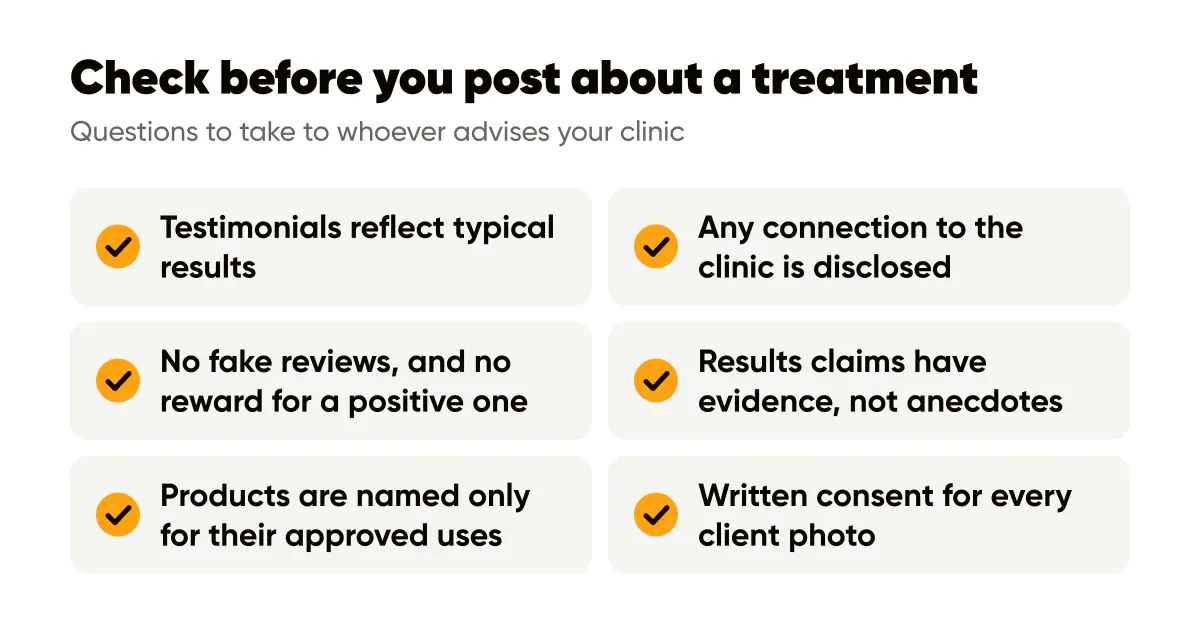
The pair is a claim about results. The FTC's Endorsement Guides questions and answers say an endorsement showing specific results will usually be read as what others can expect, and that "Results not typical" or "Individual results may vary" won't change that. You either have proof that the result is typical or you clearly say what people can generally expect. The FTC's Health Products Compliance Guidance adds that health claims need "competent and reliable scientific evidence" and that "testimonials that report results more dramatic than users can generally expect are likely to be deceptive."
The client needs to have said yes in writing. Whether HIPAA itself applies depends on your setup: the CMS page Are You a Covered Entity? says providers "who submit HIPAA transactions, like claims, electronically are covered." A cash-only med spa may not be, but the practice of its medical director may be, and state privacy law can apply either way. Where HIPAA applies, HHS's Office for Civil Rights said in its Cadia Healthcare Facilities settlement of September 30, 2025: "Generally, a valid, written HIPAA authorization from an individual is necessary before a covered entity or business associate can post that individual's PHI in a website testimonial or through a social media campaign." Cadia had posted patient "success stories" without one and paid $182,000.
A valid authorization under 45 CFR 164.508 describes the photos specifically, names who discloses and who receives them, states the purpose, has an expiration date or event, is signed and dated, and tells the client they can revoke it in writing, that treatment does not depend on signing, and that what is posted can be shared on by others. It cannot be folded into another document such as the treatment consent. Cropping the eyes out does not make a photo anonymous: HIPAA's de-identification rule lists "full face photographic images and any comparable images" and "any other unique identifying number, characteristic, or code", so a tattoo or a birthmark counts. Even where HIPAA does not apply, the same kind of form is what a client would expect.
A photo standard that keeps the pair honest
None of this is a regulator's checklist; it is how to take a pair you can defend as typical:
- The same light, angle and distance in both photos: one spot in the clinic, a mark on the floor for the chair and the camera.
- No filter, beauty mode or retouching on the treated area. If you crop, crop both the same way.
- The same expression, hair pulled back, the same makeup or none.
- The caption names the treatment, the number of sessions and how long after the last one the after photo was taken.
- A line about what most of your clients see, in your practitioner's words.
- The unedited originals and the signed form kept together.
Products, approved uses and where they come from
The FDA's dermal fillers page says fillers are approved "for use in adults 22 years of age or older" for specific uses, recommends against any injectable filler for body contouring and enhancement, and says "needle-free devices are not approved by the FDA for the injection of dermal fillers." Its consumer update Dermal Filler Do's and Don'ts warns against fillers "sold directly to the public." For toxins, its alert on a counterfeit version of Botox tells consumers to confirm they are "receiving a product from an authorized source" and to ask whether the provider is "licensed and trained to administer the product", and notes that federal law requires providers to buy prescription drugs only from authorized sources.
That gives you two posts that are both safe and useful: where your products come from, with the sealed box, and who on your team is licensed to use them. A post that sells a product for an area outside its approved use is a claim nobody has the FDA's finding behind.
Staff, creators and reviews
The same FTC questions and answers are specific about Instagram. A connection a significant minority of people would not expect, such as an employee, a relative or a creator given a free treatment, has to be disclosed clearly. "Tagging a brand is an endorsement, but it's not a disclosure." On Instagram, where captions are cut off after two or three lines, a required disclosure should be readable "without having to click 'more'", and "#ad", "Ad:" and "ad" at the start of a post "are probably all equal." A platform's own paid partnership label is not necessarily enough on its own.
For reviews, the FTC says you can't condition an incentive such as a discount on a review being positive, and that asking only the clients you expect to be happy is misleading if it substantially skews the reviews. The Consumer Reviews and Testimonials Rule, in effect since October 21, 2024, bans fake reviews and incentives tied to a sentiment and lets courts impose civil penalties for knowing violations.
If you boost a post, Meta's Health and Wellness ad standard applies: ads for cosmetic products, procedures or surgery must be targeted to people 18 or older, and before-and-after depictions of cosmetic procedures are among the ads the standard covers.
How Creobee plans a med spa's week
In Creobee's onboarding a med spa usually picks one of two kinds of business, and the choice changes the plan. On November 4, 2026 I ran Creobee's week planner, the code that decides what each post is before any words are written, for both kinds on the content mix each one starts on, at the Regular pace, 200 times each with different random seeds. The split of the nine feed posts never changed within a kind:
| "Beauty or spa" | "Clinic or dentist" | |
|---|---|---|
| Starting goal and mix | Get found by new people, Grow audience | Be seen as the expert, Build authority |
| Voice | Calm | Professional |
| Nine feed posts a week | 3 Educate, 2 Engage, 1 each Inspire, Behind the scenes, Social proof, Promote | 4 Educate, 1 each Engage, Inspire, Behind the scenes, Social proof, Promote |
| First carousel | Myth vs fact | FAQ |
Either way the week has seven stories (two Engage, two Promote, one each Behind the scenes, Inspire and Educate), an animated post or a carousel at 10:00 every day, a story at 12:30 and a single post at 17:00 on days 3 and 6: about 70 items a month, stories included, which the Autopilot plan, $39 for 100 posts, covers. Pick the kind whose voice and first carousel suit your clinic; the goal and voice can be changed in Settings later.
A new account's first three posts are a story offering a choice between two of the clinic's own treatments, the carousel in the table, and a single post that spotlights one treatment by the name the clinic's own description gives it.
What fits each slot
Educate. What happens at a first consultation and how long it takes. The aftercare sheet you hand out, as a carousel. What is normal after a treatment and when to call, from your own written protocol. Two treatments people confuse, with "ask us which suits you". Why your practitioner keeps mentioning sunscreen.
Engage. "Is it painful?" answered honestly. A question from your messages this week, on a card with no name attached.
Inspire. The one thing your team wants every nervous first-time client to know.
Behind the scenes. The treatment room set up and cleaned, with no client in it. Where your products come from, with the sealed box.
Social proof. Each practitioner's training and license, stated exactly as earned. A review quoted word for word, with permission.
Promote. How to book a consultation, your cancellation policy, gift cards before the holidays, a consultation slot that opened this week.
Honest limits: what Creobee makes and what stays yours
Creobee makes the planned, written half of a med spa feed: from your website or a few words, it plans, writes and designs your month of posts, carousels and 9:16 stories in your logo and colors as one feed, with optional short animated versions of posts. There are no AI-generated images: the pictures are your own photo, a preset background or a curated library of real people, never your clients.
It has no before-and-after format, makes no filmed video, and does not know your state's rules or your medical director's. It is AI writing, so treat every batch as a draft: nothing goes out until you download it or schedule it. On Autopilot and Pro it posts for you after your OK, stories to Instagram only; on Solo you download and post yourself. Your own photos and video still do the heavy lifting; Reel ideas for small business has angles to film. The med spa social media posts page shows a whole clinic week with its own example feed.



A sunscreen tip, a seasonal facial offer and a post about how every treatment starts with a talk: none of them shows a result. Type your website or one line about your treatments, and your first 3 posts are made free from it, with no card needed. To have the approved week posted for you, social media autopilot does that on Autopilot and Pro.
Put it into practice
Turn this into posts designed for your feed
Paste your website or say what you do. Creobee plans, writes and designs your posts about it as one feed in your logo and colors, captions included, and on Autopilot it posts them for you.
How the Posts for med spas works