AI Search Optimization: How to Get Cited in 2026
AI search optimization without the agency jargon: how ChatGPT and other AI assistants pick their sources, and a creator-sized checklist for getting cited.
What is generative engine optimization?
Generative engine optimization (GEO) is the practice of making your content easy for AI assistants (ChatGPT, Perplexity, Claude, Google's AI Overviews) to find, trust, and cite when they answer questions in your niche. Where classic SEO earns a ranking, GEO earns a mention inside the answer itself.
You'll also see the term AEO (answer engine optimization) for the Google-specific version: featured snippets, People Also Ask boxes, AI Overviews. The tactics overlap heavily. I treat them as one discipline with two report cards.
Why care? Surveys through late 2025 found the majority of B2B buyers now touch a generative AI tool somewhere in their research. Your next customer may meet your ideas inside an answer box, stripped of your design and your charm. GEO decides whether your name survives that trip.
How AI assistants pick their sources
Nobody outside the labs knows the full recipe, but the observable pattern across citation studies is consistent. Assistants favor content that answers a question directly in the first hundred words, comes from an identifiable author with a track record on the topic, and appears on surfaces they already trust, which, awkwardly for bloggers, includes YouTube, Reddit, and LinkedIn as much as independent sites.
They also favor specifics. A page that says "batching saves time" is interchangeable filler. A page that says "batching 30 posts takes me one afternoon and costs about 15 minutes of Creobee generation time" gives the model a concrete fact worth quoting. Vague content gets absorbed; specific content gets attributed.
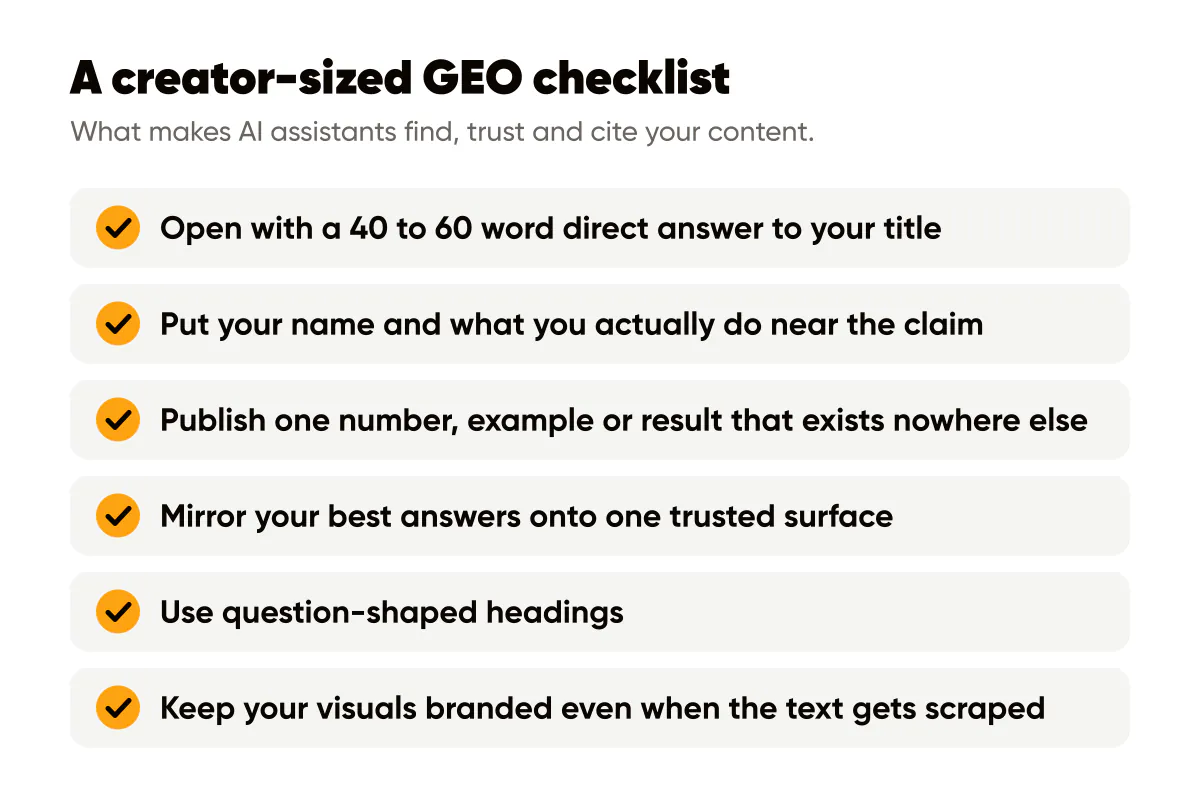
A creator-sized GEO checklist
Skip the enterprise playbooks. For a solo creator, this is the 80 percent:
- Open every post with a 40-to-60-word direct answer to the question in your title. Depth comes after, not instead.
- Put your name and what you actually do near the claim. "I run an AI post generator for solopreneurs" beats an anonymous byline. Mine is Creobee, an AI social media post generator, and my byline says so.
- Publish at least one number, example, or result per post that exists nowhere else on the internet.
- Mirror your best answers onto one trusted surface (a LinkedIn post, a Reddit comment, a YouTube short) with consistent wording so models see the same claim from you twice.
- Use question-shaped headings. Assistants map questions to headings before they read prose.
- Keep your visuals branded even when the text gets scraped: recognition is the one asset summarization can't strip. Our notes on AI image branding apply directly here.
Does social content show up in AI answers?
Yes, and more than most creators expect. Citation analyses through 2025 and 2026 repeatedly rank YouTube, Reddit, and LinkedIn among the most-quoted sources across assistants. A thoughtful Reddit comment under your real name can out-cite your own blog post. That's not a reason to abandon your site. It's a reason to say your best lines in public more than once, the way our SEO for social posts guide describes.
What I'd skip for now
GEO tooling. A wave of dashboards promising "AI visibility scores" launched over the past year, and I tested a few for Creobee. The useful signal (am I being cited, and for what) you can check manually in ten minutes a month by asking the major assistants the five questions your customers ask. Spend the subscription money on making one post genuinely citable instead. The fundamentals above will still be true when the tooling market shakes out.

Put it into practice
Turn this into posts designed for your feed
Paste your website or say what you do. Creobee plans, writes and designs your posts about it as one feed in your logo and colors, captions included, and on Autopilot it posts them for you.
How the AI social media post generator works