AI Hooks That Are Not Clickbait: 5 Prompt Rules
AI hooks drift to clickbait. Five prompt rules fix it: a specific claim, a keepable promise, a named audience, banned words and a word cap, with six rewrites.
AI writes clickbait hooks because clickbait is the average of what it learned from. To get honest hooks, constrain the prompt: name the audience, demand a specific claim the post actually delivers, ban the manipulative words, cap the length, and ask for ten options so you can pick one. The curiosity stays; the bait goes.
Why AI hooks default to clickbait
Ask a model for "a scroll-stopping hook" with no other instructions and you will get "You won't believe what happened when..." or "Nobody is talking about this..." or "STOP doing this immediately". These phrases are common in the training data because they were common on the internet, and they were common because they worked for a while. They stopped working the moment readers learned the pattern, and the model did not get that memo.
A hook is a promise about the next few seconds of the reader's attention. Clickbait is a promise the post does not keep. The fix is to make the promise concrete and keepable before the model writes a word, which means the constraint work happens in the prompt, not in the edit.
The five constraints that produce honest hooks
I use the same five lines every time, adjusted per post. They are the difference between a hook I have to rewrite and a hook I only have to pick.
- Audience named: "for first-time Etsy sellers who have made fewer than ten sales" rather than "for entrepreneurs".
- Specific claim: the hook must state something the post actually shows, with a number, a time frame or a named thing where possible.
- Keepable promise: the model may not promise more than the body delivers. If the post has three tips, the hook says three, not "the secrets".
- Banned words: you won't believe, secret, hack, nobody talks about, stop doing this, game-changer, and any word in all caps for emphasis.
- Word cap: twelve words maximum, because the first line of a caption is cut short on most screens and a 4:5 image headline has even less room.
Then one more line: "Give me ten, numbered, each using a different approach." The tenth is often the best because the model has burned off its defaults by then.
How do you tell a strong hook from a clickbait hook?
Run the curiosity-honesty test. Read the hook and write down what the reader now expects. Then read the post and ask whether that expectation was met in the first two sentences of the body. If the reader gets exactly what the hook implied, faster than they expected, the hook is strong. If the reader gets something smaller, vaguer or later, the hook is bait, however good it sounds.
There is a second, quicker test. Would you say this sentence to a customer standing in front of you? "You won't believe this" fails. "Three things I check before I quote a bathroom renovation" passes.
Encoding Hook Point as prompt lines
The most useful framework I know for this is Brendan Kane's Hook Point, which is about earning attention in the first seconds with a pattern interrupt that is tied to a real promise, not a trick. His site at brendanjkane.com lays out the thinking. Creobee offers a hook-first framework built on Kane's work as one of four copywriting frameworks for its promotional and proof posts, and when you pick it, it asks for the hook strategy, the target emotion and the clear promise. Those three fields are worth filling in whatever tool you use.
Written out for any tool, the framework looks like this: "Hook strategy: contrast between what the reader believes and what is true. Target emotion: relief. Clear promise: the reader will know which one of their five weekly posts to cut." That is enough for a model to write ten hooks that interrupt the pattern without lying about the payoff. The 4 marketing frameworks for AI captions post covers how the other three frameworks encode differently.
What makes a hook specific enough?
Specific means a reader in your audience could disagree with it or check it. "Most small businesses post too often" is a claim. "Posting daily tanked my saves by half in March; here is what I changed" is a specific claim with a receipt. The second one is a hook only you can write, which is the point. Generic hooks are generic because anyone could have written them.
Before and after: six rewritten hooks
Here is what the constraints do in practice. Each pair is a hook a model wrote unconstrained, then the version it wrote with the five constraints and a real detail supplied.
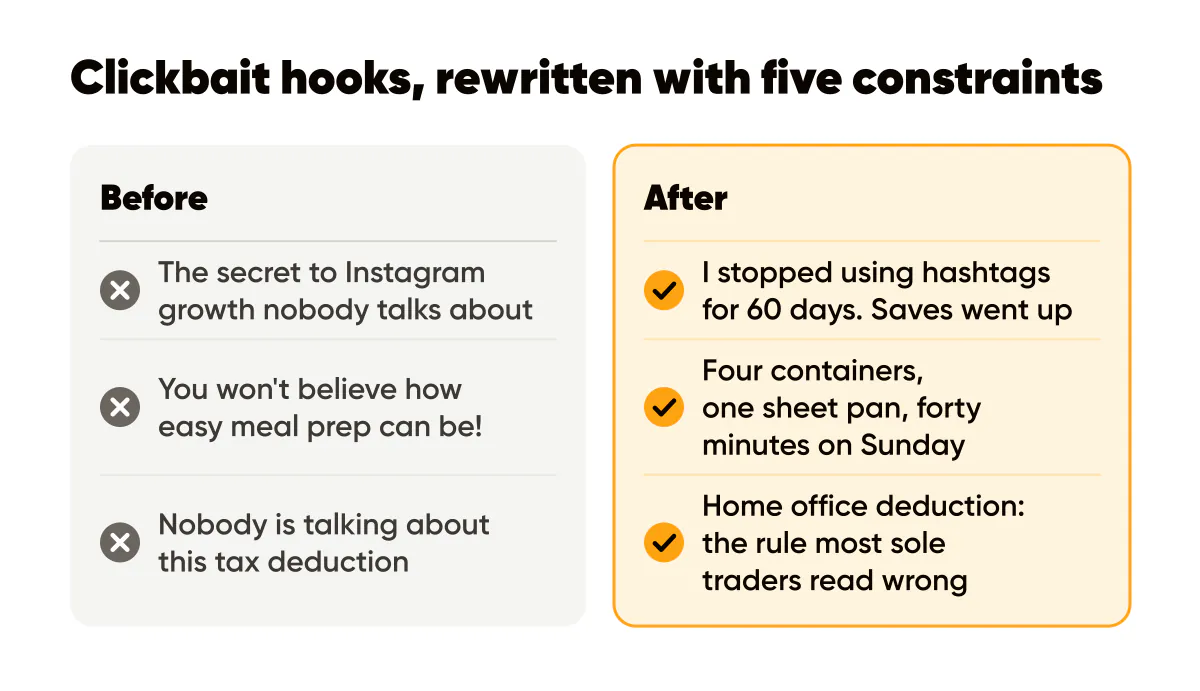
Before: "The secret to Instagram growth nobody talks about." After: "I stopped using hashtags for 60 days. Saves went up." Specific, checkable, twelve words or fewer.
Before: "You won't believe how easy meal prep can be!" After: "Four containers, one sheet pan, forty minutes on Sunday. Here is the list." A keepable promise with a number.
Before: "STOP making this pricing mistake immediately." After: "If your hourly rate has not changed since 2024, this post is for you." The audience is named and the tone is a nudge, not a shout.
Before: "Game-changing tips every coach needs." After: "The three questions I ask before I take on a new coaching client." Three means three.
Before: "This one trick will fix your website." After: "Your homepage headline probably describes you. It should describe your customer." An opinion the reader can disagree with, which is better than a trick.
Before: "Nobody is talking about this tax deduction." After: "Home office deduction: the rule most sole traders read wrong." Plain, specific, and honest about being a rule explanation.
Fitting hooks onto a 4:5 image
A hook that works as the first line of a caption usually needs a further cut to work as the headline on the image, where two to eight words read best on a phone. The rule I follow is that the image carries the claim and the caption carries the receipt. "Saves went up when I dropped hashtags" is the image; the 60-day story is the caption. The AI Instagram post generator I built splits the work the same way: a short hook as the headline on the post, the detail in the caption under it. The viral hook formulas post has three structures that survive this compression, and the launch hooks guide covers the specific case of announcing something new without hype.
For copy fundamentals underneath all of this, Copyblogger's Copywriting 101 is still the clearest free primer on headlines that promise a benefit and then deliver it.
Do this this week
- Save the five constraint lines as a snippet and paste them into every hook prompt.
- For your next post, ask for ten hooks and circle the three that pass the curiosity-honesty test.
- Cut each of the three to eight words or fewer and check which one still makes sense on an image.
- Add one real detail from the last week so the hook is one only you could write.
- Post it, then read the first three comments and note whether people got what the hook promised.
If you want more prompt structures to run these constraints through, the 25 caption prompt templates are written to accept a hook line at the top. The model will happily write bait forever; your job is to refuse to publish it.

Put it into practice
Turn this into posts designed for your feed
Paste your website or say what you do. Creobee plans, writes and designs your posts about it as one feed in your logo and colors, captions included, and on Autopilot it posts them for you.
How the AI Instagram post generator works