How to Use AI for Social Media: My Weekly Workflow
How to use AI for social media content without sounding generic: where AI belongs, where it quietly hurts, and the weekly routine I run for Creobee.
The workflow in five steps
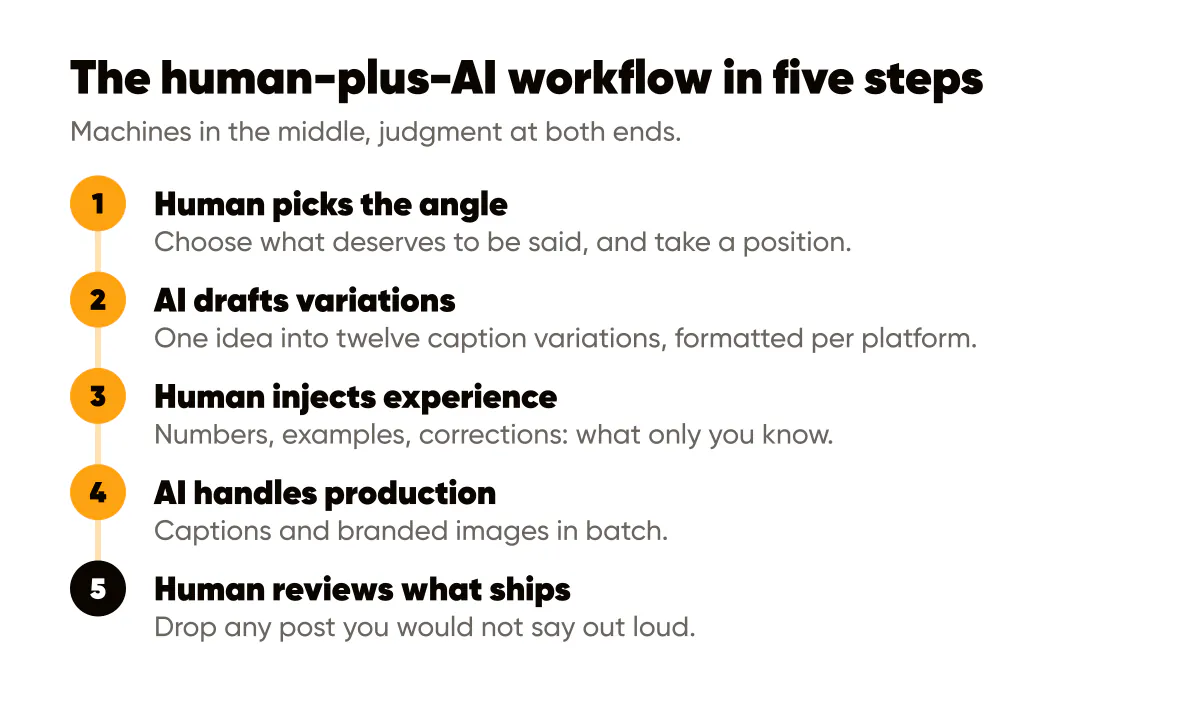
A working human-plus-AI content pipeline in 2026: (1) human picks the angle and the opinion, (2) AI drafts variations and formats, (3) human injects experience (numbers, examples, corrections), (4) AI handles production at scale, captions and branded images in batch, (5) human reviews everything that ships. Machines in the middle, judgment at both ends.
That order is the entire trick. Every failed AI workflow I've seen inverts it: the machine picks safe topics and a human polishes the output. You get competent content about nothing, faster than ever.
Humans decide, machines produce
AI is excellent at the expensive-but-mechanical parts: turning one idea into twelve caption variations, reformatting a post per platform, composing an on-brand image while you sleep. It is bad at the parts that make content worth following: having a stake, changing its mind, noticing what your audience is quietly frustrated about this month.
So budget your attention accordingly. I spend my human hours on two things only: choosing what deserves to be said, and adding what only I know. Everything between those two points is delegated. In 2024 that felt lazy. In 2026, with feeds flooded by fully-automated content, the human layer is precisely what makes a post distinguishable, the point our E-E-A-T guide makes from the ranking side.
My actual Monday routine
Monday morning, 90 minutes, coffee mandatory. First 20 minutes: review last week's numbers and pick two angles worth pursuing (never more, see the batching guide for why small batches beat marathons). Next 30: write the opinionated core of each post by hand, badly and fast. Then Creobee takes over: brand brief in, a batch of done-for-you social media posts out, each with its caption, all in one consistent look so the week feels coherent. Final 20 minutes: the experience pass on the captions before they go out, where I work in what I wrote by hand, replace every generic claim with a real number or a real story, and drop any post I wouldn't say out loud.
Total output: a week of posts. Total feeling of being a content machine: zero. That's the win.
How much should you edit AI drafts?
Enough that a third of the final piece is yours: your data, your phrasing, your position. Less than that and the content is detectable as filler (by readers before algorithms). More than 50 percent editing means the draft wasn't helping; write it yourself next time. The edit that matters most is additive, not corrective: don't just fix the AI's sentences, add the sentence it could never write.
Guardrails that keep you sounding like you
Two artifacts prevent drift. A voice file: ten sentences you actually wrote, pasted into every drafting prompt as the style reference. And a banned list: the phrases you never say ("game-changer," anyone?), updated whenever a draft makes you wince. Review both monthly. The workflow scales your voice only if the voice is pinned down first. Otherwise it scales the average of everyone's voice, which is the one thing feeds already have too much of.

Put it into practice
Turn this into posts designed for your feed
Paste your website or say what you do. Creobee plans, writes and designs your posts about it as one feed in your logo and colors, captions included, and on Autopilot it posts them for you.
How the AI social media post generator works