E-E-A-T SEO for Small Business: Proof Beats Polish
E-E-A-T SEO for a small business or solo brand: how to show experience, expertise and trust with proof of your work, not credentials or a PR team, week by week.
What E-E-A-T actually means in 2026
E-E-A-T stands for Experience, Expertise, Authoritativeness, and Trustworthiness: the qualities Google's systems try to detect when deciding whose content to surface. It's not a score you can check, but its fingerprints are everywhere: the core updates through late 2025 and into 2026 visibly rewarded content carrying first-hand experience and demoted content that merely summarizes.
The first E is the one that changed the game for small creators. Expertise can be faked with confident prose. Experience can't. It lives in the details: the screenshot of your actual dashboard, the number that's slightly messy because it's real, the thing you tried that didn't work.
And here's the part the agencies won't tell you: a solo creator is structurally better at this than a content team. You have first-hand experience of everything you publish. A ghostwritten corporate blog has none.
Show the work, not the credentials
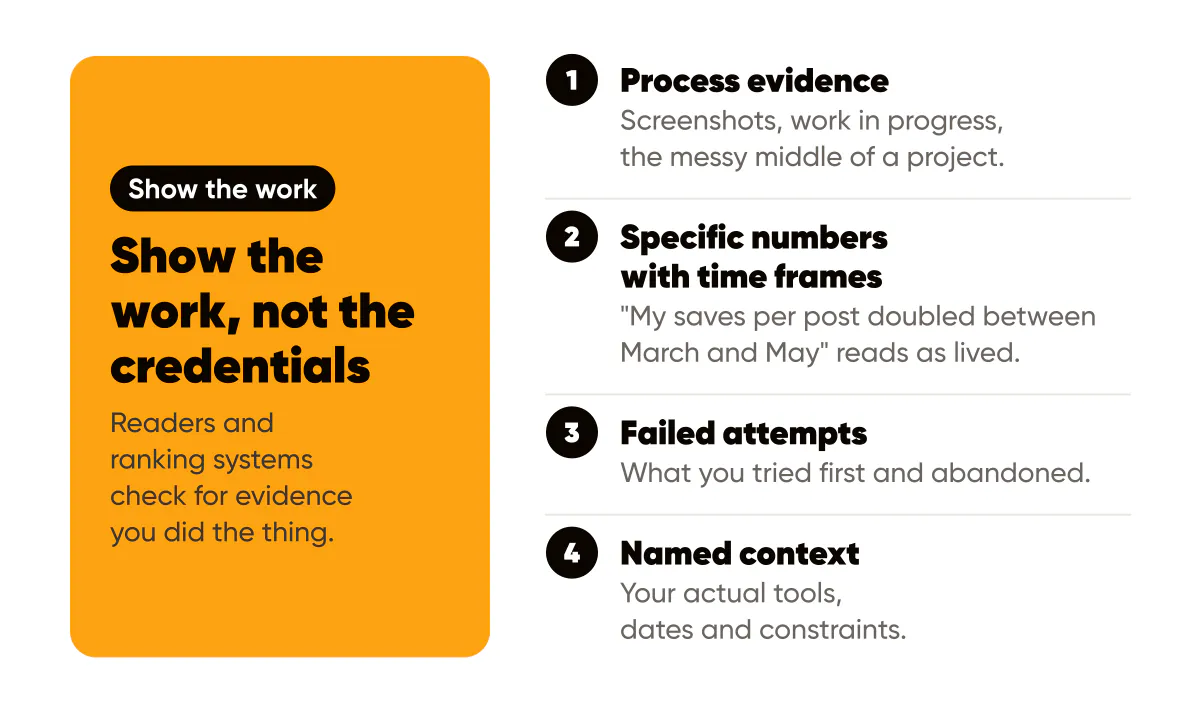
Nobody checks your diploma. Readers (and ranking systems) check for evidence you did the thing. Four kinds of receipts work in almost any niche:
- Process evidence: screenshots, work-in-progress shots, the messy middle of a project rather than only the polished end.
- Specific numbers with time frames: "my saves per post doubled between March and May" reads as lived; "engagement improved significantly" reads as generated.
- Failed attempts: what you tried first and abandoned. Failure detail is the hardest signal to fake at scale.
- Named context: your actual tools, dates, and constraints. I write "I rebuilt the way Creobee designs posts from scratch, because the first version was wrong" instead of "we developed a solution."
The AI flood made your job easier
Counterintuitive but true. The internet gained millions of competent, empty articles over the past two years. Baseline quality went up; baseline distinctiveness collapsed. In a sea of correct summaries, one paragraph of genuine first-person experience is now the most conspicuous thing on the page. You're no longer competing on writing quality. Machines equalized that. You're competing on having been there, and that's a monopoly you already own.
Can AI-generated content still rank in 2026?
Yes: Google's stated position remains that it rewards quality regardless of how content is produced, and plenty of AI-assisted pages rank. What gets filtered is AI-generated content with nothing added. The practical bar I use: at least a third of every piece must be material no model could produce: your data, your examples, your opinion, your mistake. AI drafts the scaffolding; you supply the experience. That split is the subject of our human-plus-AI workflow guide.
A weekly proof-of-work habit
Once a week, before you write anything new, capture one receipt: a screenshot, a metric, a lesson from something you actually did in the last seven days. Drop it in a folder. Every post you write pulls one receipt from the folder. Four weeks in, your content carries more experience signal than most funded competitors, and your visuals can carry it too, with real numbers designed into branded graphics rather than stock illustrations. Even if you hand the drafting to social media posts done for you by software, the receipt is the part only you can add. Our creative performance guide shows which numbers are worth designing around.
Put it into practice
Turn this into posts designed for your feed
Paste your website or say what you do. Creobee plans, writes and designs your posts about it as one feed in your logo and colors, captions included, and on Autopilot it posts them for you.
How the AI social media post generator works