AI Content Mistakes Small Businesses Make: 9 Fixes
The 9 AI content mistakes small businesses make, from generic prompts to invented facts and hype words, with a one-paragraph fix for each and a worked example.
Most AI content fails for reasons that have nothing to do with the model. Small businesses type generic prompts, skip a voice file, publish without reading, let the tool invent facts, and post the same text everywhere. Each of these nine mistakes has a fix that takes minutes, and together they turn AI output from filler into work you would sign.
Why the same nine mistakes keep showing up
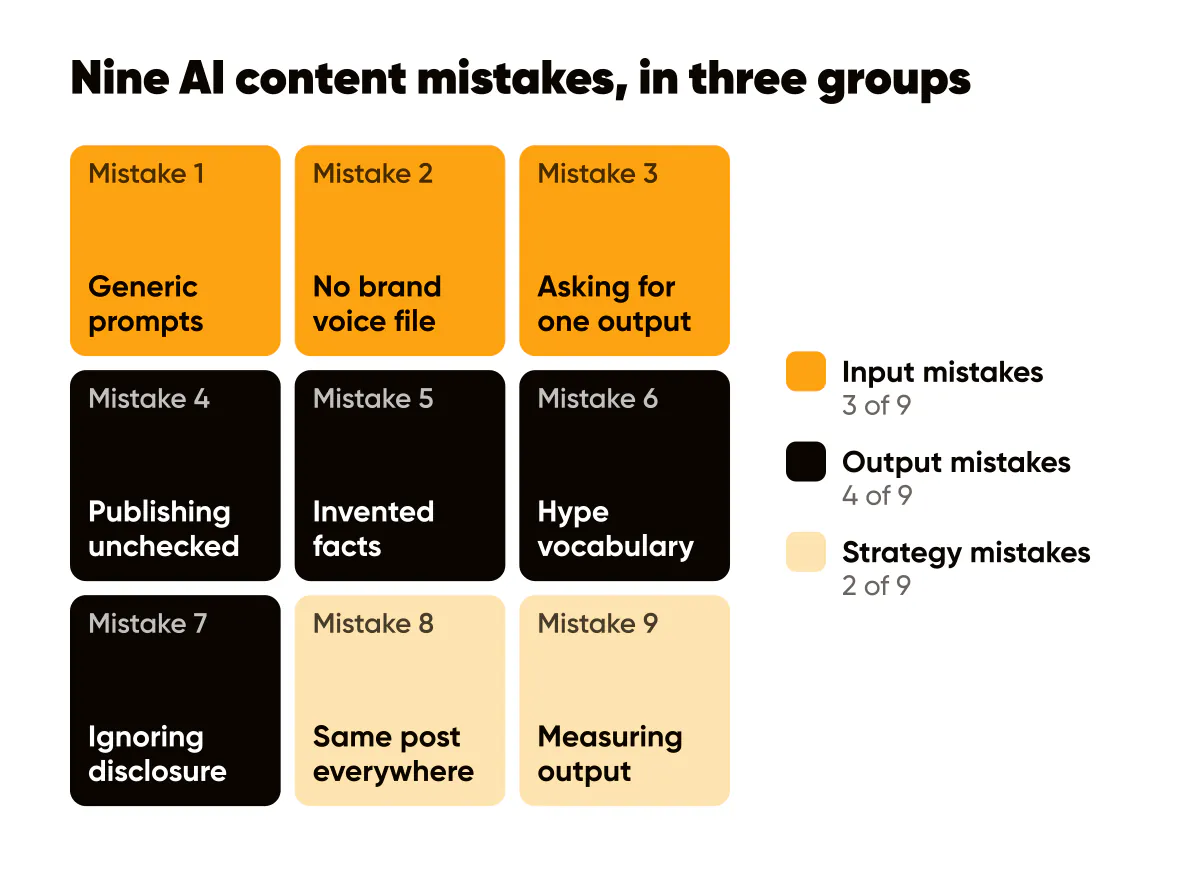
I read a lot of AI-generated captions, both from my own account and from the way people use Creobee. The failures are not random. They cluster into three groups: what goes into the tool, what comes out unchecked, and how the whole effort is judged. Fixing one group without the others gets you polished nonsense or accurate posts nobody reads. Below are the nine I see most, with the fix I actually use.
Input mistakes: garbage in, average out
Mistake 1: generic prompts. "Write a post about our services" describes a million businesses, so the tool returns the average of a million posts. The fix is a five-line prompt that names the audience precisely, states the one point of the post, sets the tone, and adds a detail from the last seven days. If you want a reusable structure for that, the one-page content brief for AI tools is the version I paste in.
Mistake 2: no brand voice file. Every session starts from zero, so every session sounds like the model's default. The fix is ten sentences you actually wrote, five banned phrases and three tone words, saved somewhere you can paste them in. My guide to teaching AI your brand voice walks through building it in twenty minutes.
Mistake 3: asking for one output. One draft gets accepted because it exists. Ask for five variants and you will notice that the third has the better opening and the fifth has the better ending. Combining them is editing, not cheating.
Why does AI content sound the same for every business?
Because the inputs were the same. A language model predicts the most likely next words given what it was told. Tell it little, and the most likely words are the ones everyone else got too. Tell it who your customer is, what they said to you on Tuesday, and which words you refuse to use, and the likely next words become yours. The model did not change. Your input did.
Output mistakes: publishing what you did not read
Mistake 4: publishing without reading. The tool wrote a rhetorical question, three tips and a hashtag row, and it went live in that shape. The fix is a rule I do not break: nothing posts without being read aloud once. If you stumble, it is not done.
Mistake 5: invented facts. Models produce plausible numbers, fake studies and confident claims about your own results. The fix is to treat every number and every "research shows" as unverified until you can point at the source or the spreadsheet. If you cannot, delete it or replace it with something you observed yourself. This is also what Google's people-first content guidance is asking for when it lists questions about accuracy and first-hand expertise.
Mistake 6: hype vocabulary. Game-changer, unlock, elevate, seamless, dive in, journey. These are the model's tics, and readers have learned to skim past them. The fix is a banned-word list in your voice file plus a thirty-second scan before posting. If a sentence collapses without its hype word, the sentence was empty.
Mistake 7: ignoring disclosure where it applies. For a caption you briefed and edited, no label is required in my view, and Google's position on AI-generated content is that quality is judged regardless of how content was made. But endorsement and paid partnership rules apply exactly as they always did, and the FTC's Disclosures 101 does not care which tool wrote the words.
Do you have to disclose AI-written captions?
Not as a general rule for your own marketing copy, in my reading of the guidance, provided the claims are true and the experiences are yours. You do have to disclose paid relationships and material connections, whether a human or a model wrote the post. And you should never let a tool state a result, testimonial or experience you did not actually have. The disclosure labels post separates these cases from synthetic photorealistic media, where platform labeling rules add another layer.
Strategy mistakes: measuring the wrong thing
Mistake 8: the same post on every platform. Pasting an Instagram caption onto LinkedIn with the hashtags still attached tells both audiences you are not really there. The fix is one graphic, native text per platform: conversational on Instagram, text-first on LinkedIn, shorter on Facebook. It takes an extra five minutes per post and is the cheapest credibility you will buy.
Mistake 9: measuring output, not outcomes. "We posted every day this month" feels like progress. The question is what those posts did: saves, profile visits, replies, DMs that became customers. The fix is to pick two outcome metrics before the month starts and review them at the end. The human-plus-AI workflow covers where a human has to own the judgment even when a machine drafts the middle.
- Before generating: audience sentence, point of the post, tone words, one real detail.
- After generating: read aloud, verify every number, cut hype words, check disclosure.
- Each month: count outcomes, not posts, and adjust the brief.
A small worked example
Say you run a mobile dog grooming service. The generic version: "Write an Instagram caption about our grooming services." Output: "Is your furry friend ready for a pamper day? Our expert groomers deliver a seamless experience! Book today." Every mistake at once.
The fixed version: "Audience: owners of anxious rescue dogs in a city who dread the car ride to a salon. Point: we groom in a van outside your door, and the dog never leaves its street. Tone: calm, plain, no exclamation marks. Detail: this week a greyhound fell asleep during the blow dry." Output: a caption with a scene, a specific promise and a true detail. Then read it aloud, check that the greyhound story is real, and post.
Do this this week
- Write your voice file: ten sentences, five banned words, three tone words. Thirty minutes, once.
- Before every generation, add one detail from the last seven days.
- Ask for five variants and combine the best parts.
- Read aloud, verify numbers, cut hype. Run the 12-point quality checklist until it becomes habit.
- Choose two outcome metrics for the month and write them at the top of your content calendar.
None of these fixes require a better tool. They require treating the tool like a fast, literal-minded assistant that needs a proper brief and a proper review. Do that and the nine mistakes mostly stop appearing on their own. The same goes if you hand the writing over to done-for-you social media posts: nothing should go live until you have read it and said yes.
Put it into practice
Turn this into posts designed for your feed
Paste your website or say what you do. Creobee plans, writes and designs your posts about it as one feed in your logo and colors, captions included, and on Autopilot it posts them for you.
How the AI social media post generator works