DM Scripts for Small Business: Comment to Customer
DM scripts for small business: four moves from comment to DM to customer, sample chats for a coach, a designer and a local shop, and the mistakes to avoid.
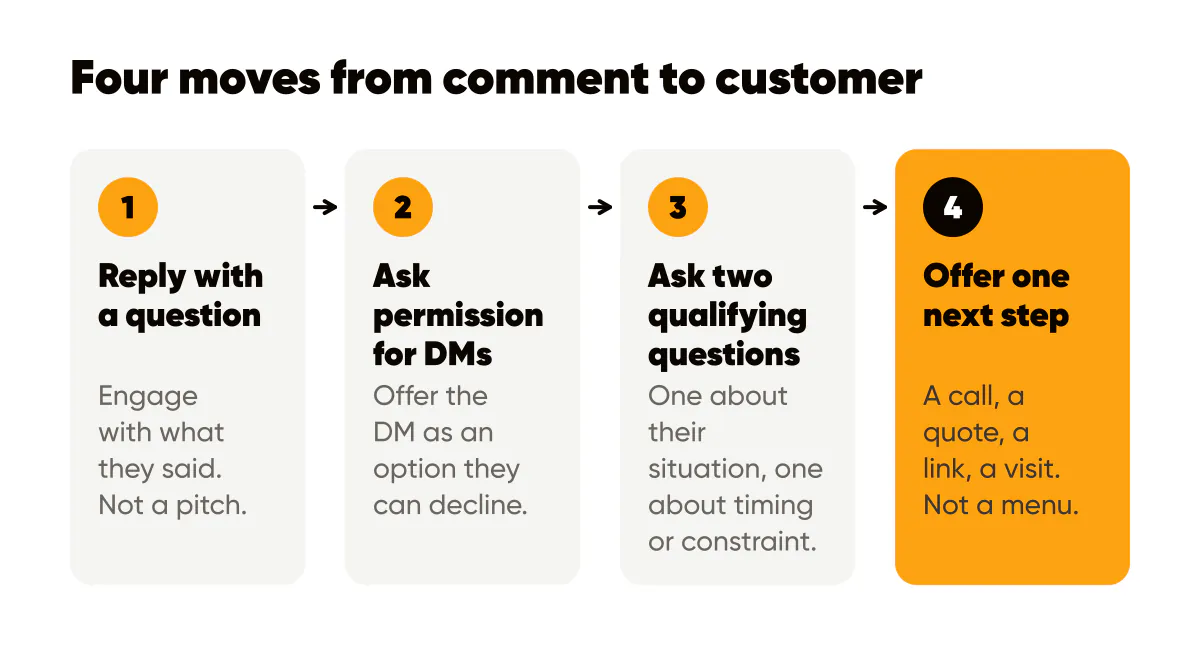
The path from comment to customer is four moves: reply to the comment with a question, ask permission before moving to DMs, qualify with two questions, and offer exactly one next step. Every message should read like something you would say to a person standing in your shop. Scripts below for a coach, a designer and a local store.
The four-move script from comment to DM to customer
Most sales on social media do not happen in the feed. They happen in a DM thread that started as a comment. The feed post did its job, someone reacted, and what you do in the next two exchanges decides whether that person becomes a customer or quietly disappears. The good news is that the path is short and the same four moves work across almost every kind of small business.
Move one: reply to the comment with a genuine question, not a pitch. Move two: if the answer suggests a real need, ask permission to continue in DMs. Move three: in the DM, ask two qualifying questions. Move four: offer one next step, and only one. That is the entire framework. The rest of this post is the wording, the traps, and three sample scripts.
How do you move a comment to a DM without being creepy?
You ask. The difference between a welcome DM and an unwelcome one is almost entirely whether the person expected it. So the comment reply does two things: it answers or engages with what they said, and it offers the DM as an option they can decline.
A comment like "I really need this for my studio" gets a reply along the lines of: "What kind of studio? I ask because the answer changes what I would suggest. Happy to go into detail here or in DMs, whichever you prefer." The person now chooses. If they say "DM me", you have permission and a warm start. If they answer publicly, you have a useful public exchange that other readers see, which is its own reward. The community-led growth prompts post has more on making comment threads themselves valuable.
Never open with a DM to someone who only liked the post. A like is not a conversation. A cold DM after a like is the digital equivalent of following someone out of a shop.
Two qualifying questions, then one next step
Once you are in DMs, resist the urge to explain everything you offer. Ask two questions that tell you whether and how you can help. The first is about their situation, the second about their timing or constraint. For a coach: "What are you trying to change in the next few months?" then "Have you tried working with someone on this before?" For a designer: "What is the project?" then "When do you need it live?"
Two questions is enough to qualify and short enough not to feel like an intake form. Then offer exactly one next step. Not a menu. Hick's Law, summarized on the Laws of UX site, describes how decision time grows with the number of options, and a DM is the worst place to hand someone a decision tree. Pick the step that fits what they told you: a call, a quote, a link, a visit.
The social media CTA examples post lists dozens of ways to phrase a next step; in a DM the phrasing matters less than the singularity. One step, clearly stated, with an easy way to say no.
Three sample scripts
These are hypothetical, written for a coach, a freelance designer and a local shop. Adapt the wording; keep the shape.
A business coach. Comment: "This is exactly where I am stuck." Reply: "Stuck on the pricing or on the saying-it-out-loud part? Both are common, and the fix is different. Happy to talk it through in DMs if useful." In DMs: "Thanks for jumping over. Quick two: what do you sell, and what does a good next three months look like?" After their answer: "Got it. The most useful thing I can offer is a 20-minute call where we map your next price change. If that sounds right, here is my calendar link. If not, no problem, the post series continues on Thursday."
A freelance designer. Comment: "Need a new logo badly." Reply: "What is wrong with the current one? Sometimes it is the logo, sometimes it is everything around it. Happy to look if you DM me a screenshot." In DMs, after the screenshot: "Two questions: is this for a rebrand or a first proper identity, and is there a date it needs to be ready by?" Then: "Based on that, a brand identity package fits better than a logo alone. I can send a one-page scope with pricing tonight. Want it?"
A local shop. Comment: "Do you have this in blue?" Reply: "We do, two shades. Want me to DM you a photo of both?" In DMs, with the photos: "Which one? And are you nearby, or would you want it shipped?" Then: "I can hold the navy one at the counter until Saturday under your name. Say the word."
Notice what the scripts share. Every reply ends with a question or an offer that is easy to decline. Every DM opener acknowledges the switch. Every close names one action. And the shop script shows that "salesy" is not about selling; the shop is selling in every line and none of it feels like a pitch, because each line is responsive to what the customer said.
What not to do
Four behaviors kill these conversations, and I have done every one of them.
- Cold pitching after a like or a follow, which converts almost nobody and quietly costs you followers who feel ambushed.
- Answering a question with a paragraph about your whole service list instead of the one thing they asked.
- Sending a link as the first DM, because a link before a question tells the person you are processing them, not talking to them.
- Manufacturing urgency that is not real, like a spot count you invented or a deadline you will extend.
The last one deserves a note. FTC endorsement and disclosure rules are mostly about paid promotion and reviews, and they do not govern a private conversation with a prospect. But the FTC's broader advertising and marketing guidance rests on a simple principle that applies everywhere: claims must be truthful and not misleading. A DM is a claim. "Only two spots left" had better be true.
Should you automate DMs?
Partially, and carefully. A keyword-triggered first message that delivers something someone explicitly asked for, like "comment GUIDE and I will send it", is fine, because the person requested it and knows a system is responding. The lead magnet posts guide covers that flow. Everything after that first delivery should be a human, or at least be written so plainly that it sounds like one.
The tell of bad automation is a message that could have been sent to anyone: "Hey there! Thanks so much for reaching out!" followed by a wall of options. If a message does not reference something the person actually said, do not send it automatically. The point of DMs is that they are personal; automation that removes the personal part removes the reason to be there. If you want software somewhere in this loop, put it on the posts that start the conversations: with done-for-you social media posts you approve the week's posts and keep every reply and DM for yourself.
Do this this week
Pick your most recent post with more than three comments. Reply to each one that hints at a need with a question and an offer to continue in DMs, using the shape above. For anyone who takes you up on it, ask two qualifying questions and offer one next step. Keep a note of how many comments became conversations and how many conversations became a call, a quote or a sale.
Then write your own three scripts, one per type of comment you get most often, and keep them in a note. Not to paste verbatim, but so the shape is ready when a real comment arrives. The link in bio strategy post covers what to do with the people who never comment but do click through, which is the other half of the funnel. And if the next step you offer usually involves a price, should you post your prices on social media is the companion read.

Put it into practice
Turn this into posts designed for your feed
Paste your website or say what you do. Creobee plans, writes and designs your posts about it as one feed in your logo and colors, captions included, and on Autopilot it posts them for you.
How the AI Instagram post generator works