Instagram Lead Magnets That Grow Your Email List
Instagram lead magnet posts that grow your email list: which freebies fit a one-person business, the 3-part post, comment-to-DM delivery and the first email.
A lead magnet post offers one small, useful thing, a checklist, a template or a mini guide, in exchange for an email address. The post needs three parts: a specific promise, a preview of what is inside, and one call to action. Deliver it by comment-to-DM or link in bio, then follow up with a short, honest email.
Which lead magnets fit a solopreneur
A lead magnet is a small piece of work you give away in exchange for permission to email someone. The word "small" is doing a lot of work in that sentence. Solopreneurs get stuck building 40-page ebooks that nobody finishes, when the lead magnets that actually get downloaded and used are the ones that solve one problem in one sitting.
Three formats do most of the work for a one-person business. A checklist: the ten things to verify before X. A template: a fill-in document, a spreadsheet, a caption skeleton, a brief. A mini guide: two or three pages that answer one question fully. Each takes an afternoon to make, each is easy to describe in a headline, and each can be delivered as a PDF or a link.
The test for choosing a topic is whether it sits one step before what you sell. A bookkeeper's lead magnet is a year-end checklist, because people who need that checklist are about to need a bookkeeper. A web designer's is a homepage copy template, because people writing homepage copy are close to needing a site. The educational content that sells post covers this teach-first logic in the feed; a lead magnet is the same logic with an email address attached.
What makes a lead magnet worth an email address?
Specificity and speed. People trade their address for something that solves a named problem quickly, and they refuse to trade it for something vague and long. "A guide to social media" is worth nothing. "The 12-point checklist I run before every post goes live" is worth an address, because the reader can picture using it tomorrow.
The other half is trust that the emails afterward will not be a nuisance. Say what happens next, in the post or the caption: "You will get the checklist immediately and one short email a week after that. Unsubscribe any time." That sentence lowers the perceived cost of the exchange and it happens to be the honest thing to say.
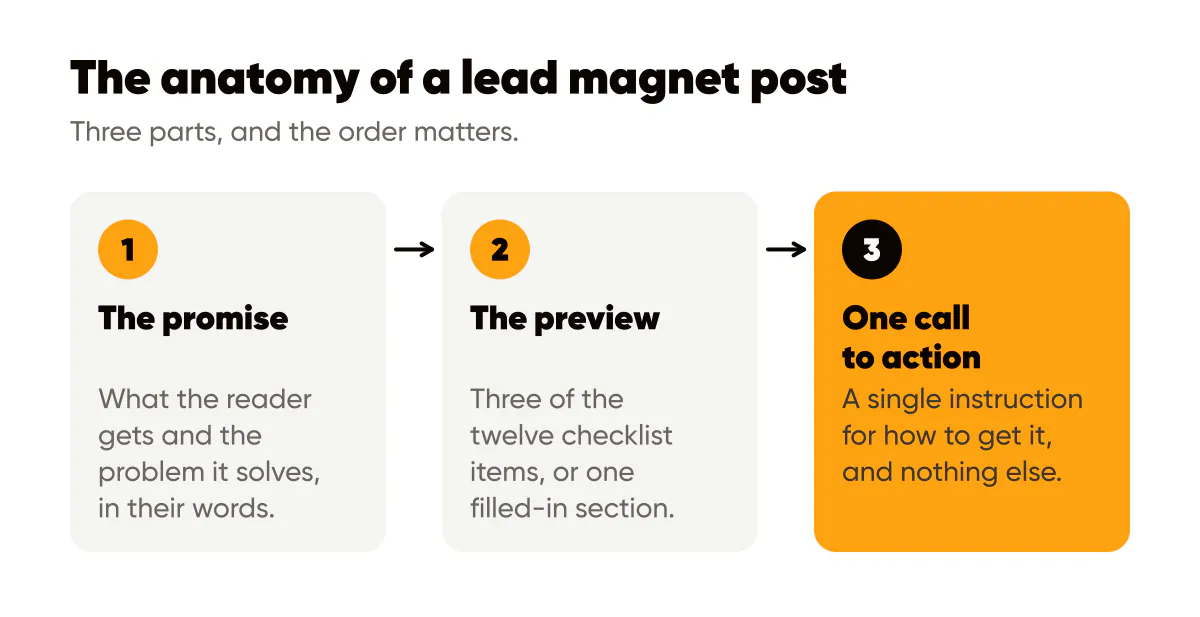
The anatomy of a lead magnet post
The post itself has three parts, and the order matters.
- The promise: one line stating what the reader gets and the problem it solves, in the reader's words rather than yours.
- The preview: a glimpse of the inside, such as three of the twelve checklist items, one filled-in section of the template, or a single line from the guide.
- One call to action: a single instruction for how to get it, and nothing else competing for the click.
On a 4:5 image, the promise is the headline. The preview goes either in the caption or on the second slide of a carousel, the format an Instagram post generator that makes carousels can draw for you. The CTA sits at the end of the caption and, if it is comment-based, on the image itself in a small supporting line. Resist adding a second CTA like "also follow for more"; every extra ask lowers the response to the main one. The 40 CTA examples post has plenty of phrasings, but for a lead magnet the two that matter are "comment WORD" and "link in bio".
Copyblogger's Copywriting 101 is a useful primer for writing the promise line: lead with the benefit, be specific, and write like a person. The whole post should read as an offer of help, not a trade.
Delivery: comment-to-DM or link in bio
You have two delivery paths, and they suit different audiences.
Comment-to-DM: the reader comments a keyword, you (or a keyword-triggered tool) send them a DM with a short form or a direct link. The advantage is that comments boost the post's visibility and the DM opens a conversation. The cost is that you need to actually send the thing, quickly, to everyone who asks, and you need a way to capture the email once you are in the DM, usually a link to a simple form. The DM conversation scripts post covers how to keep those threads human once they start.
Link in bio: the reader taps your profile link and lands on a signup page. Fewer steps for you, one more for them, and you lose the comment boost. It suits accounts with a steady flow of profile visits and a link page already set up. The link in bio strategy post covers how to point that link at the current lead magnet rather than a generic home page.
I use comment-to-DM for launches of a new magnet, where the comment activity helps, and link in bio for the evergreen version that runs for months afterward.
What should the first email say?
Deliver the thing in the first line, with no preamble. Then one paragraph on how to use it, then who you are in two sentences, then what to expect next. That is the whole email. People opened it for the checklist; make them scroll past a life story and you have taught them your emails are work.
Open rates vary a lot by industry and list size, and Mailchimp publishes email marketing benchmarks by industry that are worth a look to calibrate expectations for your field. The practical lesson from every benchmark set I have seen is the same: the welcome email is the most-opened email you will ever send to that person, so it is the one to get right. Put the value at the top and keep the subject line literal: "Your checklist".
The converting social followers to email subscribers post covers the longer sequence that follows.
Reciprocity, honestly
Giving something away creates a mild pull to return the favor. That is real, it is human, and it is the reason lead magnets work. It is also easy to abuse, and the abuse shows. A "free" guide that turns out to be a sales letter, a checklist that is unusable without buying the course, or a download followed by daily pitches all cash in the goodwill faster than it was earned.
My rule is that the lead magnet must be useful to someone who never buys anything from me. If it is, the people who do buy trust me more, and the people who do not still say nice things. If it is not, I have collected addresses from people who now associate my name with a small disappointment.
Do this this week
Choose one problem your customers have one step before they hire you, and make a one-page checklist or template that solves it. Write the lead magnet post: promise as the headline, three preview items in the caption, one CTA. Set up delivery, either a keyword you will respond to by hand this week or a link-in-bio form, and write the welcome email before you publish.
Post it, respond to every request the same day, and note how many people who received the magnet reply or ask a question. Those replies are the start of the conversations that become customers, and they are the real measure of whether the giveaway was worth an address.
Put it into practice
Turn this into posts designed for your feed
Paste your website or say what you do. Creobee plans, writes and designs your posts about it as one feed in your logo and colors, captions included, and on Autopilot it posts them for you.
How the AI Instagram post generator works