Should You Post Your Prices on Social Media?
Should you post prices on social media? The case for and against, the starting-at middle path, a clean pricing graphic, and how to announce a price rise.
Post your prices if your offers are packaged and repeatable; hold them back only when every job is genuinely custom. Public prices build trust, qualify buyers before they message you, and cut wasted conversations. The middle path, starting-at prices and clear package tiers, gives most solopreneurs the benefits without boxing them in. Whatever you post must be true.
The case for posting prices on social media
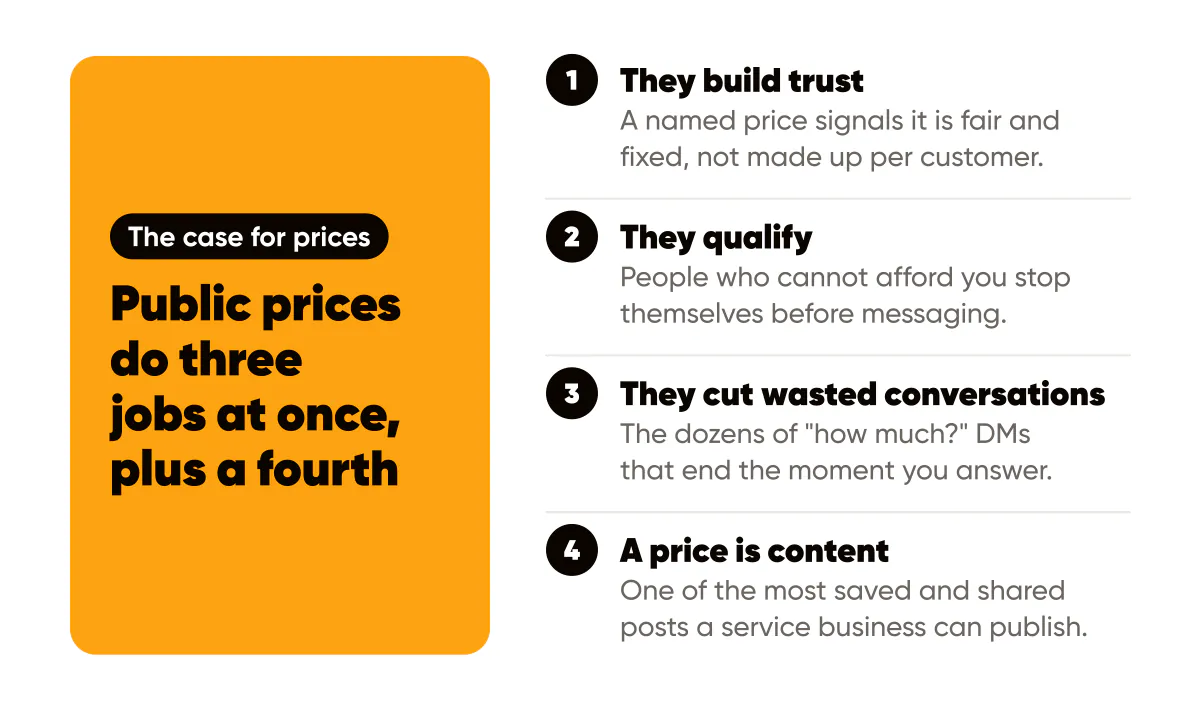
Public prices do three jobs at once. They build trust, because a business that names its price is signaling that the price is fair and fixed rather than made up per customer. They qualify, because people who cannot afford you stop themselves before messaging, and people who can message you already knowing what they are getting into. And they cut wasted conversations, the dozens of "how much?" DMs that end the moment you answer.
There is a fourth benefit that gets less attention: a price is content. A clear pricing post is one of the most saved and shared posts a service business can publish, because it answers the question everyone was too polite to ask. It also fits how people research now: they want the answer without a conversation, and if you do not give it, a competitor's post or an AI summary will. The zero-click content strategy post covers that shift more broadly.
The case against
The arguments for hiding prices are not all bad. If every job is scoped individually, a public number is either wrong for most clients or so hedged it is meaningless. If your market is small and your competitors watch your account, posting prices hands them a target to undercut. And there is anchoring: once someone sees your lowest price, that number frames everything you say afterward, even if it applies to a service they do not need.
Two of those three have workarounds, covered below. The competitor argument is the weakest, in my experience: competitors who compete on undercutting you were going to do that anyway, and customers who choose on price alone were never your customers. The anchoring problem is real and is solved by which number you show, not by hiding all of them.
What if my work is custom?
Then post the shape of the price instead of the price. Say a brand designer writes "Brand identity projects start at 2,400 and most land between 3,000 and 5,000 depending on scope." Those numbers are illustrative, but the sentence is honest, useful and still custom. It tells serious prospects whether to message, and it tells you that whoever does message has already accepted the range. That sentence, on a clean graphic, does more qualification than a month of discovery calls.
If even a range is impossible, post what determines the price. "Three things set the cost of a kitchen renovation: footprint, cabinetry grade and whether plumbing moves. Here is how each one shifts the number." You have posted a price post without a single figure, and readers come away calibrated rather than guessing.
The middle path: starting-at prices and tiers
Most solopreneurs land here, and it is the right place. Three formats cover nearly every situation.
- Starting-at prices: one number per service, prefixed with "from", with a line about what moves it up.
- Package tiers: two or three named packages with a price each and a short list of what is inside, so the reader can self-select.
- Price context posts: a single price explained, such as what a 90-minute session includes and why it costs what it costs.
Tiers deserve a note about count. Two or three, never five. The Laws of UX summary of Hick's Law describes how decision time rises with the number of options, and a pricing graphic with five columns is a spreadsheet, not a post. Put the tier you most want to sell in the middle, and make the differences between tiers obvious in one line each.
Starting-at prices need one discipline: the starting price must be one you actually sell at. "From 99" when nobody has paid 99 in a year is the kind of claim that erodes trust the moment someone asks for it. The FTC's advertising and marketing guidance is built on the principle that claims must be truthful, not misleading and, where relevant, substantiated. A "from" price is a claim. Make sure it is true, and make the caption say what moves the number.
The offer posts guide covers the structure that surrounds a price when you are actively selling: who it is for, what is included, proof, one CTA, a real deadline. A pricing post is the evergreen cousin of that: same honesty, no deadline.
Designing a clean pricing graphic
Pricing graphics fail when they try to be a brochure. The best ones look like a menu board: a few large numbers, short labels, generous space, your brand colors and nothing else.
For a single starting-at price on a 4:5 canvas, the number is the headline. Set it large and heavy, put the service name in a smaller line above it and the "from" and the qualifier in a smaller line below. One number, one canvas. For tiers, a carousel works better than a single image: one slide per tier with the same layout, so the reader swipes to compare, with a summary slide at the end.
Whatever the layout, use the same template family and palette as the rest of your grid, so the pricing post is recognizably yours and not a screenshot from a website. That is the point of designing your Instagram feed as one grid: the pricing post lands in the same look as the lessons around it. Dark backgrounds suit pricing posts well; the number stands out and the post reads as a considered statement rather than a flyer. The dark backgrounds guide covers the contrast rules if you go that way. Keep the currency symbol and any decimals small; the reader needs the amount, not the punctuation.
How do you handle a price increase publicly?
Announce it, with a date and a reason, before it takes effect. "From September 1st, sessions move from 120 to 140. Existing clients keep their current rate through the year. The change reflects the prep time each session now includes." That single post does three things: it treats existing customers well, it gives fence-sitters a real reason to book now, and it signals that your prices are considered rather than arbitrary.
What not to do is quietly change the number on your website and hope nobody notices. Someone always notices, and the story becomes the secrecy rather than the price. Pair the announcement with proof of what customers get for it; the social proof posts guide covers how to do that without bragging.
Do this this week
Write down every service you sell and, next to each, the lowest price you actually charged for it in the last six months. That is your honest "from" price. Pick the one service people ask about most and make one pricing graphic: the number large, the service above, the qualifier below, in your template and your colors. Post it with a caption that explains what moves the number and invites a DM with one specific question.
Then watch the DMs for two weeks. If the "how much?" messages drop and the messages you do get are more specific, the post is working. If you still get price questions, the graphic is not clear enough, not the strategy. For the conversations that follow, the comment to DM to customer scripts post covers how to turn them into bookings without a pitch.
Sellers of physical products face the same question with fewer excuses, since the price is already on the shelf; social media for product sellers covers how to show it without a photoshoot.


Put it into practice
Turn this into posts designed for your feed
Paste your website or say what you do. Creobee plans, writes and designs your posts about it as one feed in your logo and colors, captions included, and on Autopilot it posts them for you.
How the AI Instagram post generator works