Educational Content Marketing: Teach, Then Sell
Educational content marketing for small accounts: why teaching posts earn trust and saves, the teach-to-offer ratio I run, and the bridge from lesson to sale.
Educational content sells because it does the trust-building before the offer arrives. A post that teaches one useful thing earns saves, repeat profile visits and a reason to believe you know your craft. Then a short offer post converts the people who already trust you. Teach most of the time, sell some of the time, and connect the two deliberately.
Why educational content builds trust before it sells
When someone learns something from your post, they have experienced your expertise instead of being told about it. That is the difference between a claim and a receipt, and it is the same logic behind the proof-of-experience approach to E-E-A-T that works for solo creators in search. A caption that says "I help bakeries grow" is a claim. A post that shows the exact three photos a bakery should take at 7am is a receipt.
There is a distribution reason too. Instagram's own ranking explainer describes how the system weighs what people do with a post, including whether they save it or send it to a friend. On my account, teaching posts are the ones that get saved. Nobody saves a pitch.
The third reason is quieter. Teaching forces you to be specific, and specificity is what makes a small brand feel competent. Vague brands sound like everyone. Specific brands sound like a person who has done the work.
Does educational content actually lead to sales, or just free advice?
The fear is real: if I show the whole method, people will do it themselves. My position after two years of posting for Creobee is that the people who do it themselves were never going to buy. They are not lost customers, they are readers, and readers share.
The people who would buy learn two things from your teaching: that the path exists, and that you know it well enough to walk it for them. That is the sale. The trade-off is speed. Teaching builds a slow, compounding asset. A discount builds a spike and then a hangover. I would rather have the asset.
The teach-to-offer ratio I actually run
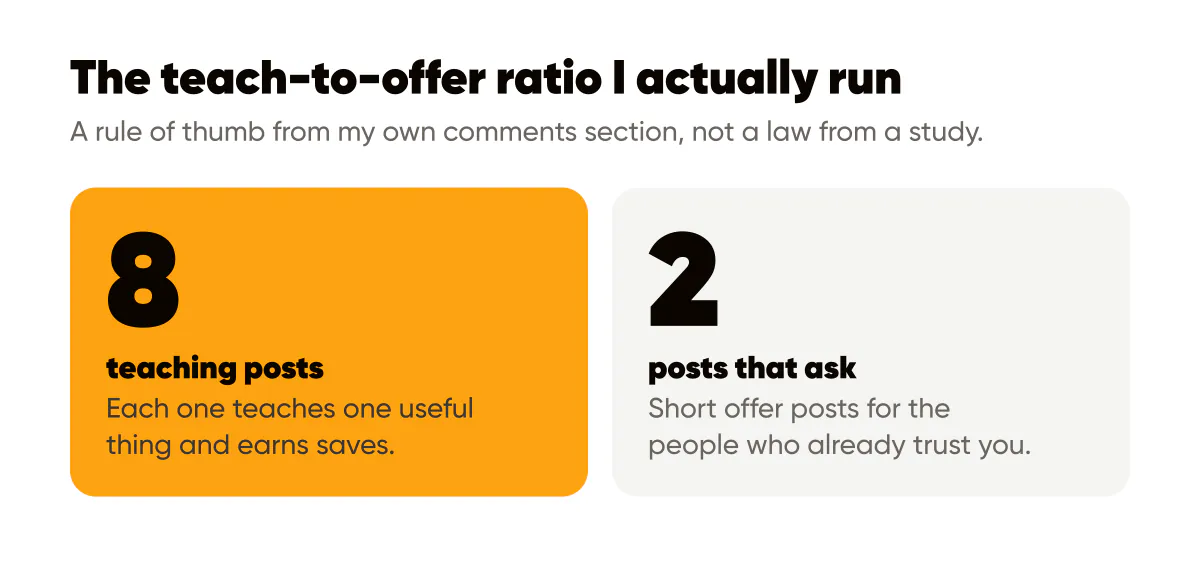
My rule of thumb is roughly eight teaching posts for every two that ask for something. That is not a law from a study, it is what I settled on after watching my own comments section. During Creobee launch weeks I drifted toward half offers, and the replies went quiet within days. When I swung back to teaching, they came back.
The ratio also protects you from yourself. A one-person brand feels the pressure to sell every day because the rent is due every month. Writing the ratio down and scheduling against it takes the daily decision away. An AI content calendar generator that plans the week's mix ahead does the same job, with teaching and offer posts decided before the week starts.
How do you decide what to teach?
Pull from the questions customers ask you before they buy. Those questions are your curriculum, and grouping them into three to five themes is the whole idea behind content pillars that never run dry. If a question comes up twice in your DMs, it deserves a post.
Then run one test: would a customer be slightly better off after reading this, even if they never buy anything? If yes, it is teaching. If the post only makes sense when a purchase follows, it is an offer wearing a costume, and people can smell it.
Three teaching formats that carry a 4:5 feed
You do not need a dozen formats. These three cover most weeks for me, and they all fit a 1080x1350 portrait post without squeezing the text.
- The how-to carousel puts one step on each slide, with the outcome on slide one and a summary on the last slide, which is the structure I break down in carousels that convert.
- The myth-versus-fact post is a single image with two short lines: the thing people believe, and the thing that is true, which works because it creates a small correction in the reader's head.
- The checklist is the save magnet, five to seven items that someone will want to come back to, and it is the easiest format to batch because the design never changes.
The design rule across all three: one idea per image, large text, high contrast, your logo in the same corner every time. Consistency is what makes a teaching post recognisably yours when it gets shared into a stranger's DMs.
The soft bridge from lesson to offer
The bridge is one sentence, usually in the caption or on the last carousel slide, that names what the lesson cannot do for the reader. "This checklist gets you a consistent grid. If you want the thirty posts made for you in an afternoon, that is what I built Creobee for." No urgency, no countdown, no capital letters.
It works because it respects the reader's position. They just received value. The bridge tells them the next step exists without demanding they take it. Copyblogger's copywriting fundamentals make the same point from the other direction: good copy earns attention before it asks for action.
Two rules for the bridge. Use it in a minority of teaching posts, not all of them, or it becomes a signature everyone learns to skip. And when you do write a dedicated sales post, write it properly, with the anatomy I lay out in offer posts that convert without discounting, instead of tacking a link onto a lesson.
A hypothetical week for a freelance bookkeeper
Say you are a solo bookkeeper for small cafes. Monday: a myth-versus-fact post, "You need to keep every paper receipt" against "A photo with the date and total is what your accountant actually needs." Wednesday: a seven-slide checklist carousel, "Numbers to check before quarter end." Friday: a short story post about a client whose books were three months behind and what the first week of cleanup looked like, no names.
The following Monday, the offer: a quarter-end cleanup package, with the bridge pointing back to the checklist. "If you ticked fewer than four of those seven, this is for you." Three teaching posts earned the right to one ask, and the ask refers to the teaching. That is the whole system.
What to do this week
Pick one pillar and write three teaching posts from the questions you were asked most recently: one how-to, one myth-versus-fact, one checklist. Write a single bridge sentence and attach it to only one of the three. Batch the three visuals in one template so they read as a set, which also makes them easier to recognise when they get shared. If you are unsure which of your existing posts already do this job, the saves and shares breakdown will show you which ones your audience treats as reference material. Start there, and teach that.

Put it into practice
Turn this into posts designed for your feed
Paste your website or say what you do. Creobee plans, writes and designs your posts about it as one feed in your logo and colors, captions included, and on Autopilot it posts them for you.
How the AI content calendar generator works