Product Launch Social Media Posts: A 14-Day Plan
Product launch social media posts for 14 days: tease, problem, story, proof, open cart, objections, urgency and close, with the post format for each day.
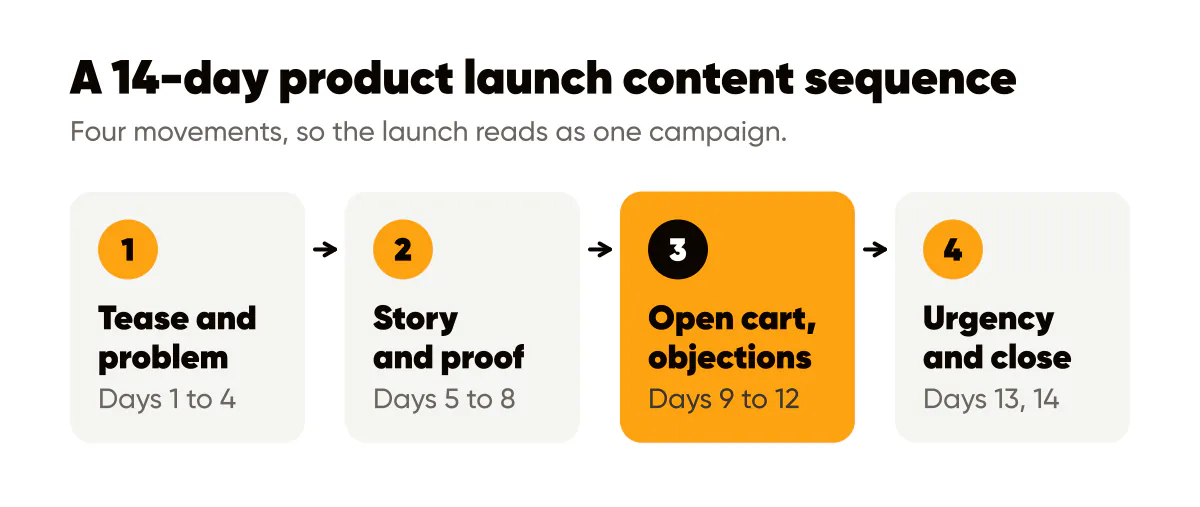
A 14-day launch content sequence runs in four movements: tease and problem in days one to four, story and proof in days five to eight, open cart and objections in days nine to twelve, urgency and close in days thirteen and fourteen. Produce every visual before day one in one template family, so the launch reads as one campaign.
Why a launch needs a sequence, not a burst
The common solopreneur launch is three posts on the day the product goes live, then silence, then a discount a week later. It fails because nobody was warmed up. A sequence spreads the persuasion across two weeks so that by the time you ask, the reader already understands the problem, believes you can solve it, and has seen someone else get the result.
I launched Creobee's first paid plan with a burst and learned this the slow way. The second launch ran on a sequence, and the difference was not cleverness, it was that people had heard about it eight times before I asked them to pay. Repetition with variation is the whole trick.
How long should a launch sequence be?
Two weeks is the sweet spot for a one-person brand. Shorter and you cannot fit the story and proof phases; longer and you run out of things to say and your regular content starves. If you have a small audience, 14 days is also long enough for the algorithm to show your posts to the same people more than once.
The 14 days, one by one
Each day lists the job of the post and the format I would use on a 4:5 feed. Adjust the format, keep the job.
- Day 1, tease: a single text post with one sentence, "Something for people who design every post at midnight is coming." No name, no price. The Zeigarnik effect is the reason an unfinished idea keeps attention: people want the loop closed.
- Day 2, problem: a carousel naming the problem in the customer's own words, pulled from DMs and comments. No solution yet.
- Day 3, cost of the problem: a text post on what the problem costs in time, money or energy, framed as your observation, not a statistic.
- Day 4, second tease: a behind-the-scenes photo or short video of the thing being built, with a date. Now the loop has a deadline. For launch videos that got shared, here are 15 product launch videos with their real view counts.
- Day 5, origin story: why you built it, including the version that did not work. This is the post people remember.
- Day 6, how it works: a carousel walking through the method or product step by step, teaching as much as selling.
- Day 7, proof: a testimonial or your own before-and-after, with permission and time frames, built the way I describe in social proof posts that do not brag.
- Day 8, who it is for and who it is not for: a text post that names both. Excluding people is what makes the right people trust the inclusion.
- Day 9, open: the offer post. Who, outcome, what is included, price, one CTA, real deadline. This is the anatomy from offer posts that convert without discounting.
- Day 10, objection one: usually "I do not have time." Answer it in a carousel with the actual time it takes.
- Day 11, objection two: usually "will it work for my niche?" Answer with examples across three niches.
- Day 12, second proof: a different customer or a different result, in the same quote-card template as day 7.
- Day 13, urgency: the honest version. "Closes tomorrow at midnight" or "price rises on the 15th," only if it is true. Stories carry this well, so re-cut the post to 9:16 within Meta's safe zone for Stories to avoid the interface covering your text.
- Day 14, close: a short post that repeats the offer in one sentence, thanks people who joined, and states the deadline one last time. Then stop.
The hooks for each of these days matter as much as the structure, and I keep a bank of them in hooks for product launches so day one does not start with a blank page.
What if you do not have testimonials yet?
Use your own results on days 7 and 12, framed as exactly that: "Here is what changed for me when I started doing this." Or run a small beta before the launch, give five people access, and ask for one specific sentence each. Never invent proof. A launch without testimonials is a launch with less proof; a launch with fabricated testimonials is a business problem.
Produce every visual before day one
This is the part that makes the sequence survivable for one person. Write all fourteen captions and generate all fourteen images in one sitting, in one template family: same colors, same type, same logo corner. The teasers are text-only, the proof posts are quote cards, the offer post is your darkest, highest-contrast template so it stands out in the run. Everything else sits between them.
Batching also fixes the design drift that happens when you make posts day by day during a stressful week. My own approach is to run the posts and carousels through one batch (with Carousels switched on), the method in batch-creating thirty Instagram posts in an hour, make the Story versions separately the same week, and then spend the launch fortnight replying to comments instead of opening a design tool. A launch is a customer-conversation period; the visuals should already be finished. If the regular weeks around the launch are what slips, an AI content calendar generator can plan and write those, so your own hours go to the fourteen launch posts.
Use the AIDA order as a sanity check across the fourteen days: attention in the teasers, interest in the problem and story, desire in the proof, action in the open and close. The AIDA model (attention, interest, desire, action) is old and blunt, and that is why it works as a checklist. If day 9 arrives and you have not built desire, you have skipped a movement.
A hypothetical sequence for an online course
Say you teach a four-week course on pricing for freelancers, opening on the 15th. Day 1 teases "the pricing question I get every week." Days 2 to 3 name the underpricing problem and what it costs a freelancer over a year, framed as your experience with clients. Day 5 tells how you underpriced your own first year. Day 7 quotes a past student with permission. Day 9 opens with the price and a real close date of the 28th. Days 10 and 11 answer "I am too new" and "my market will not pay more." Day 13 goes to Stories with the deadline. Day 14 closes. Fourteen images, one template family, made on the 1st.
Do this this week
Pick your launch date and count back 14 days. Copy the day-by-day list above into your calendar with a caption slot for each. Write the day 9 offer post first, because everything before it exists to make it land, then write days 1 through 8 backwards from it. Generate all fourteen visuals in one template family before day one. Finally, run your dates, links and the bio link change through the social media launch checklist so the mechanics are done before the first tease goes out.
Put it into practice
Turn this into posts designed for your feed
Paste your website or say what you do. Creobee plans, writes and designs your posts about it as one feed in your logo and colors, captions included, and on Autopilot it posts them for you.
How the AI Instagram post generator works