How Often Should You Post on Instagram in 2026?
How often should you post on Instagram in 2026? A cadence ladder that starts at three feed posts a week plus Stories, and how batching keeps it easy.
Post on Instagram as often as you can sustain for six months without lowering quality, and no more. For most solopreneurs that is three feed posts a week plus a few Stories. Consistency is what compounds; frequency past your capacity produces thinner posts and a quiet account when you burn out.
The wrong question and the right one
"How often should I post" assumes there is a number that works for everyone. There is not, and I am suspicious of anyone who gives you one with confidence. What exists is a trade-off: more posts means more chances to be seen and less attention per post. Where the trade-off lands depends on your time, your format and how much your audience wants from you.
The better question is "what cadence can I hold for six months." Six months because that is roughly how long it takes for a small account's pattern to become visible to followers and to yourself. A pace you can hold that long beats a pace you can hold for three weeks, every time.
What Instagram actually says
Instagram's own ranking explainer describes the signals that decide what a viewer sees: their activity, information about the post, information about the poster, and their history of interacting with the poster. It does not publish a posting-frequency target. Nothing in that document says "post daily," and I would treat anyone who claims Instagram told them so with caution.
What the explainer does imply is that each post is ranked on its own merits for each viewer, using how people engage with it. A post that earns saves and shares does well regardless of whether you posted yesterday. A post nobody engages with does badly regardless of your streak. Frequency is not a ranking signal you control; engagement per post is. The algorithm guide unpacks the official signals in detail.
Instagram's Creators resources lean toward consistency and understanding your audience over any volume target, which matches what I see: accounts that post three good things a week reliably outlast accounts that post daily for a month and vanish.
The cadence ladder
What is the sustainable floor for a one-person brand?
Three feed posts a week plus two or three Stories. That is my floor recommendation for a solopreneur who also has to run the business, and it is the pace I hold for Creobee's account. Three posts is enough to rotate through your content pillars, enough to show up in followers' feeds more than once a week, and small enough to edit properly.
Below three, the account starts to feel dormant to a new visitor scanning the grid, and you lose the rhythm that makes posting a habit rather than an event. That is an observation from my own account and from watching others, not a platform rule.
When should you climb the ladder?
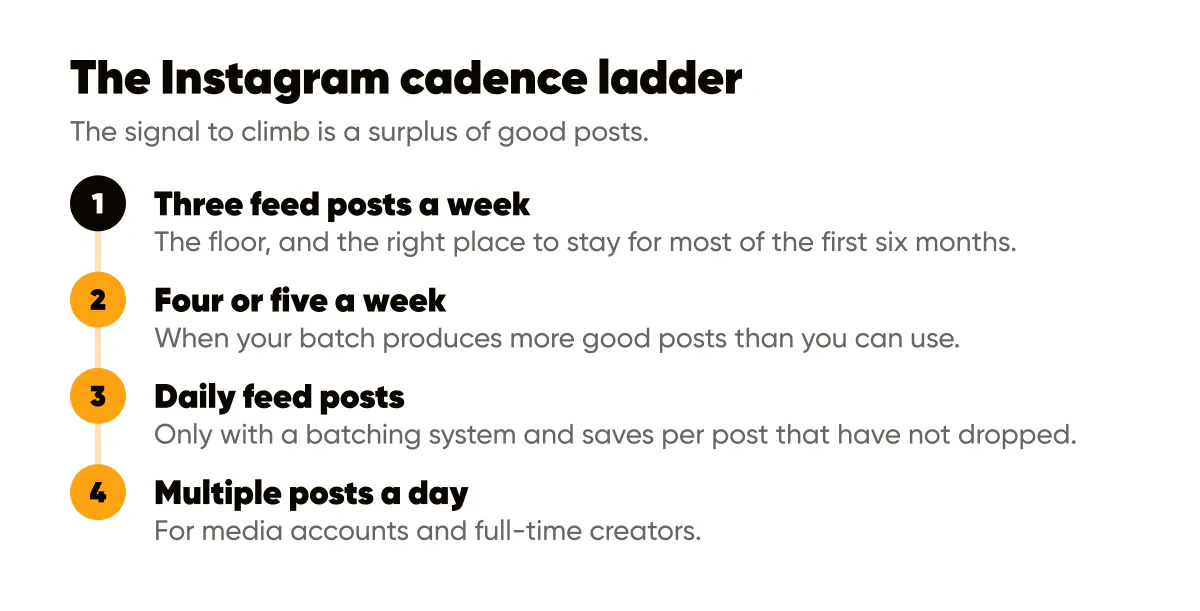
Climb one rung at a time, and only when the current rung feels easy. The ladder I use:
- Three feed posts a week plus a few Stories: the floor, and the right place to stay for most of the first six months.
- Four or five feed posts a week: when your batch process produces more good posts than you can use, not before.
- Daily feed posts: only if content is a core part of the business, you have a batching system that produces a week in one sitting, and your saves per post have not dropped as you added volume.
- Multiple posts a day: for media accounts and full-time creators. A solopreneur selling a service almost never needs this.
The signal to climb is a surplus of good posts. The signal to come back down is a drop in saves and shares per post, or a Monday you dread. Both mean the cadence has passed your quality capacity.
Should you post less in the feed and more in Stories?
Feed posts and Stories do different jobs, so the ratio depends on your goal. Feed posts are discoverable, permanent and saveable; they build the grid a new visitor judges you by. Stories reach mostly existing followers and disappear. If you need new people to find you, protect the feed cadence first. If you have an audience and need them to buy, Stories can carry more of the load. The Stories versus feed guide covers the split week by week.
People spend a lot of energy on the best hour to post. Sources like Sprout Social's best-times research and Later's Instagram timing guide are useful as starting points to test, but they aggregate many accounts, and your own insights will tell you when your specific followers are active. Pick two or three slots that fit your life, hold them for a month, then check whether moving them changes anything. Write those slots down as your Instagram posting schedule: the days, the times and which kind of post goes in each. If you would rather have the week laid out for you, Creobee's social media posting schedule makes a week at one of three paces, with every post and story on its day and time.
The reason I say timing matters less: a post that is good enough to be saved will keep being shown after the first hour. A post that is not will not be rescued by a perfect slot. Spend the energy on the post.
When to post: what the timing data actually shows
The published charts agree on less than their headlines suggest. Sprout Social and Later both publish yearly best-times charts, and both say the same thing in the small print: the best time is the one your own audience shows you in Insights. Treat the charts as a first guess, not a finding.
Here is how I turn that guess into my own number. Open Instagram Insights, find the most active times for your followers, and note the top hour on the two or three days you post. Then post in 15-minute windows around that hour for two weeks: if the top hour is 9, try 8:45, 9:00 and 9:15 on comparable posts and compare reach in the first hour. Two weeks is the minimum, because one week is easily skewed by a single post that happened to travel.
If your followers are spread across time zones, Insights shows the top locations; pick the slot that serves the largest one and accept that the rest see the post later. And recheck every quarter. Follower behavior shifts with seasons, school terms and daylight saving, so a slot that worked in March can be quiet by October. Twenty minutes with Insights four times a year is enough to catch it.
How batching makes cadence painless
The cadence problem is almost never a motivation problem. It is a production problem. Three posts a week feels hard when each one is a fresh sit-down: pick a topic, write, design, export, caption, post. Multiply by three and you are at several hours of scattered effort, and the week you have a client crisis is the week the account goes quiet.
Batching collapses that into one session. Decide the week's angles in fifteen minutes, generate or draft everything at once, edit in one pass, schedule in ten minutes. The one-hour batch method walks through producing a month of posts in a sitting; Creobee generates up to 30 branded 4:5 posts per batch, which is roughly ten weeks at the floor cadence. You do not need to post that many. You need the freedom to choose the best three each week from a surplus, and a folder of spares for the week life intervenes.
How do you know the cadence is wrong? Too high, in my experience: you skip the edit pass, you repeat yourself within the month, your saves per post fall while your post count rises, and you feel relief on days you do not post. Too low: new visitors see a top row of posts from six weeks ago, you have to reintroduce yourself in every caption, and you lose the habit entirely between posts.
Neither is fatal. Adjust by one rung and give it a month.
Do this this week
Count how many feed posts you published in the last four weeks and divide by four. If the number is under three, do not try to post more this week; instead, block 90 minutes to batch next week's three posts in one sitting, and see how the week feels. If the number is above five, check your saves per post over the same period; if they fell as volume rose, drop to four and put the saved time into editing. The weekly planning routine is the structure that makes either adjustment stick.
Put it into practice
Turn this into posts designed for your feed
Paste your website or say what you do. Creobee plans, writes and designs your posts about it as one feed in your logo and colors, captions included, and on Autopilot it posts them for you.
How the Social media posting schedule works