Social Media Content Planning in 90 Minutes a Week
Social media content planning in one 90-minute weekly block: 15 minutes review, 15 angles, 30 draft, 20 edit, 10 schedule. A whole week of posts, done.
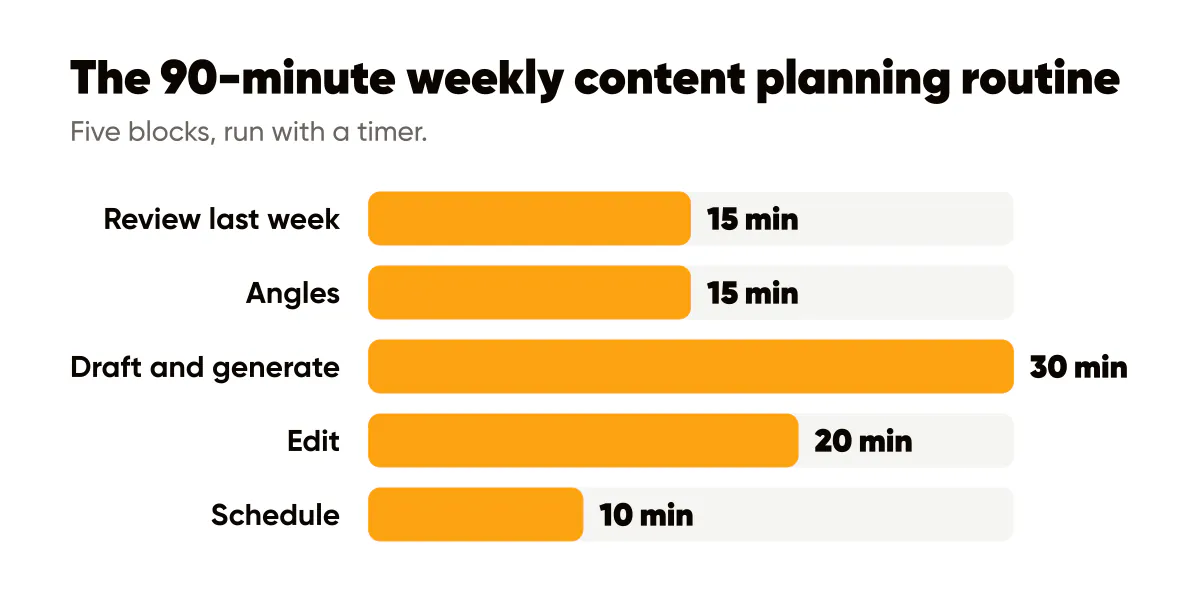
A one-person brand can plan and produce a full week of social content in a single 90-minute block: 15 minutes reviewing last week, 15 choosing angles, 30 drafting and generating, 20 editing, 10 scheduling. The trick is doing the five steps in that order, once, on the same day every week.
I post for Creobee every week and I run the company, so content gets one protected block and no more. Ninety minutes is long enough to produce five to seven posts with a proper edit pass and short enough that I actually do it. Two hours slides into three. Ninety stays ninety.
Monday morning because the week's context is fresh and nothing has gone wrong yet. Pick any day you can defend; the point is that it is the same day every week, so planning stops being a decision and becomes a habit. The batching workflow explains the sprint logic behind this; the routine below is that logic compressed into one sitting.
The weekly content planning routine, block by block
Minutes 0 to 15: what do you review first?
Open your insights and look at last week's posts only. Not the month, not the account, last week. Note which post earned the most saves and shares, which earned the fewest, and whether anything drove profile visits or DMs. Write one sentence about why the winner won. You will often be wrong, but the habit of guessing sharpens your judgment over months.
Then check the calendar for the coming week: any launch, deadline, holiday or event that a post should reference. Fifteen minutes is generous for this. If you have time left, read the last three comments on your winner and note any question you could answer in a post.
Minutes 15 to 30: angles
Pick the week's posts, as one-line angles, not captions. I aim for five feed posts and rotate pillars so no two consecutive posts share one. Each line names the pillar, the format and the specific angle: "Process pillar, behind the scenes, the step I skipped last week and regretted."
Pull angles from three places in order: the review you just did, your content pillar matrix, and the week's calendar. If a cell in the matrix has been sitting there for a month, use it or delete it. Fifteen minutes is enough for seven lines if you refuse to write captions during this block, which is the discipline most people break.
Minutes 30 to 60: draft and generate
Now produce. If you write by hand, draft five captions and five headlines from the angles. If you use AI, paste your brand voice file, then the angles, and generate a batch. In Creobee, an AI Instagram post generator, my brief is already saved, so I generate a batch of captions and 4:5 images together and keep the posts that fit the week's angles, which is why 30 minutes covers both the words and the visuals. In a chat tool plus a design tool, budget the same 30 minutes but expect to cut a post if layout runs long.
Generate more than you need. Seven captions for five slots gives you the freedom to reject two, and rejection is where quality comes from. The human-plus-AI workflow describes the division of labor in detail: you own the angle and the judgment, the machine owns the volume.
Minutes 60 to 80: edit
Twenty minutes for the pass that makes the posts yours. Cut hype words. Replace every vague claim with a specific one you can back up. Add one detail per post that only you could know: a number from your week, a client question, a thing that went wrong. Check the headline at thumbnail size. Write alt text.
Do the edits one check at a time across all posts, not one post at a time across all checks. Scan every caption for banned words, then every image for readability, then every post for its call to action. It is faster and you catch inconsistencies between posts that you would miss in sequence.
Minutes 80 to 90: when do the posts go out?
Load the finished posts into your scheduler or Instagram's own scheduling tool, spread across the week. Posting times matter less than people fear, but consistency matters, so pick slots you can hold. If you want a starting point, the Sprout Social best-times research is a reasonable reference to test against your own insights, which will always beat a general chart. If choosing the slots every week is the part you keep putting off, a social media posting schedule that plans the days and times with the posts takes that decision off the block.
Update the link in bio if this week's posts point somewhere new. Close the laptop. You are done with content until next Monday, apart from replying to comments, which is not planning and does not belong in this block.
A planning routine dies when the tool becomes the project. You need one place to hold angles and one place to hold finished posts. A single spreadsheet does both. So does a page in a notes app. If you want structure without building it, the Notion content calendar templates are a fine starting point, and most of them do more than you need.
Instagram's own ranking explainer is worth a read once, not weekly. It describes signals like a viewer's activity and their history with your account. None of that is affected by which planning app you use. It is affected by whether you show up every week with posts people want to save, which is what the 90 minutes are for.
Guardrails against overproduction
The routine has a failure mode: once producing is easy, you produce too much. A batch tool can hand you 30 posts in the time it used to take to make three, and the temptation is to post all 30. Do not. More posts from the same brand in the same week compete with each other for the same audience's attention, and your edit pass gets thinner as the count rises.
My guardrails, which you can adjust:
- Cap feed posts at a number you can edit properly in 20 minutes. For me that is five to seven.
- Never publish a post you did not read aloud once. If the week's batch is too big to read, it is too big.
- Keep spare generated posts in a holding folder for the week you are sick or travelling, rather than posting them now.
- Skip a week rather than lower the bar. A quiet week costs less than a bad post.
The posting frequency guide makes the longer argument for cadence over volume. The short version: the routine exists to make a sustainable pace effortless, not to maximize output.
The block will get skipped sometimes. A client emergency lands on Monday morning and the block evaporates. The rule I use: move it, do not shrink it. A 30-minute version on Tuesday produces posts you will regret. A full 90 on Wednesday is fine, and the holding folder covers Monday and Tuesday.
If two consecutive weeks get skipped, that is a signal about the routine, not about your discipline. Usually the block is scheduled at a time that keeps losing to something else. Move it permanently.
Do this this week
Put a 90-minute block in your calendar for the same morning next week and name it. Before it starts, make sure three things exist: a list of your pillars, your brand voice file, and last week's insights open in a tab. Then run the five blocks with a timer, strictly. At the end, write down how many posts you produced and how many edits the batch needed. That number is your baseline, and the content audit routine will tell you, a month from now, whether the posts were any good.
Once the weekly block is a habit, zoom out one level: the Q4 2026 seasonal content calendar shows how to slot key dates into the same routine without extra hours. And if a weekly block keeps losing to client work, plan the month in one sitting instead: an AI content calendar generator drafts the month's slots and the finished posts together, and the weekly block shrinks to a review.

Put it into practice
Turn this into posts designed for your feed
Paste your website or say what you do. Creobee plans, writes and designs your posts about it as one feed in your logo and colors, captions included, and on Autopilot it posts them for you.
How the AI content calendar generator works