Instagram SEO Keywords: Where to Put Them in 2026 (5 Places)
Instagram SEO keywords: the 5 places search reads them (name, bio, captions, alt text, hashtags), why image text does not count, and how to write them.
Instagram SEO means putting the words customers actually type into the fields Instagram search reads: name field, bio, captions, alt text and hashtags. Text baked into an image is not read unless it also appears in the caption or alt text. Write naturally with those words, and search starts sending people who were already looking for you.
Where Instagram search reads keywords
Instagram is a search engine for a growing number of people, especially for local and how-to queries. Someone types "wedding photographer Lisbon" or "meal prep ideas" into the search bar and gets accounts, posts and places. Whether you appear depends on whether those words exist somewhere Instagram can index.
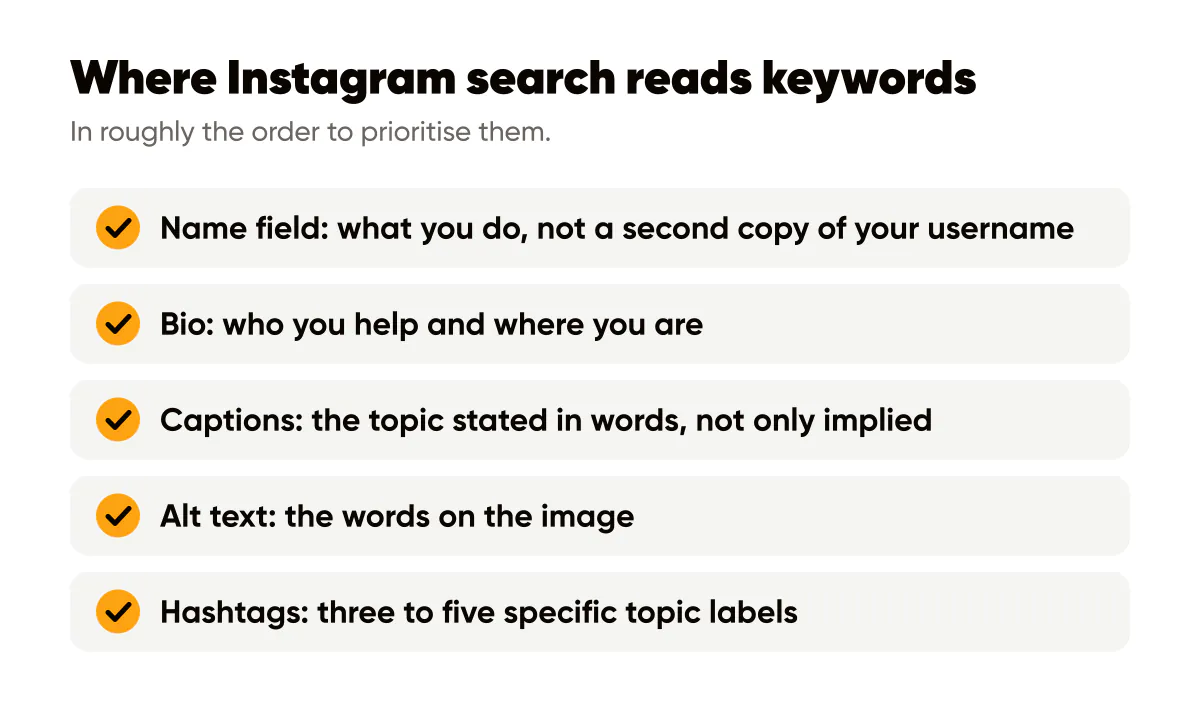
The fields that count, in roughly the order I would prioritise them:
- The name field, which is separate from your handle and is the most heavily weighted text on your profile, so it should carry what you do, not a second copy of your username.
- The bio, where a plain description of who you help and where you are beats a row of adjectives.
- Captions, which Instagram has said it reads for search and recommendations, so the topic of the post should be stated in words, not only implied by the picture.
- Alt text, which serves accessibility first and search second, and which most accounts leave on the automatic setting.
- Hashtags, which still function as topic labels, though not as the reach lever people once treated them as.
Instagram's own explainers, including Shedding More Light on How Instagram Works, describe how the system tries to understand what a post is about from its text and other signals. The practical lesson is simple: if the words are not there, the system is guessing.
Do keywords on the image itself count for Instagram search?
No, not reliably. This is the mistake I see most with branded text posts, including my own early Creobee posts. The headline on the 1080x1350 image said exactly what the post was about, and the caption said "Thoughts?" The image text is pixels. Search reads text fields.
The fix costs one sentence. Repeat the headline, or the idea behind it, in the first line of the caption, and write custom alt text that states the words on the image. The alt text guide for Instagram covers the accessibility side of that habit, and the search benefit comes free with it. It is also why every post from the AI Instagram post generator I build comes with its own caption, not just the words on the image.
How to write captions with keywords without sounding like a robot
The rule is to use the words your customer would use, not the words your industry uses. A customer types "logo for my bakery," not "brand identity system." A customer types "how often to post on Instagram," not "content cadence optimisation." Write the customer's phrase in the caption, once, near the top, in a sentence a human would say.
One phrase per post is enough. Stuffing a caption with every variant of a keyword reads badly to people and, in my experience, does nothing extra for search. Pick the phrase, use it naturally, and let the rest of the caption be the caption.
A test I use before posting: read the first line and ask whether someone who searched for the topic would recognise it as the answer. "Three ways to fix a busy Instagram grid" passes. "Been thinking about this lately" does not, even if the rest of the caption is brilliant.
Where do hashtags fit into Instagram SEO now?
As labels, not as magic. Three to five specific hashtags that describe the post's topic help the system categorise it. Thirty generic ones do not. I go into the honest version of this argument in Instagram hashtags in 2026, but the short version is that the caption keyword does most of the work now and the hashtags confirm it.
The bio and name field: your most searchable text
The name field is the single highest-value place for a keyword and almost everyone wastes it. If your handle is your business name, the name field should say what you do and, for local businesses, where. "Brand photographer, Lisbon" is searchable. Your business name written twice is not.
The bio then answers who you help and what they get. Keep the customer's language: "posts for small businesses that hate design" will match more real searches than "visual storytelling solutions." The full structure of a converting bio is in Instagram bio optimisation for solopreneurs, and the SEO part is simply making sure the words in it are the words people type.
Showing up in Google too
Instagram profiles and some posts appear in Google results, and Google reads the same text fields plus whatever the page exposes. You cannot control Google's indexing of Instagram, but you can make your profile and captions legible to it by using plain descriptive language, which is the same advice as above.
For the images you post elsewhere, on your own site or blog, Google's image SEO best practices lay out what makes an image findable: descriptive filenames, alt text that says what is in the picture, and surrounding text that matches. When I reuse a branded post as a blog cover, the alt text carries the headline and the filename carries the topic. The Instagram Help Center is the place to check current settings for alt text and search visibility, since these move.
The wider question of how social content and search interact, including what to do when a search result answers the question without a click, is the subject of SEO for social posts.
A worked example: a mobile dog groomer
Say you groom dogs at people's homes in Manchester. Name field: "Mobile dog groomer, Manchester." Bio: "I come to you. Nervous dogs welcome. Booking two weeks out." Caption for a before-and-after post: "Mobile dog grooming in south Manchester: this cockapoo had not been brushed in three months, here is what a full groom fixed." Alt text: "Before and after photo of a cockapoo groomed at home in Manchester, with the words full groom in two hours." Hashtags: four, all about dog grooming and Manchester. Every field says what a customer would type. Nothing is stuffed.
Do this this week
Rewrite your name field to say what you do and where, in the customer's words. Open your last ten posts and check whether the first caption line states the topic; edit the ones that do not. Turn on custom alt text and, for every branded text post going forward, state the words on the image in it. Then search Instagram for the phrase you most want to be found for and look at who appears; their captions will tell you which words the search is already rewarding. Small, repeated, boring work, and it compounds in a way that a hashtag experiment never did for me.
Instagram search is one of several answer engines now reading your captions. How to get cited by the AI ones is covered in AI search optimization for creators.

Put it into practice
Turn this into posts designed for your feed
Paste your website or say what you do. Creobee plans, writes and designs your posts about it as one feed in your logo and colors, captions included, and on Autopilot it posts them for you.
How the AI Instagram post generator works