Should You Disclose AI-Made Content? Meta Labels, FTC Rules and Trust
AI-generated content labels for small brands: what Meta's AI labels cover, what the FTC requires, Google's stance, and a 10-minute disclosure policy.
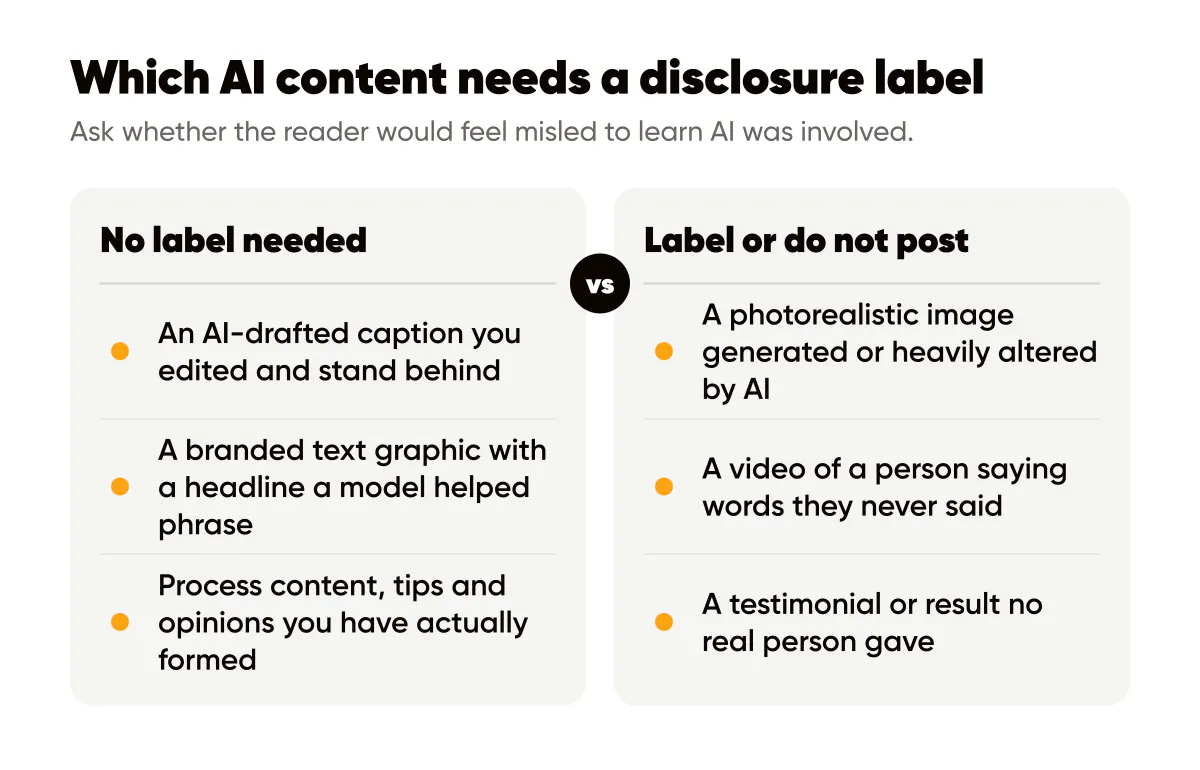
Disclose AI when the reader would feel misled to learn it was involved. That means labeling photorealistic synthetic media and any AI-generated experience, review or result, and it means following the same FTC endorsement rules regardless of tool. An AI-drafted caption you edited and stand behind does not need a badge.
Two very different things get called AI content
The disclosure debate goes in circles because it lumps together two things that have nothing in common from the reader's point of view.
The first is AI-assisted production: a model drafts a caption you edit, an AI Instagram post generator turns your idea into a branded post, a generator proposes thirty angles and you keep twelve. The reader receives your idea, in your voice, checked by you. The tool is a faster keyboard. I build one of these tools, so take my view with that in mind, but I hold it for the same reason I do not label posts "written in a word processor".
The second is synthetic media that presents itself as a record of reality: a photorealistic image of a product that does not exist, a video of a person saying words they never said, a "customer photo" of a customer who was never born. Here the reader is being asked to believe something happened. If it did not, silence is deception, and no amount of "everyone does it" fixes that.
Almost every hard question about disclosure resolves once you ask which of the two you are looking at. This is not legal advice; it is the policy I use and the reasoning behind it.
What Meta's AI labels actually cover
Meta applies AI labels on Instagram, Facebook and Threads in some situations, both from signals it detects in the file (industry-standard indicators embedded by generation tools) and from self-disclosure by the poster. The Instagram Help Center is the current source for how the label works and when Instagram asks you to add it yourself, and the details have shifted more than once, so check it rather than relying on a screenshot from last year.
The intent, in general terms, is to flag photorealistic content that was generated or substantially altered by AI so viewers are not fooled about whether something is real. It is not designed to flag a headline that a model helped you phrase, and a branded graphic with text on a gradient is not the kind of content the label exists for.
Do AI captions and branded graphics need an AI label on Instagram?
Under the current framing of Meta's labeling, a branded text post, with a headline drafted by a model and edited by you, is not photorealistic media and does not pretend to be a recording of anything. I do not label those and I would not advise a client to. What I do advise: if you used a generator to produce a photorealistic image, especially one involving a person, a place or a product, use the platform's self-disclosure option and say so in the caption too. The label is not a punishment; a viewer who later discovers an unlabeled synthetic image trusts every other post less.
The FTC does not care which tool you used
The FTC's Disclosures 101 for social media influencers covers a different question entirely: when you have a material connection to a brand or product you are promoting (payment, free product, a business relationship), you must disclose it clearly and close to the claim. That duty does not change if AI wrote the words. It also does not change if AI produced the image. The disclosure has to be where people see it, in plain language, not buried under twenty hashtags.
The FTC Endorsement Guides FAQ adds the piece that matters most for AI-assisted content: endorsements and testimonials must reflect the honest experience of a real person. A model cannot generate a customer review and you cannot post one as if a customer wrote it. That is not an AI question. It is fabrication, and it was prohibited long before generators existed. If you use a model to help a real customer polish a real testimonial, keep their approval in writing, and never let the tool add results they did not get. My social proof posts guide covers permission and specificity for testimonials.
Does Google penalize AI-generated content?
Google's published position, in its guidance on AI-generated content, is that it evaluates quality regardless of how content was produced, and that using automation to manipulate rankings is the problem, not automation itself. It also suggests disclosure where readers would reasonably wonder how something was made. What gets filtered in practice is content with nothing added: the summary of summaries. The E-E-A-T guide for solo creators is the longer version of why first-hand experience, not the drafting tool, is what ranking systems reward.
Trust is the real reason to have a policy
Regulators and platforms set the floor. Your audience sets the ceiling, and the ceiling is simple: never let a reader discover a fact about your content that would have changed how they read it. A model drafting your caption does not change how anyone reads a tip about meal prep. A model inventing the "client" in your case study changes everything.
So the practical test I use is a single question: if I appended "made with AI help" to this post, would any reader feel tricked by the post as it stood without that line? For process content, tips and opinions I have actually formed, no. For a photorealistic image, a testimonial or a claimed result, yes, so either the underlying thing is real and documented or the post does not go out.
A disclosure policy you can write in ten minutes
Here is the one I run for my own account, and it fits on an index card.
- AI-drafted text that I edit and agree with is my writing. No label, but every claim in it must be true for me specifically, and I add a receipt when the draft lacks one, as described in the AI caption generator guide.
- Any photorealistic image generated or heavily altered by AI gets the platform's AI label plus a one-line note in the caption. Branded text graphics do not.
- Testimonials and results are only ever from real people I can name, with permission saved, and no tool adds a number they did not give.
- Paid or gifted relationships are disclosed at the top of the caption in plain words, in every post, with every tool.
- If a reader asks how something was made, I answer honestly and specifically.
Write yours this week and put it somewhere you will see it before you post. Then run your next batch through it. The 12-point quality checklist for AI content has the factual-claim and would-I-say-this-out-loud checks that catch most problems before the policy ever has to. Disclosure is what you do at the end; honesty is what you build in at the start, and the human-plus-AI workflow is where that gets built.
Put it into practice
Turn this into posts designed for your feed
Paste your website or say what you do. Creobee plans, writes and designs your posts about it as one feed in your logo and colors, captions included, and on Autopilot it posts them for you.
How the AI social media post generator works