AI-Generated Content Copyright: Who Owns What
AI-generated content copyright in plain language: what the US Copyright Office says, who owns AI-written captions and templated images, and the records to keep.
Under the US Copyright Office's current position, material generated purely by a machine is not protected by copyright because it lacks human authorship, while the parts a person creatively contributed can be. For creators, that means your logo, your written and edited words, and your arrangement choices are yours; a raw AI image on its own probably is not. This is a summary, not legal advice.
Why this matters more than it seems
I am not a lawyer, and this post is a founder's plain-language reading of public guidance, not legal advice. If a real dispute is on the table, talk to someone qualified. With that said, most creators never think about ownership until a competitor lifts their post, or a client asks who owns the deliverable, or a platform asks them to confirm they hold the rights. Knowing the basics in advance is cheap.
The starting point is what copyright actually protects. The US Copyright Office's overview of what copyright is describes it as protection for original works of authorship fixed in a tangible form, arising automatically when the work is created. The word that carries the weight in the AI discussion is authorship.
What the Copyright Office says about AI
The Office maintains a dedicated Copyright and Artificial Intelligence page with its registration guidance and policy reports. In plain terms, its position is that copyright requires human authorship, and that material generated by an AI system in response to a prompt, without further human creative contribution, does not meet that bar. Prompting alone has not been treated as enough, because the system, not the person, decides the expressive details.
The same guidance leaves the door open for works that combine machine output with human creativity. If a person selects, arranges, edits or adds to AI-generated material in a way that is itself creative, the human contribution can be protected, even though the purely machine-made portion is not. Registration applications are expected to disclose the AI-generated parts and claim only the human ones.
Is an AI-written caption protected by copyright?
A caption you generated and posted verbatim is, on the Office's reasoning, unlikely to be protected as your work. A caption you generated, then rewrote, reordered, cut and added your own detail to is a different story: the human-authored expression can be yours, and the more substantial your edits, the stronger that claim. In practice this lines up with what makes captions good anyway. The edit pass that adds your receipt and removes the hype is also the pass that makes the words yours in a legal sense.
Two cautions. Ownership is not the same as originality; a heavily edited caption is still a problem if it copies someone else's post. And what matters is the actual human contribution, not how much you feel you contributed, so keep the drafts if it could ever matter.
Who owns a templated image with my logo and AI-written text?
Break the image into its parts. Your logo was created by a human (you or a designer you have an agreement with) and is protected as a graphic work in the normal way. The headline text, if you wrote or edited it, is your expression. The choices about layout, color, placement and which backgrounds to pair with which headlines are selection and arrangement decisions a person made. A background produced by a generative model with no further human input is the part most likely to fall outside protection.
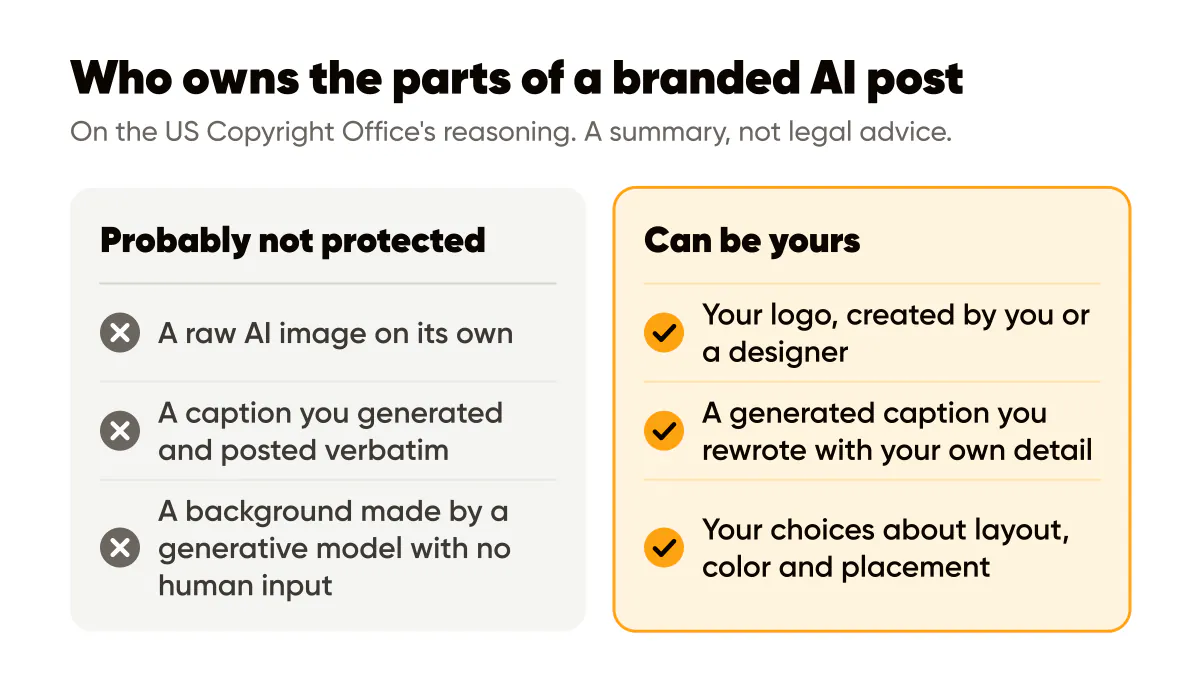
This is one reason to build every post around your own logo, your own palette and words you have checked yourself: the elements that carry your brand are then the elements a human authored. The AI image generators vs branded post composers post goes into that distinction from the design side rather than the legal one. It is also why the AI social media post generator I build designs each post on your own logo and colors with no AI-generated images, and leaves only the words to a model.
Tool terms of service are a separate question
Copyright law decides what is protectable. A provider's terms decide what you are allowed to do with outputs and what rights the provider claims or gives you. These are different layers and both apply. OpenAI, for example, publishes usage policies that set out prohibited uses, and its terms address output rights separately. Other providers differ, and terms change, so read the current version of whichever tool you actually use.
What to look for, in general terms:
- Whether the provider assigns you its rights in the output, and whether that assignment has conditions.
- Whether commercial use is permitted on your plan.
- Whether you are required to disclose AI use in some contexts, and what the provider prohibits outright.
- Whether the provider may use your inputs for training, which matters if you paste client material.
The stock photo licensing guide covers the parallel question for photos you did not make, and the font licensing post covers type. The three together are most of what a solopreneur needs to think about before pressing publish.
Keeping records that help later
If a question ever comes up, the person with records wins the argument. I keep a simple log for anything that matters: the tool used, the date, the prompt or brief, the raw output, and the edited version. For images, the record includes which elements were mine (logo, text, layout choices) and which were generated. This takes about a minute per asset and it also makes the disclosure decision easier, because you already know what was generated and what was not.
A worked example. Say you are a bookkeeper and you generate a batch of thirty branded posts explaining common tax mistakes. The headlines were drafted by a model from your brief, then you rewrote a third of them and cut every hype word. The logo is yours. The backgrounds are preset abstract shapes from the tool. My reading: the edited headlines and the arrangement are your human contributions, the logo is yours regardless, and you should not expect to own the abstract backgrounds as such. That is fine, because nobody is going to build a competing brand out of your abstract backgrounds. The parts that identify you are the parts you own.
Do this this week
- Read the current terms of the one AI tool you use most and write a two-line summary of what it says about output rights and commercial use.
- Start a log: tool, date, brief, raw output, edited version. One row per asset that matters.
- Adopt an edit rule: no AI-written headline or caption is published without at least one substantive change in your own words.
- Check that your logo has a clear paper trail: either you made it, or you have a written agreement with whoever did.
- If a specific dispute, client contract or registration is on the table, get advice from a qualified professional; this post is background, not counsel.
The practical summary is that the more of yourself you put into a piece of content, the more of it you own. That happens to be the same advice that makes content worth posting in the first place.
Put it into practice
Turn this into posts designed for your feed
Paste your website or say what you do. Creobee plans, writes and designs your posts about it as one feed in your logo and colors, captions included, and on Autopilot it posts them for you.
How the AI social media post generator works