Content Ideas for Service Businesses: 60 Posts
Content ideas for service businesses: 60 post ideas for coaches, consultants and freelancers in six pillars, and a two-minute way to turn each into a post.
A service business never runs out of content if it pulls from six pillars: educate, process, proof, personal, offer and community. Below are sixty one-line ideas, ten per pillar, written for coaches, consultants and freelancers. Each line is enough to prompt a caption and a 4:5 headline in about two minutes.
How to use these content ideas for service businesses
Do not post these as written. They are angles, and an angle becomes yours the moment you add the detail only you have: the client, the number, the mistake. Pick five for the week, one from each of five pillars, and rotate so no two consecutive posts share a pillar. The content pillars guide explains why that rotation matters.
How do you turn one line into a post and caption?
Three steps. First, write the headline: the idea compressed to two to eight words that would stop a scroll on a 1080 by 1350 image, such as "Hourly billing punishes speed." Second, write the caption: the headline's claim, one specific example from your own work, and one call to action. Third, put the headline on your branded template. In Creobee's AI Instagram post generator all three steps happen in one batch: I describe the business once and get the headlines, captions and branded images back together; by hand, budget ten minutes per post. The caption frameworks give you structures for step two.
Educate and process ideas
Educate: teach one thing your clients pay you to know, so the post earns saves.
- The one question to ask before hiring anyone in your field.
- Three mistakes you see in every first consultation, and the fix for each.
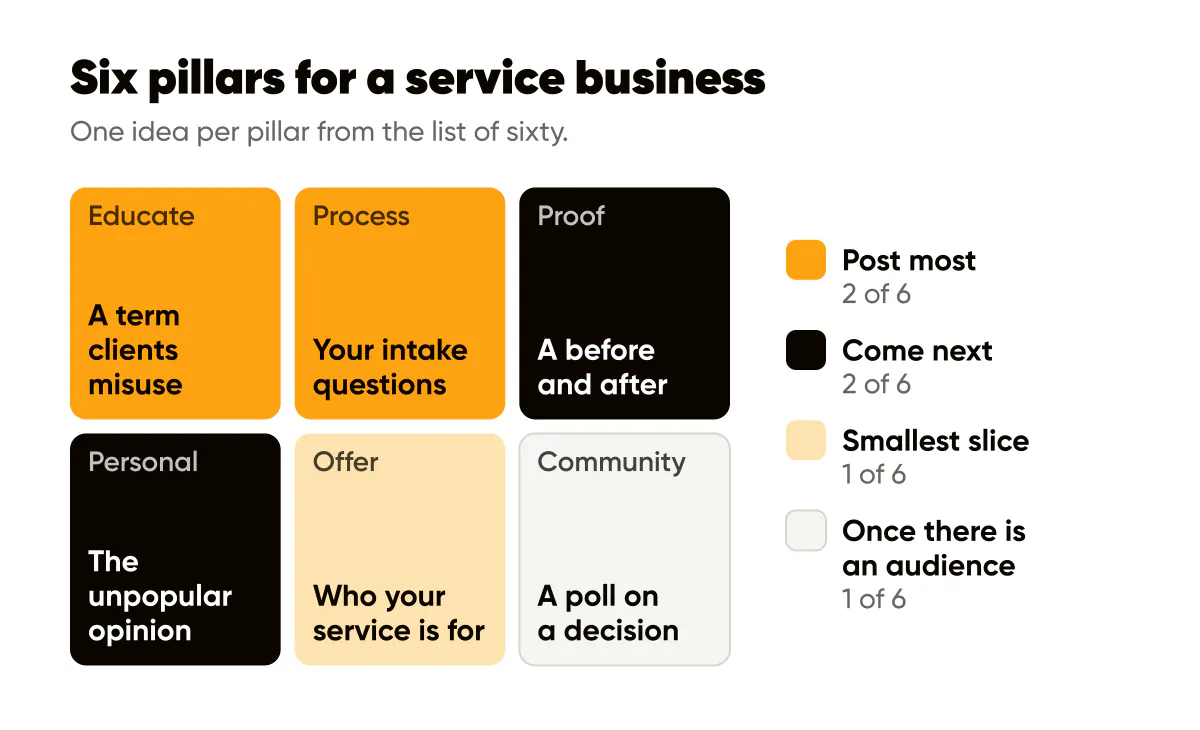
- A term clients misuse, explained in one sentence.
- The cheapest improvement most clients overlook.
- What to prepare before working with someone like you.
- A myth in your industry, and what is actually true.
- How to tell a good provider from a bad one in five minutes.
- The beginner mistake you also made once.
- One tool you recommend and the one you stopped using.
- The rule you break on purpose, and why.
Process: show how the work happens, because unfamiliar work feels risky.
- The first thing you do when a project starts.
- What a typical week looks like inside your service.
- The step clients most want to skip, and what happens if they do.
- Your intake questions and why each one exists.
- How you decide a project is finished.
- A behind-the-scenes photo of your workspace on a normal Tuesday.
- How long each stage takes, honestly.
- The checklist you run before every delivery.
- What you do when a project goes off track.
- A tool or template you built for yourself and still use.
Proof and personal ideas
Proof: show the result and the receipt, with permission and without inflating anything.
- A client result with a time frame, shared with their consent.
- A before and after, framed around the decision that made the difference.
- A screenshot of a message a client sent, with permission and the name blurred.
- The problem a client brought you and how it was solved, without the client's name.
- A number from your own business this month and what it taught you.
- The project you turned down and why that was the right call.
- A common objection and how a real client's outcome answered it.
- A review quoted on a branded card, with the person's permission.
- The mistake you made on a project and how you fixed it.
- What a past client says they wish they had done sooner.
Personal: let the account be a person, because people hire people.
- Why you started this business, in three sentences.
- The habit that keeps your work good.
- A book, talk or idea that changed how you work.
- The unpopular opinion you hold about your industry.
- A day that went wrong and what you would do differently.
- What you do when you are not working, in one photo.
- The client interaction that reminded you why you do this.
- Something you believed a year ago and no longer do.
- Your working hours and the boundary behind them.
- The skill you are learning now and why.
Offer and community ideas
Offer: sell clearly, rarely, and to people who already understand the work.
- Who your service is for, and who it is not for.
- What is included, in a plain list.
- The outcome a client can expect, stated without hype.
- The small first step: a free checklist, audit or call.
- Why your price is what it is.
- The question to ask yourself to know if you are ready to hire you.
- Spots open this month, with a real number and a real date.
- What happens in the first week after someone signs.
- The guarantee or promise you make, and its limits.
- A comparison of your two service tiers and who each suits.
Community: start conversations that other people want to join.
- Ask followers the question you get asked most.
- Invite people to share their biggest challenge in your area.
- A fill-in-the-blank about a common frustration in your field.
- Highlight a client or peer doing good work, with their permission.
- Ask which of two approaches people prefer and why.
- Share a follower's question and your answer.
- A poll on a decision you are genuinely making.
- Thank the people who helped you this quarter, by name if they agree.
- Ask what people want you to post about next month.
- Recap the best comments from a recent post.
Which pillar should you post most?
Educate and process, because they are the ones a stranger can benefit from before trusting you. Proof and personal come next. Offer is the smallest slice; in my own batches it is never more than one post in five, and that is my practice rather than a rule. Community ideas work best once there is an audience to answer, so weight them up as the account grows. Instagram's Creators blog tends to emphasize the same thing: give people a reason to follow before you give them a reason to buy.
Two honesty notes on the proof pillar. Every testimonial, screenshot or result must be real and shared with permission. And if a client relationship involves anything of value beyond the normal service, disclose it; the FTC's disclosure guide explains when a material connection needs to be stated. The social proof posts guide covers how to design these without sounding like a brag.
Do this this week
Pick five lines, one each from educate, process, proof, personal and community. Add one detail from your own work to each. Write five headlines under eight words, then five captions of under 60 words with one call to action. Drop them into next week's slots in your content calendar and generate or design the five images in one sitting. Next week, pick five more. The list will outlast the year.
If the bottleneck is not ideas but the hours to turn them into posts every week, done-for-you social media posts is the other route: describe the business once, and the month comes back planned, written and designed in your colors, with every post waiting for your approval.

Put it into practice
Turn this into posts designed for your feed
Paste your website or say what you do. Creobee plans, writes and designs your posts about it as one feed in your logo and colors, captions included, and on Autopilot it posts them for you.
How the AI content calendar generator works