Content Pillars for Small Business, With Examples
Content pillars for small business: pick 3 to 5 from audience problems, your offer and proof, see two worked examples, and fill months of posts with a matrix.
Content pillars are three to five recurring themes that every post belongs to. Pick them from three sources: the problems your audience already has, the offer you sell, and the proof you can show. Cross each pillar with four or five formats and you get a matrix that produces post ideas faster than you can publish them.
What content pillars are for
A pillar is a promise about what your account is about. Followers stay because they know roughly what they will get, and you keep posting because you never face a blank page. Without pillars, every post is a fresh decision, and fresh decisions are exhausting. That is the real reason small accounts go quiet: not lack of ideas, but the cost of deciding what to make each time.
Pillars also make AI useful. A prompt that says "write a caption" produces mush. A prompt that says "write a caption for the process pillar, format: behind the scenes, about the step most people skip" produces something you can edit into a post. Pillars are the constant. Posts are the variable.
How to pick pillars that will not run dry
Where do good pillars come from?
From three places, and you need at least one pillar from each.
- Audience problems: the questions clients ask before they buy and the mistakes they make before they find you. These pillars educate and get saved.
- Your offer: what you actually sell and how it works. These pillars build understanding of the thing so the sale is not a surprise.
- Your proof: results, process, and the way you work. These pillars build the trust that Google's people-first content guidance describes as demonstrable experience.
A fourth optional source is you: the personal pillar, the opinions and habits that make the account a person rather than a brochure. It is optional because some brands do not need it, but most solo brands do better with it.
How many pillars is too many?
Five is the ceiling and three is often better. Beyond five, a pillar posts so rarely that followers never learn it exists, and you lose the recognition benefit. If you have eight candidate themes, group them. "Pricing tips," "contract tips" and "client red flags" are one pillar called "running your business."
Instagram's own ranking explainer describes how the feed weights what a viewer has interacted with before. Consistent themes make that pattern easier to form: someone who saved your last three pricing posts is a good candidate to be shown the fourth.
The pillar-to-post matrix
This is the tool that makes pillars generative rather than decorative. Write your pillars down the left side of a page. Across the top, write four or five formats you actually make: a one-line text post, a carousel, a personal story, a myth-versus-fact post, an offer post. Every cell in the grid is a post idea, and a four-by-five grid is twenty ideas before you have thought hard about anything.
Fill each cell with a one-line angle, not a finished caption. "Pricing pillar, myth-versus-fact format: charging hourly protects you." That line is enough to prompt a caption and a 4:5 headline later. When a cell is empty and stays empty, that is information: either the format does not suit the pillar or the pillar is weaker than you thought.
Two worked examples
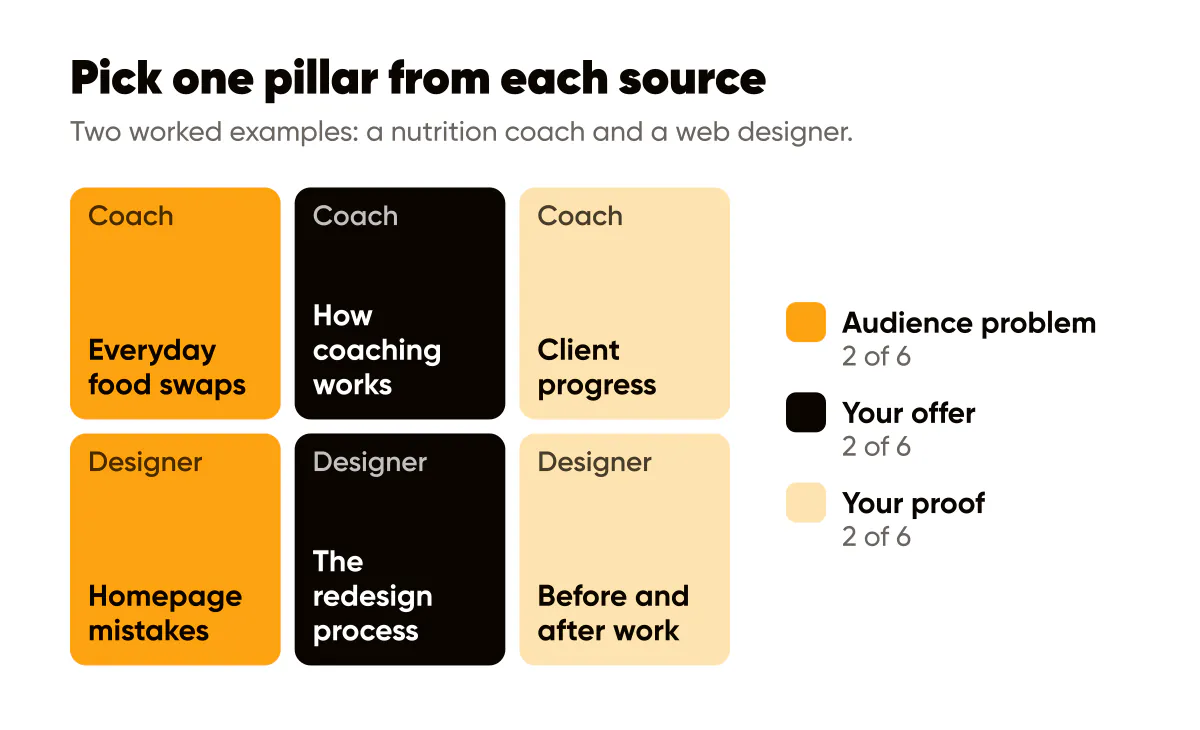
First, a nutrition coach. Pillars: everyday food swaps (audience problem), how coaching works (offer), client progress and my own meals (proof), and what I actually think about diet culture (personal). Four pillars, one from each source.
Run the matrix. Food swaps as a one-liner: "Protein first, then whatever you want." Food swaps as a carousel: seven breakfasts under ten minutes. How coaching works as a story: what the first call looks like, including the question I always ask. Progress as a myth-versus-fact: "You need to weigh yourself daily." Diet culture as a personal post: the phrase I banned from my own vocabulary this year. That is five posts from five cells, each one clearly hers, each one recognizably part of a system.
Second, a web designer. Pillars: homepage mistakes (audience problem), the redesign process (offer), before-and-after work (proof). Three pillars, no personal one, because this designer prefers the work to speak.
Matrix cells: mistakes as a one-liner: "Your homepage should say who it is for in the first sentence." Process as a carousel: the five stages of a redesign and how long each takes. Before-and-after as a story: a site that was fine and still converted nobody, and the one change that mattered. Mistakes as myth-versus-fact: "More pages means more SEO." Process as an offer post: a paid homepage audit as the first step. The service business content ideas list has sixty more of these, grouped by pillar, if your grid needs seeding.
How pillars feed AI prompts
Once the matrix exists, a caption prompt writes itself. The pillar gives the topic and the reason it matters; the cell gives the angle; your brand voice file gives the tone. "Pillar: homepage mistakes. Angle: the first sentence should name who the site is for. Format: one-line text post plus a 40-word caption. Voice: see file." The prompt templates collection has fill-in versions for every format above.
In Creobee I pick a content mix before each batch, so a batch of 20 posts lands across teaching, conversation, proof and selling posts instead of clustering on the one topic I felt like writing about that day. The same discipline works in any tool. Decide the pillar mix before you generate, not after. That order is the whole idea behind an AI content calendar that writes the posts too: the plan and the finished posts come from the same mix.
Pillars are not permanent, either. Review them quarterly. A pillar that has not produced a post you were proud of in three months should be merged or replaced. A topic that keeps appearing in your DMs and does not fit any pillar is a candidate for a new one. When you replace a pillar, tell your audience in a post; it is content, and it signals that the account is run by a person paying attention.
Also watch the ratio. My own rough target is that no single pillar takes more than about 40 percent of a month's posts, and the offer pillar never leads the count. That ratio is my practice, not a rule from research, but the failure mode it prevents is real: an account that becomes all offers loses the audience that made the offers work.
Do this this week
Write down three to five pillars, one from each source: audience problem, offer, proof. Draw the matrix with four formats across the top. Fill as many cells as you can in fifteen minutes with one-line angles. Then drop the filled cells into a 30-day calendar, rotating pillars so no two consecutive posts share one, and you have your next month decided. The weekly planning routine turns that month into a repeatable Monday habit.

Put it into practice
Turn this into posts designed for your feed
Paste your website or say what you do. Creobee plans, writes and designs your posts about it as one feed in your logo and colors, captions included, and on Autopilot it posts them for you.
How the AI content calendar generator works