Evergreen vs Trending Content: The 80/20 Mix
Evergreen vs trending content for small accounts: why evergreen is the base, the 80/20 split I run, how to spot a trend worth joining, and a worked month.
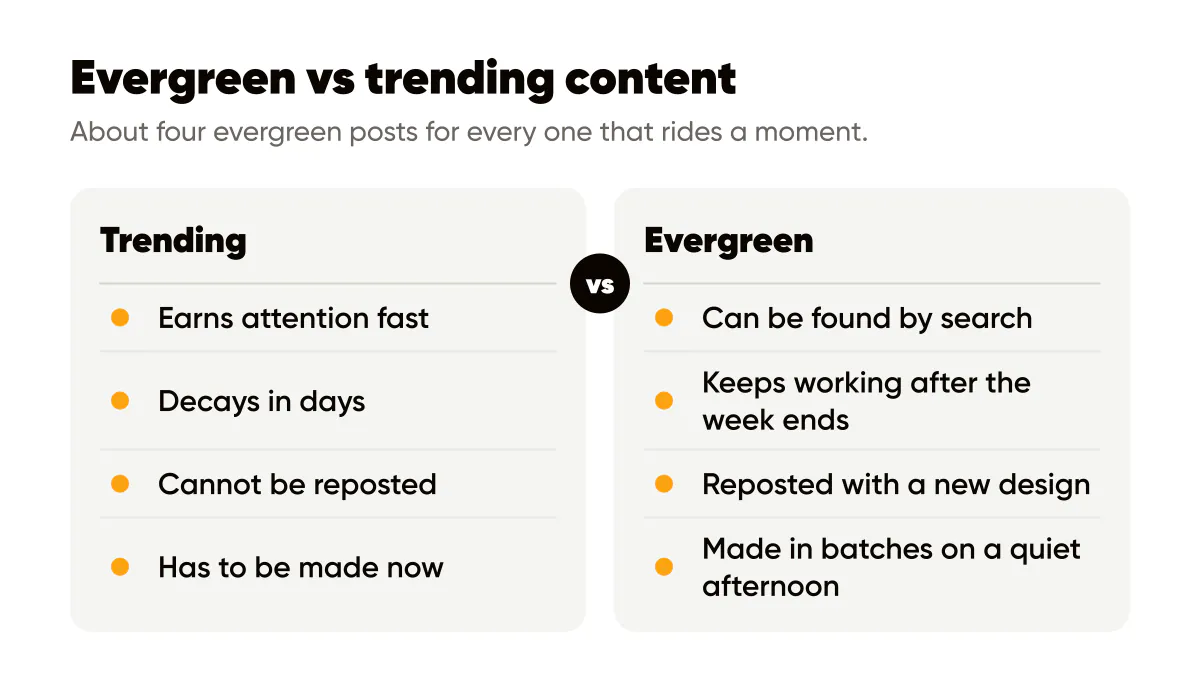
For a small account, evergreen content should be the base and trends a small slice. Evergreen posts are searchable, repostable and easy to batch, so they keep working after the week ends. Trends earn a burst of reach only when they fit your audience. On my own account the split is roughly four evergreen posts for every one that rides a moment.
Why evergreen is the base for a one-person brand
Evergreen content answers a question your customer will still have next year. How to price a service, what a boiler service includes, three signs a website headline is wrong. These posts have three properties a solopreneur needs: they can be found by search on the platform and increasingly by AI answer engines, they can be reposted with a new design without embarrassment, and they can be made in batches on a quiet afternoon.
Trending content has the opposite profile. It earns attention fast, decays in days, cannot be reposted, and has to be made now, which is the one thing a one-person business rarely has. That does not make trends worthless. It makes them a seasoning, not the meal. The evergreen content library post explains how to build the base so it compounds.
The 80/20 split, and where that number comes from
My practice, not a law: about four evergreen posts for every trend-driven one. I want to be careful with the framing. The idea of a lopsided split is borrowed from the Pareto principle, the observation that a minority of causes often produces a majority of effects. I cite it for where the instinct comes from, not as proof that 80/20 is the right ratio for your account. The actual ratio should come from your insights: if trend posts consistently bring followers who then stick around, shift toward them; if they bring a spike and a drop, shift away.
What I have seen on my own account is that trend posts occasionally outperform on reach and almost never outperform on saves, profile visits or replies. Those last three are the metrics that turn into customers for a small business, which is why evergreen keeps the majority.
Does the Instagram algorithm favor trending content?
Instagram's own ranking explainer describes ranking in terms of signals like your activity, information about the post, information about the poster and your interaction history, with different surfaces ranked differently. Nothing in there says "trends win". What tends to happen is that trend formats get more early interaction because people already recognize them, and early interaction feeds distribution. That is an effect of familiarity, not a rule that penalizes evergreen posts. A useful evergreen post that earns saves and shares is playing the same game with a longer clock.
How to spot a trend worth joining
Most trends are not for you, and joining a trend that does not fit is worse than skipping it, because it tells your audience you are performing rather than serving. I run four checks before I spend an hour on one.
- Audience fit: would the specific person in your audience sentence recognize this trend and enjoy seeing you do it? If it needs explaining, skip it.
- A bridge to your pillar: can the trend carry one of your actual topics, or would you be posting entertainment with your logo on it?
- Time to make: if the format needs a shoot, an edit and a soundtrack, and you have forty minutes, it is not your trend.
- Shelf life: if the trend is already everywhere, you are late. If it is in your niche but not yet in your city or category, you are early enough.
Two out of four is a no. Four out of four, do it that day, because the window is short. A clean way to keep the trend on-brand is to keep your template: same colors, same logo position, same font, with the trend format inside the frame. The Q4 seasonal calendar treats predictable moments like Black Friday and year-end recaps as scheduled trends you can prepare for, which is the easiest kind to join.
How often should you repost evergreen content?
More often than feels comfortable. Most of your followers did not see a post the first time, and the ones who did have forgotten. My rule is that any evergreen post that performed in the top fifth on saves gets a second life after about three months, re-templated so it looks fresh: new background, same headline or a sharpened one, updated caption with a new receipt. Re-templating is fast when the layout is fixed and only the background and text change. Nobody has ever complained that I said a true thing twice.
A worked month for a small account
Say you post twelve feed posts a month, three a week. Ten are evergreen, drawn from your pillars: two myths, two costs-explained posts, two how-tos, two opinion posts, one client question answered, one repost of a past winner in a new template. Two are moment-driven: one planned seasonal post (a deadline, a holiday, a season change) and one slot held open for a trend that passes the four checks. If nothing passes, the slot becomes another evergreen post and you lose nothing.
Timing the moment-driven posts matters more than timing the evergreen ones, because their window is short. General research such as Sprout Social's best times to post gives a starting point, and the posting frequency guide explains how to replace those general figures with your own insights within a month.
Batching the base, leaving room for the moment
The practical reason the split works is production. Ten evergreen posts can be made in one sitting: a brief, a batch of headlines, a template, an hour. The two moment-driven posts are made the week they happen. If you try to make all twelve as they come, the evergreen ones never get made because there is always a moment that seems more urgent.
I generate my evergreen batch at the start of the month in one template family, schedule it so social media runs on autopilot, and then treat the trend slot as optional. When the business is quiet, that batch is also the answer to what to post when nothing is happening, because none of it depended on news.
Do this this week
- Tag your last twenty posts as evergreen or moment-driven and note which group earned more saves and profile visits.
- Set your own ratio from that data. Start near 80/20 if you have no data yet and adjust monthly.
- Batch next month's evergreen posts in one template family in a single sitting.
- Hold one slot a week for a trend and write the four checks on a sticky note next to it.
- Pick your best-performing evergreen post from three months ago and re-template it for next week.
Evergreen is the part of your content that is still working while you are asleep or on a job. Trends are the part that works for an afternoon. Build the account on the first and enjoy the second when it fits.

Put it into practice
Turn this into posts designed for your feed
Paste your website or say what you do. Creobee plans, writes and designs your posts about it as one feed in your logo and colors, captions included, and on Autopilot it posts them for you.
How the AI content calendar generator works