Holiday Marketing Calendar 2026 for Small Business
A holiday marketing calendar for Q4 2026: the six dates worth a post, October to December, evergreen-to-seasonal remixes, and when to batch each month's posts.
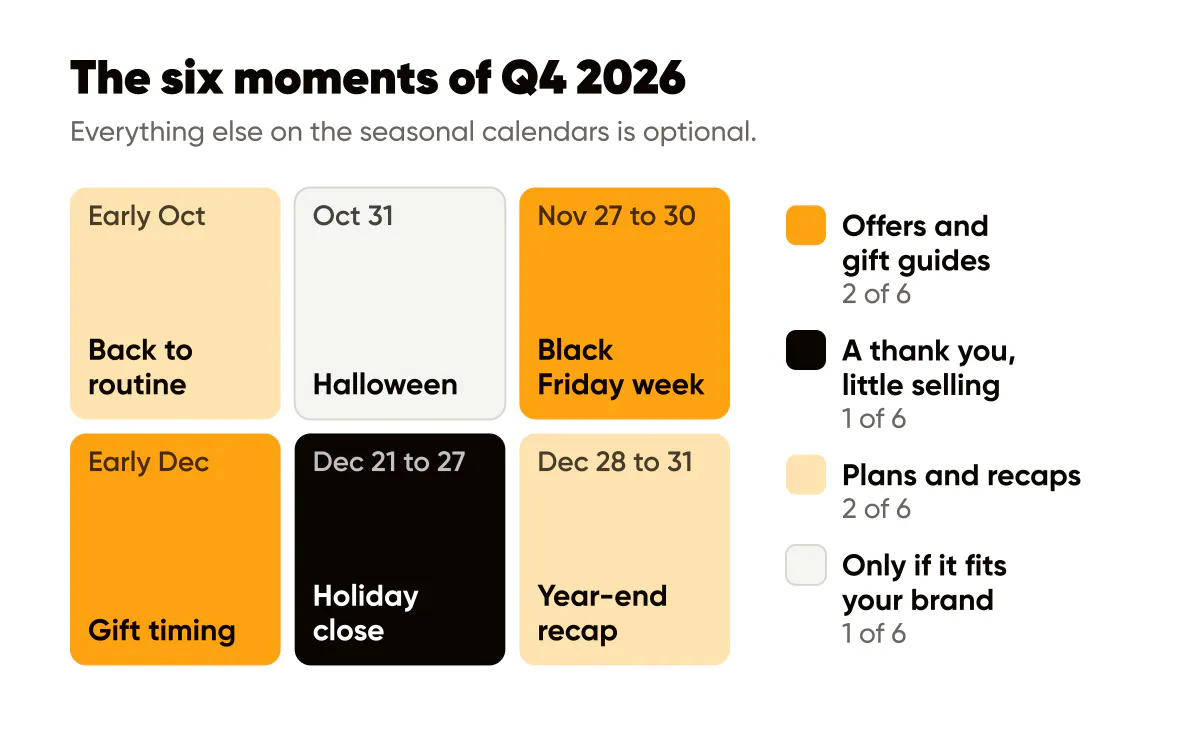
A Q4 content calendar for a small business needs six moments, not sixty: back-to-routine in early October, Halloween, the Black Friday week from November 27 to 30, early-December gift timing, the holiday close, and a year-end recap. Plan those, remix evergreen posts around them, and batch each month's visuals on one fixed date.
Why Q4 needs a plan and the rest of the year mostly does not
For most of the year a solopreneur can post from pillars and a weekly routine without thinking about dates. Q4 is different because your audience's attention is pulled toward specific days, and the businesses that look prepared win a disproportionate share of it. Not because they made more content, but because their content matched the moment.
The trap is treating Q4 as a production sprint. I have watched small brands try to produce 40 seasonal posts in November and abandon the account by mid-December. The plan below produces roughly the same volume as any other quarter, three feed posts a week, with about a third of them tied to a moment. The rest is your normal evergreen mix in seasonal clothes.
The six moments of Q4 2026
Which dates actually matter for a small business?
Fewer than the marketing calendars suggest. Here are the six I plan around, with the 2026 dates:
- Back to routine, the first two weeks of October: people are settled after summer and receptive to plans, programs and fresh starts.
- Halloween, Saturday October 31: only if it fits your brand; a playful template color swap is often enough.
- Black Friday week, Friday November 27 through Cyber Monday November 30, with Small Business Saturday on November 28: the one week you can sell harder than usual without apology.
- Gift timing, the first two weeks of December: gift guides, vouchers and "book now for January" posts, before attention fades.
- Holiday close, roughly December 21 to 27: a thank you, your hours, and very little selling.
- Year-end recap, December 28 to 31: numbers, lessons, and what is coming, which is also your best content for the personal and proof pillars.
Everything else on the seasonal calendars is optional. If a date does not connect to what you sell or who you serve, skip it without guilt.
Evergreen-to-seasonal remixes
The cheapest seasonal content is an evergreen post you already have, reframed. Your evergreen library is the raw material; the season is the wrapper. A few remixes that work for almost any service or product business:
An educational post becomes a "before the year ends" post: "Three things to fix in your website before January" is the same post as "Three homepage mistakes," with a deadline attached. A process post becomes a capacity post: "How onboarding works" becomes "How onboarding works if you book before December 15." A proof post becomes a recap: three client results from the year, on one carousel. A personal post becomes a reflection: the habit that kept you going this year.
The remix rule I use: change the frame, keep the substance. If the seasonal version says less than the evergreen one, it is worse content with a date on it, and it will not earn saves.
The Q4 batch schedule
When should you produce each month's content?
Two to three weeks before the month starts, in one sitting per month. My dates for Q4 2026:
- Mid-September: batch October. Back-to-routine posts, your normal pillar mix, an optional Halloween color variant.
- Around October 10: batch November. This is the big one, because Black Friday week needs its posts, a teaser sequence and Story slides all finished before November begins.
- Around November 10: batch December. Gift-timing posts, the holiday-close thank you, and the year-end recap template with blanks for the final numbers.
Each batch is 12 to 15 feed posts, which at three a week covers the month with a couple of spares. The one-hour batch method is how I produce that many in one sitting; Creobee's AI content calendar generator plans the month and designs up to 30 branded 4:5 posts per batch, so a month fits comfortably in one run, with the seasonal color variant as a second small batch if you want one.
The recap is the exception: build the template in November, fill in the numbers in the last week of December. Leaving a placeholder is fine. Leaving the whole post to December 29 is how recaps do not get made.
On visuals: you do not need seasonal templates. You need your template with a seasonal accent. Keep your layout, type and logo position exactly as they are, so the account remains recognizable, and change one thing: the background or accent color.
For Q4 that might be a deeper, warmer version of your brand palette for October, your standard palette with a single high-contrast accent for the Black Friday week so offer posts stand out in the grid, and a quieter, darker variant for the holiday close. Three swaps for the whole quarter. The brand templates guide explains why the layout stays fixed; the short version is that recognition is what makes the seasonal posts land at all.
Check contrast every time you swap. A festive red behind white text often fails the readability bar that your everyday palette passes.
Black Friday for a business that hates discounting
You do not have to discount. The week works because attention to offers is high, not because prices must fall. Options that keep your margin: a bonus added to the normal price, a bundle of two services, a price lock for people who book now for the new year, or a limited number of spots with a real closing date. Shopify's Instagram marketing guide covers the mechanics of shoppable posts if you sell products; for services, the offer posts guide covers the anatomy of an offer that converts on value rather than a percentage off.
Sequence the week rather than shouting on Friday. A teaser the week before, the offer on Friday, a proof post on Saturday tied to Small Business Saturday, a reminder Sunday, and a real close on Monday. That is five posts, batched in October, scheduled once. A full two-week launch sequence is the longer version if the offer is a genuine launch.
Q4 is the hardest quarter, so a method that survives it survives the year. Each quarter, about six weeks before it starts, do three things in one hour. Write down the quarter's moments, no more than six, and cut any that do not connect to your business. Pick one evergreen post per pillar to remix for each moment. Set the three monthly batch dates in your calendar and treat them like client appointments.
Then run the same weekly planning routine you run all year. The quarterly hour only decides which weeks carry a moment. For timing within the week, your own insights beat any general chart, though a reference like Sprout Social's best-times research is a fine place to start testing.
Do this this week
Open your calendar and mark the six Q4 moments above, deleting any that do not fit your business. Put three batch dates in: mid-September, around October 10, around November 10. Then open your best-performing posts from this year and pick one per pillar to remix for the Black Friday week; that is your first seasonal batch, and the 30-day calendar method will slot it into October's plan without disturbing your evergreen rhythm.

Put it into practice
Turn this into posts designed for your feed
Paste your website or say what you do. Creobee plans, writes and designs your posts about it as one feed in your logo and colors, captions included, and on Autopilot it posts them for you.
How the AI content calendar generator works