What to Post When You Have Nothing to Post
What to post when you have nothing to post: ten post types that need no news, from FAQs and myths to reposted winners, and how to keep a bank of 20 posts ready.
Most weeks in a small business have no news, and that is fine, because the best posts rarely depend on news. Ten post types work in any quiet week: an FAQ, a myth, a checklist, a tool you use, a before and after, a definition, an opinion, a client question, a reposted winner and a mini lesson. Keep twenty of them made in advance and the quiet week stops being a problem.
Quiet weeks are the normal state
There is a myth that a healthy business always has something to announce. In practice, a solopreneur launches something two or three times a year and spends the rest of the time doing the work. If your posting depends on news, you post two or three times a year. If your posting depends on knowledge, you can post every week for a decade.
Consistency is what the platforms reward, in the broad sense that Instagram's ranking explainer describes: how people interact with your posts and with you shapes what gets shown next. You cannot build interaction history with an account that goes silent for six weeks between launches. So the quiet week is not a gap to fill. It is where most of the account gets built.
Ten post types that need no news
Each of these can be made from what you already know, in a branded template, in under ten minutes.
- FAQ: a question you get asked every week, answered in two sentences on the image and four in the caption.
- Myth: something your customers believe that is wrong, and the correction.
- Checklist: three to six things to do or check before a common decision in your niche.
- Tool you use: one product or method, what it costs, why you chose it over the alternative.
- Before and after: a real change you produced, described honestly, with the time it took and permission if a client is involved.
- Definition: a term your industry uses that customers pretend to understand. Explain it plainly.
- Opinion: a position you hold that some peers would argue with. "I do not quote over the phone" or "most small brands post too often".
- Client question: an anonymized question from a DM or call this month, with your answer.
- Repost a winner: a post from three or more months ago that earned saves, re-templated with a new background and a sharpened headline.
- Mini lesson: one thing you learned this week doing the work, in one paragraph.
The content pillars guide will tell you which of these fit which pillar; every one of the ten maps to at least one pillar in any service business I have looked at.
What should a small business post when there is nothing new to say?
Post something old that is still true. Your audience does not experience your feed as a timeline of your business; they see one post at a time, often weeks apart, and Nielsen Norman Group's research on how users read on the web is a reminder that they scan rather than study even the posts they do see. A clear explanation of your callout fee written in April is exactly as useful to the person who finds you in September. The only thing "nothing new" stops you from posting is announcements, and announcements were never the posts that earned trust anyway.
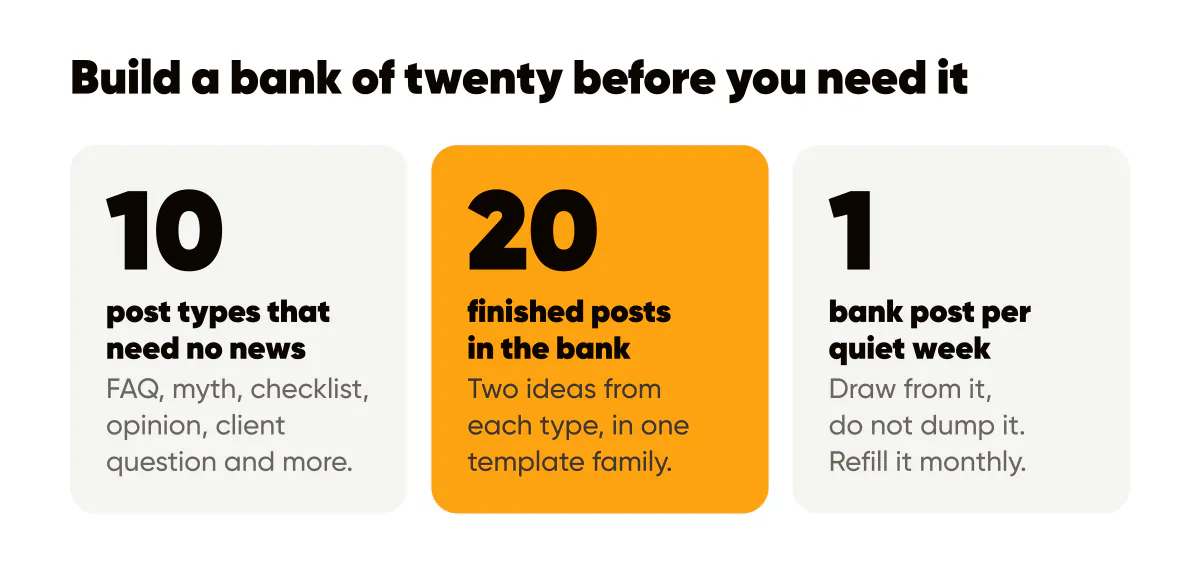
Build a bank of twenty before you need it
The reason quiet weeks feel like a crisis is that you go looking for a post on the day it is due. The fix is a bank: twenty branded posts, finished and captioned, sitting in a folder or a scheduler, made on a day when you had energy and ideas. Then a quiet week means opening the folder, not staring at a blank canvas.
Here is how I fill it in one sitting. Pick two ideas from each of the ten types above, so twenty in total. Write a two-to-eight word headline for each. Generate the twenty images in one template family so they match on the grid, and write a short caption for each while the headlines are fresh. In an AI Instagram post generator like Creobee that is one batch: describe the business, pick a framework, set the count to twenty, and it writes the headlines and captions across a mix of post types. Skip any post that does not fit rather than forcing it into the bank. The batch-create guide walks through the full hour, including the review pass you should not skip.
Two rules keep the bank useful. First, draw from it, do not dump it: one bank post per quiet week, not five in a row. Second, refill it monthly, because the bank should always hold posts you would be happy to publish tomorrow.
How do you keep a post bank from feeling stale?
Rotate the types and refresh the design. If the last three bank posts were FAQs, the next should be an opinion or a tool post. Every quarter, re-template the older ones with a new background so the grid does not show a visible seam between "bank posts" and "live posts". And add one line of currency to the caption on the day you post it: something from this week, even if the image was made in spring. The evergreen content library post covers the longer-term version of this, where the bank becomes a permanent asset you draw from for years.
A worked quiet week for a freelance web designer
Nothing shipped this week; two projects are mid-build and one proposal is out. Monday: definition post, "What a staging site is and why you have one" in the template. Wednesday: client question, "A client asked whether they need a blog. My answer: only if you will write it", anonymized. Friday: repost of a March winner, "Your homepage headline probably describes you, not your customer", new background, same logo corner. Stories in between: a screenshot of the staging site with a one-line caption about the decision being made that day. That is a full week of presence with zero announcements, and it took about forty minutes including the caption edits because the images came from the bank.
Behind-the-scenes fragments like that staging screenshot are the natural companion to bank posts; the behind-the-scenes guide covers what to show and what to keep private.
The one trap to avoid
Do not manufacture news. "Exciting things coming soon" with nothing behind it, a fake milestone, a "we are so grateful" post with no specific thing to be grateful for. Readers feel the emptiness, and it trains them to skim your account. A plain, useful FAQ post beats a hollow announcement every time, and it will still be useful when the real announcement comes.
If the quiet week is really quiet, use it to collect. The questions in your inbox this week are next month's FAQ posts; the customer questions method turns thirty of them into a month of content in a single afternoon.
Do this this week
- Write one idea for each of the ten post types. Ten lines, fifteen minutes.
- Pick the best ten and make them in one template family in a single sitting.
- Write a short caption for each while the headlines are fresh, then store them in a folder or scheduler.
- Publish one this week, on your normal day, and add one line about this week to the caption.
- Put a monthly reminder in your calendar to refill the bank to twenty.
Nothing happening in the business is not nothing to say. It is the week your account earns trust without asking for anything, which is most of what a feed is for.
Most of these are evergreen by nature, which is the point: the evergreen versus trending mix explains why a quiet week is the best time to top up that base.

Put it into practice
Turn this into posts designed for your feed
Paste your website or say what you do. Creobee plans, writes and designs your posts about it as one feed in your logo and colors, captions included, and on Autopilot it posts them for you.
How the AI content calendar generator works