Instagram Collab Posts: How Small Brands Borrow Each Other's Audiences
How Instagram Collab posts work, how to pick a partner with an adjacent audience, how to co-brand one graphic with two logos, and what to measure afterwards.
An Instagram Collab post is one post published to two accounts at once, with shared likes and comments, so your work reaches a partner's followers as a native post rather than a repost. For a small brand it is the cheapest honest way into a new audience: pick an adjacent partner, co-brand one graphic, agree on the caption.
How Collab posts work
The mechanics are simple. When you create a feed post or Reel, you can invite another account as a collaborator. If they accept, the post appears on both profiles and in both sets of followers' feeds, and the likes, comments and view counts are pooled. One post, two grids, one conversation thread. The Instagram Help Center has the current steps and limits, and Hootsuite's collab post guide walks through the tap-by-tap process with screenshots, so I will not repeat that here.
What matters strategically is the word "native." A repost or a Story shout-out is a recommendation; the follower still has to leave what they are doing and go find you. A Collab post is your content sitting in their feed as if they already followed you, with your name on it. That is a fundamentally better introduction.
The other thing that matters is the shared engagement. Both audiences comment in one place, which means a follower of your partner sees your existing followers talking, and that is social proof you did not have to manufacture. The same principle drives saves and shares: a deliberate action by someone else does the distribution for you.
Do Collab posts help both accounts equally?
Roughly, when the audiences are similar in size. If one account has ten times the followers, the smaller account gains far more, and the larger account is doing a favor. That is fine, but be honest about it in the outreach. For small brands the sweet spot is a partner within about half to double your own follower count, with an audience that wants what you make but does not already follow you.
Choosing a partner with an adjacent audience
Adjacent means: same customer, different product. A wedding photographer and a florist. A bookkeeper for freelancers and a contract lawyer for freelancers. A ceramics studio and a coffee roaster. Their followers are your future customers and yours are theirs, and nobody is competing for the same sale.
The wrong partner is a friend with an unrelated audience. A Collab with your cousin's fitness account when you sell accounting services gets you likes from people who will never hire you. Pooled engagement looks great in the moment and does nothing a month later.
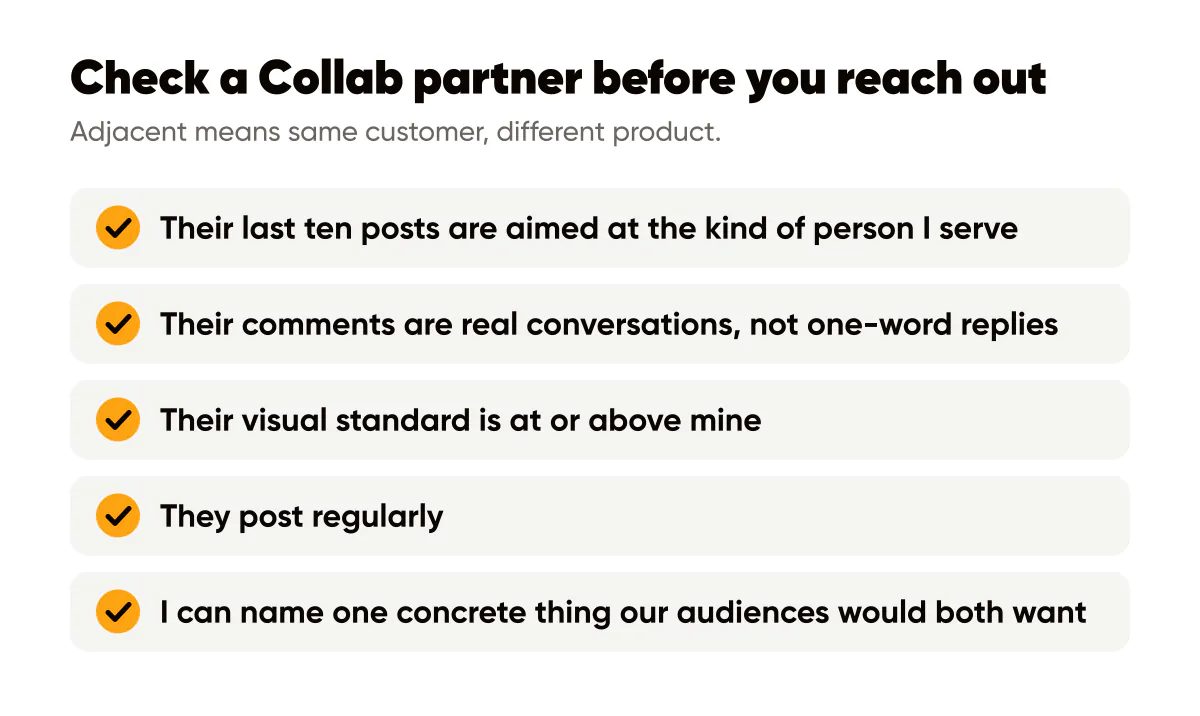
Here is my checklist before I send an outreach message.
- Their last ten posts are aimed at the same kind of person I serve, described in the same words.
- Their comments are real conversations, not one-word replies from bot accounts.
- Their visual standard is at or above mine, because the post will sit on my grid too.
- They post regularly, so the Collab does not look like the only life on their profile.
- I can name one concrete thing our audiences would both want from a joint post.
That last item is the whole pitch. "Let's collab" is not an idea. "A 5-point checklist for freelancers filing their first tax year, half from you, half from me" is an idea. If you are the bookkeeper in that pair, these social media posts for accountants show what the rest of your week can look like.
Co-branding one graphic
A Collab post should look like it belongs on both grids, which is a real design constraint when two brands have two palettes. My approach: one template, two logos, one neutral background.
Use the layout family you already post with, but drop the background to a near-black or off-white neutral so neither brand color dominates. Put both logos at the same size in the same corner region, side by side or stacked, with the same clear space around each. Choose a headline typeface one of you already uses; do not try to blend two fonts. If both brands have a strong color, use each as a small accent in the copy, one word each, rather than fighting over the background. If you do not have a layout family yet, Instagram templates for small business that fill themselves in give you one in your logo and colors.
Logo size and position matter more here than on a solo post, because a lopsided pair of logos signals a lopsided partnership. The conventions for corner placement, size relative to the canvas and clear space are in where to put your logo on social posts; for a Collab, apply them to both marks identically. Because the post shows on both grids, run it past both of you at thumbnail size before publishing, and check that it does not clash with the posts either of you has scheduled around it. Grid rhythm is covered in how to plan a cohesive Instagram grid.
What should the Collab post actually say?
Something neither of you could say alone. The best joint posts I have been part of were combined checklists, "what we wish clients knew" lists from two sides of the same project, and before-and-after posts where each partner did a different half of the work. Avoid the announcement post ("We are excited to collaborate!"). It has no value to the follower and gets skipped.
An outreach message that gets a yes
Keep it short, specific and easy to accept. Here is a version I have used, with the details changed.
"Hi Dana, I run a bookkeeping practice for freelance designers and I think a good share of my clients follow you for contract advice. Would you be up for one Collab post: a five-point checklist for a designer's first year in business, three points from you on contracts, two from me on taxes? I will design the graphic in a neutral template with both our logos and send you a draft to edit. You would just accept the collab invite and add anything you want to the caption. No cost, no strings; if it works we could do one a quarter."
Notice what is in it: who I am, why our audiences overlap, exactly what the post is, who does the work, and what the partner has to do (almost nothing). Then, if they say yes, I write the caption in a shared document with both voices visible and both handles tagged, and we agree on the date and the one call to action, ideally a comment prompt that both of us will answer. Prompts that start conversations are the subject of community-led growth prompts.
What to measure
Follower count is the wrong first metric. In Insights, look at the post's reach broken down by followers versus non-followers, then profile visits and follows from the post over the following week. Compare it to your average solo post. A good Collab should reach a much higher share of non-followers than your usual work, and the follows it produces should be from accounts that match your customer. Check ten of the new followers manually. If they look like your customers, do another Collab with the same partner next quarter. If they look like your partner's cousin's fitness friends, pick a different partner.
Do this this week
Write a list of five accounts whose customers are your customers, with follower counts between half and double yours. Pick the one whose recent posts you would happily have on your own grid. Draft one specific joint-post idea using the checklist pattern, design it in your template on a neutral background with room for a second logo, and send the message above with the details swapped in. One yes a quarter is enough. The rest of the year, keep collecting proof you can show without bragging, which is what social proof posts covers.
Put it into practice
Turn this into posts designed for your feed
Paste your website or say what you do. Creobee plans, writes and designs your posts about it as one feed in your logo and colors, captions included, and on Autopilot it posts them for you.
How the AI Instagram post generator works