Personal Brand vs Business Brand for Solopreneurs
Personal brand vs business brand: five criteria for choosing as a solopreneur, the hybrid most one-person companies should use, and what it means for your logo.
Choose a business brand if you plan to sell the company, hire a team or work in a niche where people buy from institutions. Choose a personal brand if trust in your judgment is the product. Most solopreneurs should pick the hybrid: a business name and logo on every post, with the founder's face and voice doing the talking.
The personal brand versus business brand question, answered with criteria
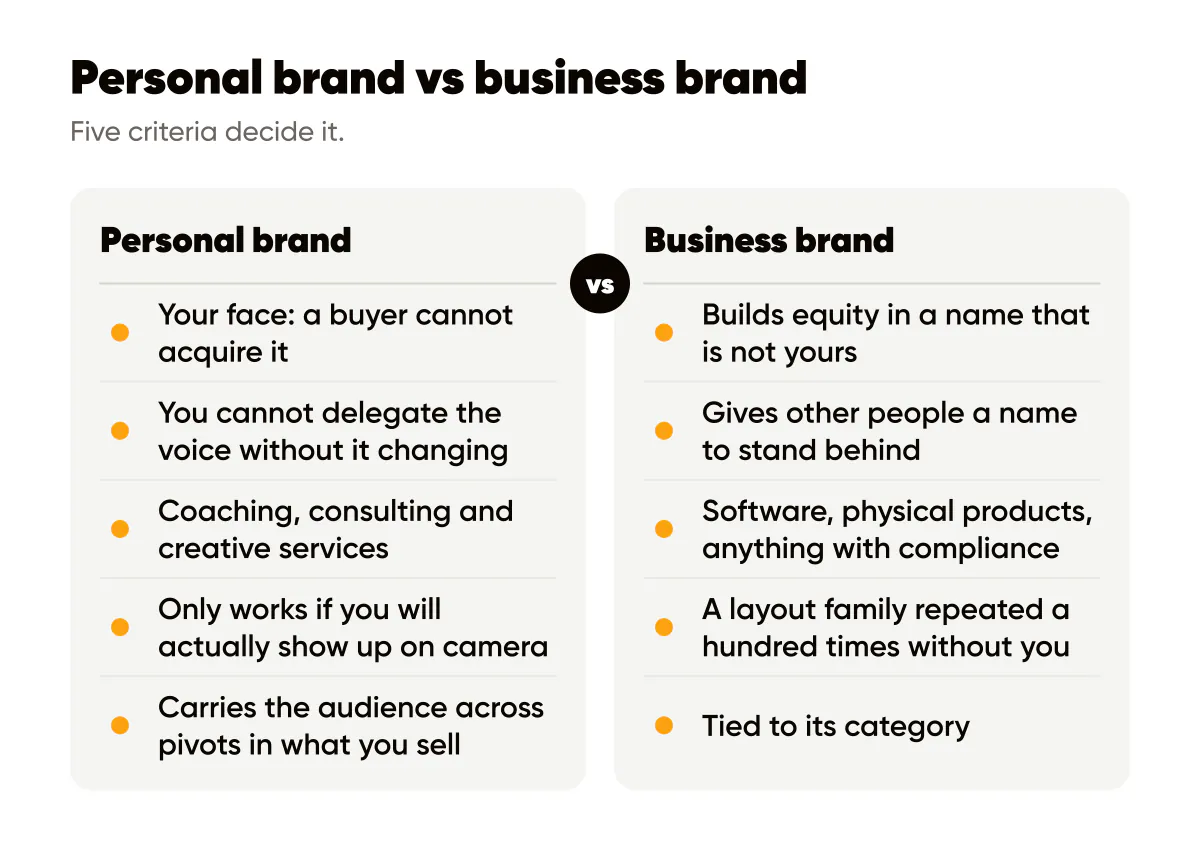
I ran Creobee under my own name for the first months, then moved to a business handle with my face still in the content. Neither choice was wrong. The mistake would have been picking one because a growth guru said so instead of because of how my business actually works. Five criteria decide it.
- Exit plans: a business you might sell one day needs equity in a name that is not yours, because a buyer cannot acquire your face.
- Hiring: if you expect other people to post, ship or support customers within two years, a business brand gives them a name to stand behind.
- Niche trust dynamics: some categories buy from people (coaching, consulting, creative services) and some buy from entities (software, physical products, anything with compliance).
- Comfort on camera: a personal brand without a person in it is just a business brand with a smaller name, so be honest about whether you will actually show up.
- Longevity of the offer: if you change what you sell every year, a personal brand carries the audience across pivots, while a business brand is tied to its category.
Score yourself on all five before reading further. Two or more pointing at business, plus any exit ambition, and you have your answer.
Is a personal brand better for a one-person business?
Better for trust, faster to start, harder to leave. A personal brand converts well because people already know how to trust a person. Google's guidance on helpful, people-first content leans the same way: it asks whether content shows first-hand experience, and experience is easier to demonstrate when a named human is doing the demonstrating. That is the case I make in E-E-A-T for solo creators.
The cost is that you cannot take a week off without the brand going quiet, and you cannot delegate the voice without it changing. I know founders who built strong personal brands and then found that the business could not be separated from them when they wanted to step back. That is not a reason to avoid it. It is a reason to decide on purpose. A business account on autopilot for social media, posting a planned week after your OK, fixes the going-quiet part, though not the voice part.
Can you switch later without losing followers?
Yes, if you move one thing at a time. Going from personal to business is the common direction, and the tactic is to introduce the business name as a project of yours for a few months before it becomes the handle. Followers accept "here is the thing I am building" much more easily than a sudden rename.
Going from business to personal is rarer and usually happens when a founder realises the company was them all along. Either way, keep one visual anchor constant through the change, usually the brand color, so the feed still reads as the same account.
The hybrid: business name, founder face
This is what I recommend to most people who ask, and it is what I run. The account is the business. The logo sits on every template. But the captions say "I", the stories show a person, and the opinions are clearly one human's opinions.
The hybrid gets you the trust of a person and the equity of a name. It also leaves the door open: if you hire, the "I" gradually becomes "we" without the handle changing. If you sell, the buyer gets the name and the templates, and you keep your face.
It is also what platforms are set up for. Instagram's own resources for businesses and its creator resources increasingly describe the same account types and tools, which tells you the line between a business presence and a personal one has blurred on the platform side too. Founder-led content on a business account is normal now, not a compromise.
What each choice means for your templates and logo
The branding decision is also a design decision, and this is where I see solopreneurs get stuck. A business brand needs a logo mark that works small, one brand color, and a layout family that can be repeated a hundred times without you in it. A personal brand needs a consistent way to present your face and your name, and the "logo" is often a wordmark of that name.
The hybrid needs both, and they compete for space on a 1080x1350 canvas. My solution: the logo mark lives in one fixed corner of every template, small, and the face lives in the content itself, in photos and video, never as a second logo. The one-page brand sheet I describe in a one-page design system for solopreneurs has a line for exactly this: where the mark goes, and where it never goes.
Logo placement matters more than logo size here. A small mark in the same position on every post builds recognition faster than a large one that moves around, and the logo placement guide covers the corners that stay clear of Instagram's interface. Consistency is doing the work that a big logo pretends to do.
A worked example: a freelance web designer
Say you build websites for local restaurants. Criteria check: no exit plan yet, maybe one contractor in two years, a category where people hire the person, comfortable on camera, offer stable. That leans personal, with a hint of business.
The hybrid version: a studio name as the handle and on the templates, your name in the bio's name field, your face in every third post, and captions in first person. Portfolio posts use the studio template. Opinion posts about restaurant websites are you talking. If you later hire a second designer, the studio name already exists and nothing about the feed has to change.
For a LinkedIn presence the same logic applies, and the founder voice matters even more there, which is the ground I cover in LinkedIn thought leadership for founders. Same face, same opinions, business name in the headline.
What to do this week
Score the five criteria on paper and write one sentence stating your choice and why. Then check your current profile against it: does the name field, the handle, the template logo and the caption voice all agree with that sentence? Fix the one that disagrees most. If you picked the hybrid, decide the fixed corner for your logo mark and re-export your three most-used templates with it there. A decision you can describe in one sentence is one your followers can recognise in one scroll, and recognition is the whole point of the brand consistency argument.
Put it into practice
Turn this into posts designed for your feed
Paste your website or say what you do. Creobee plans, writes and designs your posts about it as one feed in your logo and colors, captions included, and on Autopilot it posts them for you.
How the AI content calendar generator works