Instagram for Local Businesses: 30 Minutes a Week
Instagram for local businesses in 30 minutes a week: location tags, neighborhood keywords, three batched posts and a Google Business Profile that reuses them.
A local business wins on Instagram by being findable and recognizable to people within a few miles, not by chasing reach. Thirty minutes a week is enough if you batch three branded 4:5 posts, tag your location on everything, use neighborhood words in captions, and reuse the same visuals on your Google Business Profile.
Local Instagram is a different game
A creator wants a million people to see a post. A cafe wants the four thousand people who live or work within walking distance to think of it at 8am. Those are different problems, and most Instagram advice is written for the first one. Follower count barely matters for a salon. What matters is whether a person searching "balayage near me" or scrolling their neighborhood's location tag sees a post that looks trustworthy and makes it easy to book.
That changes the tactics. Viral hooks are optional. Location tags, local words and a recognizable look are not. And because the audience is small and specific, you can show up in front of the same people repeatedly, which is exactly how familiarity turns into a visit.
What should a local business post on Instagram?
Three pillars cover almost every local business I have looked at, whether it is a bakery, a dental clinic or a bike shop.
- The thing itself: the product, the service, the result. A finished cut, today's pastries, a repaired bike. This is the proof that you are good.
- The place and the people: the room, the street, the staff, the regulars who agreed to be photographed. This is the proof that you are real and nearby.
- Practical information as content: hours, closures, seasonal items, how to book, what to bring. Dull in theory, saved and shared in practice, because it is what customers actually need.
The method for choosing and rotating pillars, with worked examples, is in content pillars for small business. For a local business I would add one rule: at least one post a week names your neighborhood in the caption.
The 30-minute weekly routine
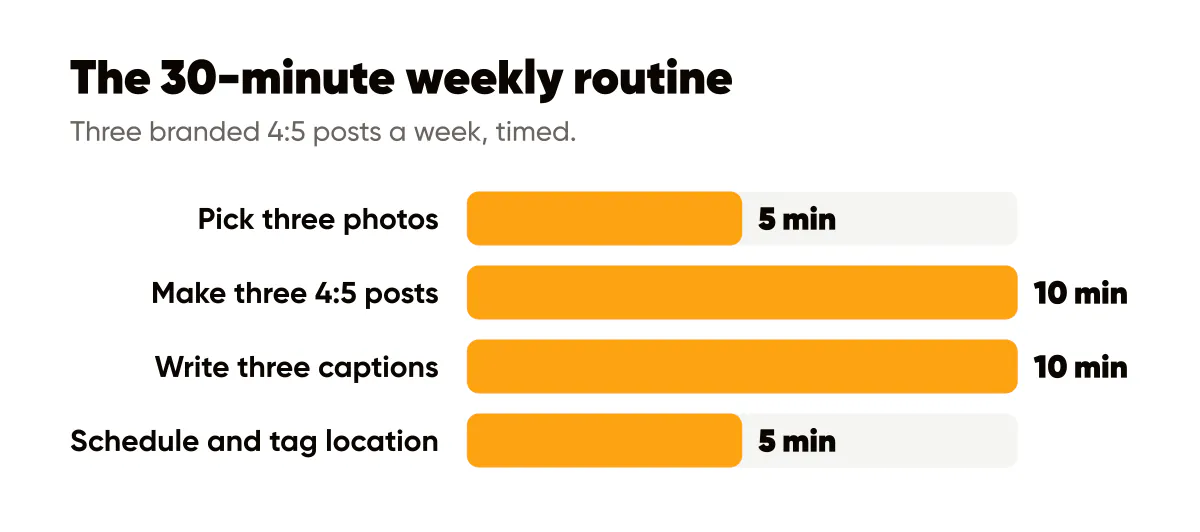
This is the routine, timed. It assumes you have a phone full of photos from the week, because taking one photo a day at work is the only ongoing habit it requires.
- Five minutes: pick three photos from the week, one per pillar. Do not agonize; a slightly blurry photo of real bread beats a stock photo of perfect bread.
- Ten minutes: make three branded 4:5 posts. Same template, your logo in the same corner, a short headline on each. For the practical-info post, the headline is the information: "Closed Monday for the holiday. Back Tuesday at 7."
- Ten minutes: write three captions, each with the neighborhood or city named once, naturally, and one specific call to action: book, preorder, come in, DM.
- Five minutes: schedule the three posts for different days, tag your location on each, and copy the best photo and caption to your Google Business Profile as an update.
The batching is what makes ten minutes for three posts realistic. This is what I built Creobee for: you describe the business once, add your logo and brand color, and have the AI Instagram post generator produce a set of designed 4:5 posts with headlines in one go, on a preset background or one of your own photos. Any tool that keeps your branding fixed works; the point is that you are not designing from a blank canvas on a Tuesday night. The broader sprint approach is in batching content workflows, and if you want the three days picked for you too, a social media posting schedule sets the week's days and times along with the posts.
Do location tags on Instagram actually help local businesses?
Yes, and they are the closest thing to free local distribution on the platform. Tagging your business location on every post puts it on your location's page, which people browse when they are deciding where to go, and tagging the neighborhood or city on Stories does the same for a wider area. Encourage customers to tag your location too; a customer photo on your location page is worth more than yours. If your business does not appear as a taggable location, it is usually because it is not set up as a place on Facebook, which the Instagram for Business resources walk through.
The second local signal is words. Instagram search matches names, bios and captions, so "Elm Street Bakery, Portland" in the name field and "on Elm Street" in captions gets you found by people typing those words. The bio structure that supports this is in Instagram bio optimization for solopreneurs.
Google Business Profile: the companion you already have
Here is the piece most local businesses skip. When a nearby person searches your category on Google or Maps, they see your Google Business Profile before they ever see Instagram. That profile accepts photos and short updates, and the same branded 4:5 post you made for Instagram works there with no changes.
Google's help pages on managing photos and videos on your Business Profile describe what you can add and the formats it accepts, and if you have not claimed the profile at all, start with adding or claiming your Business Profile. The whole point is consistency: the person who sees your post on Maps, then on Instagram, then on your door, should recognize the same brand each time. I go into the routine for keeping both in sync in Google Business Profile posts and Instagram.
How does a local business get customers to post about it?
Ask, make it easy, and make it visible. A small sign with your handle and location name at the counter does more than any caption. When a customer tags you, reshare it to your Story the same day and thank them by name. Over a few months the location page and your tagged photos become a stream of real people at your business, which is the most persuasive content you will ever have and the only kind you do not have to make. The prompts and permission habits that make this work without being awkward are in UGC prompts that work.
What not to bother with
Hashtag research. Three specific tags, including your neighborhood, is plenty. Posting daily. Three good posts a week with location tags beats seven rushed ones. Reels production. If you enjoy video, a fifteen-second clip of the espresso machine or the shop floor is great, but it is not required to be found by someone two streets away. Follower counts. Watch profile visits, direction taps, calls, and messages instead; those are the local numbers.
Do this this week
Block thirty minutes. Take one photo a day at work until then. In the block, make three branded posts, one per pillar, with your neighborhood named in each caption and your location tagged. Schedule them. Copy the best one to your Google Business Profile as an update. Put a small sign with your handle at the counter. Repeat next week, same slot, same template. In two months, the neighborhood will recognize your posts at a glance, and that recognition is the whole strategy.

Put it into practice
Turn this into posts designed for your feed
Paste your website or say what you do. Creobee plans, writes and designs your posts about it as one feed in your logo and colors, captions included, and on Autopilot it posts them for you.
How the AI Instagram post generator works