Instagram Quote Posts That People Save and Share
Instagram quote posts get scrolled past when the words and design are borrowed. How to write a short line of your own and design a 4:5 post people save.
Quote posts fail when both the words and the design are borrowed. They work when the sentence is yours, makes one specific claim in two to eight words, and sits inside a template people recognize as your brand. Save-worthy text posts are original thoughts in a consistent frame, not famous quotes on a gradient.
Why most Instagram quote posts get ignored
Open any small-business feed and you will find the same post: a line attributed to a famous founder, set in a script font, floating over a sunset. It is not a bad post. It is an invisible one. The feed has trained people to skip it in under a second, because it promises nothing they have not seen a hundred times.
The problem is double. The quote is generic, so there is nothing new to remember. The design is generic, so there is nothing to recognize. A post has to win on at least one of those two axes, and the standard quote post loses on both.
I learned this the slow way. Early on, I posted borrowed motivational lines for Creobee and got polite likes and almost no saves. When I switched to my own one-liners about posting habits, the same design started collecting saves. The words were the variable. The audience was the same.
What makes a text post worth saving?
A save is a bookmark. People save what they want to return to, or what they want to send to a friend later. Instagram's own ranking explainer describes predicting how likely someone is to interact with a post, and saves and sends are among the interactions it cares about. That is why I treat saves as the metric for text posts, a point I expand in why saves and shares grow accounts faster than likes.
Three kinds of sentences earn saves reliably. A rule someone wants to remember, such as a pricing principle. A reframe that names a feeling they have not put into words. And a specific number from your own work, with a time frame attached. Inspiration alone rarely gets saved, because inspiration is not useful at 9 a.m. on a Tuesday.
The original-thought test
Before a sentence goes onto a canvas, I run it through three questions. Could a competitor post this word for word and nobody would notice? Does it contain a specific noun, number, or position? Would I say it out loud to a client without cringing? If the first answer is yes or either of the others is no, I rewrite.
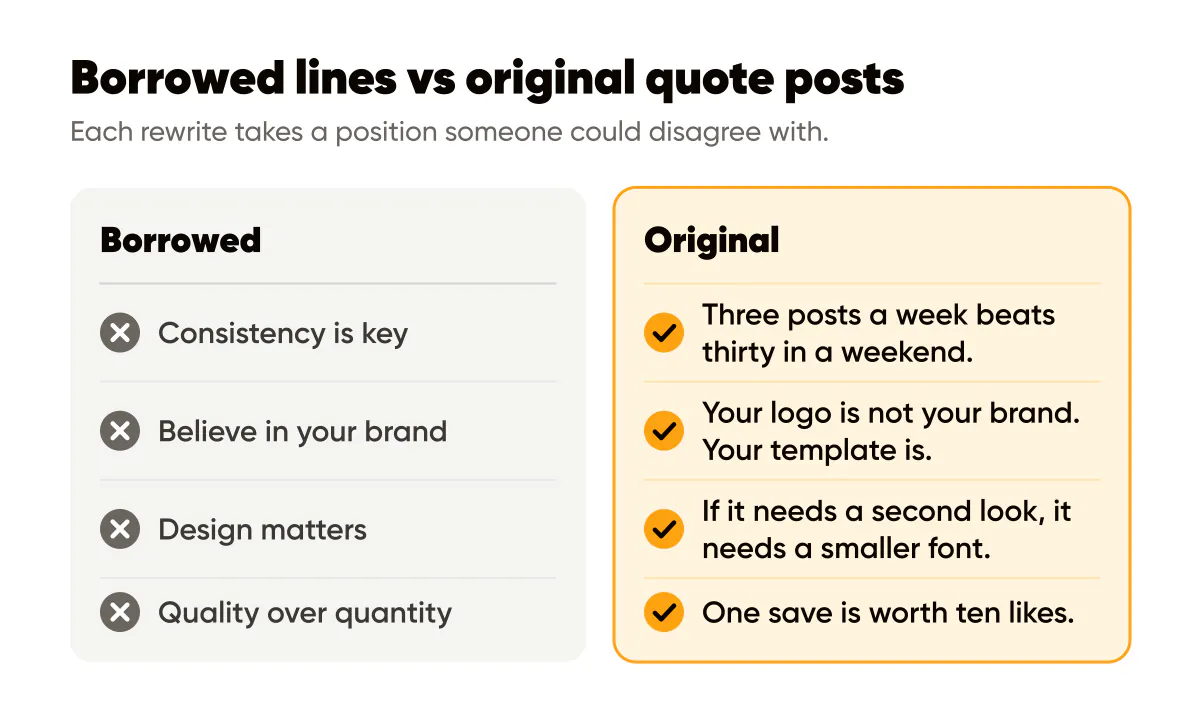
The rewrite usually means trading a universal for a particular. Here are a few before-and-after pairs from my own drafts:
- "Consistency is key" became "Three posts a week beats thirty in a weekend."
- "Believe in your brand" became "Your logo is not your brand. Your template is."
- "Work smarter, not harder" became "Batch on Monday. Reply all week."
- "Quality over quantity" became "One save is worth ten likes."
- "Design matters" became "If it needs a second look, it needs a smaller font."
Each rewrite takes a position someone could disagree with. That is the point. A statement nobody could argue with is a statement nobody needs to save. If you want more structures for this kind of line, the honest hook formulas for social media posts translate directly to text posts.
How many words should a quote post have?
Two to eight, and the fewer the better if the sentence survives the cut. On a phone, a 4:5 post gets a glance, not a read. MIT researchers have shown the brain can identify an image in as little as 13 milliseconds; the MIT News summary of that work is worth a look. Reading text is far slower than recognizing an image, so every extra word costs you attention you may not have.
I split my own headlines into two bands. Two to five words for the ultra-minimal posts, where one word carries the meaning and the rest is scaffolding. Five to eight words for the punchy claims that need a subject and a verb. The minimalist social media design guide goes deeper on writing the three-word version.
Designing a 4:5 text post that gets read
Words first, then the frame. My rules for a 1080 by 1350 canvas are boring on purpose, because boring rules are the ones you actually follow every week.
Keep the text inside a center-safe rectangle with generous margins, so nothing collides with Instagram's caption area or the like column. Check contrast against the WCAG 2.2 minimum of 4.5:1 for normal text; a dark background with light text passes almost every time, while white text on a bright brand color usually does not. Use one display font at a size you can read when the post is a thumbnail in your grid. Give one word a color or weight change, and only one.
Then leave the frame alone. A quote post template that changes every week gives followers nothing to recognize. The typography rules for social posts cover the font and size decisions in detail, and the case for locking a layout is made in brand templates that convert browsers into buyers.
Here is the full walkthrough for a hypothetical bookkeeper. The borrowed version: a famous line about money and freedom over a stock photo of a laptop. The original version: "Receipts before revenue." set in a heavy sans on a near-black background, with "Receipts" in the bookkeeper's teal, the logo small in the bottom-right corner, and a caption that explains the one habit behind the sentence. Same effort, completely different post. One gets a like from a cousin. The other gets saved by a freelancer who just lost a receipt.
Should the caption repeat the quote?
Yes, and then expand it. Text on an image is not readable by Instagram search or screen readers, so the caption needs to carry the words. More usefully, the caption is where the eight-word claim gets its evidence. The image makes the promise. The caption shows the receipt: the client story, the number, the mistake you made before you learned the rule.
Do this this week
Write down ten sentences you actually said to a client or customer in the last month. Cut each one to eight words or fewer. Run the three-question test and keep the five that pass. Drop those five into one template with one font, one background, and your logo in the same corner every time. An Instagram quote maker can write original lines from your brief and set them as designed quote posts in your colors, but the sentences you actually said to clients are still the best raw material. Post one, and compare its saves to your last five posts rather than its likes.
If you want to produce the whole set in one sitting instead of one post at a time, the weekly batching workflow shows how I turn a list of sentences into a month of posts in a single afternoon.

Put it into practice
Turn this into posts designed for your feed
Paste your website or say what you do. Creobee plans, writes and designs your posts about it as one feed in your logo and colors, captions included, and on Autopilot it posts them for you.
How the Instagram quote maker works