Facebook for Small Business: Is a Page Worth It?
Facebook for small business, honestly: when a Page is worth posting to, when to skip it, and how to keep one alive in ten minutes a week with cross-posts.
Facebook Page posts are worth it for a small business when your customers are older than the Instagram average or when you serve a specific town, because that is where Facebook still has daily habits and active local groups. If neither applies, keep the Page alive with cross-posted Instagram content and spend your real effort elsewhere.
The honest answer depends on two things
I get asked this more than almost any other channel question, usually by someone who feels guilty about a Page they have not touched in months. My answer is a question back: how old are your customers, and do they live near you?
Facebook is still one of the most widely used platforms among adults, and its usage is spread more evenly across age groups than Instagram or TikTok, which skew younger. The Pew Research Center's social media fact sheet tracks adoption by platform and demographic, and it is the source I point people to instead of guessing. If your buyers are in their forties, fifties and sixties, the odds that they open Facebook every day are good. If they are in their early twenties, the odds are poor.
The second factor is locality. Facebook Groups for neighborhoods, towns, schools and hobbies remain active in a way that has no Instagram equivalent. A plumber, a dog groomer, a tutoring service or a farm stand can get more real leads from one helpful comment in a local group than from a month of Instagram posts.
Who should keep posting on a Facebook Page?
- Local service businesses whose customers search for recommendations in town groups.
- Businesses with customers over forty: home services, financial advisors, health practices, community organizations.
- Anyone who runs events, because Facebook Events still has reach and reminders built in.
- Sellers who want a Marketplace or Shop presence tied to a Page.
- Businesses that run Meta ads, since a Page is required and organic posts give the ad account something to point at.
If you recognized yourself in two or more of those, the Page is worth ten minutes a week. If none applied, skip ahead to the section on when to leave it.
The ten-minute-a-week Page
The reason most Pages die is that people treat them as a separate content job. They are not. The same branded graphics you make for Instagram, whether from a template or an AI Facebook post generator, work on Facebook without changes, and Meta's own tooling posts to both places at once.
Meta Business Suite is the free dashboard that manages a Facebook Page and an Instagram account together. You can compose once, choose both destinations, and schedule. That is the whole trick: the Page stays alive because it rides along with the Instagram work you were already doing.
Here is my routine for the Page of a business I help locally. Monday, five minutes: open Business Suite, schedule the week's three Instagram posts to the Page as well, and shorten each caption to two or three sentences, because Facebook readers do not want a 150-word Instagram caption. Thursday, five minutes: check comments and messages, reply to everything, and share one post into the one or two local groups where it is genuinely relevant and allowed.
Should Facebook captions be different from Instagram captions?
Shorter, mostly. Hashtags do almost nothing on Facebook, so strip them. Keywords for search matter less. What matters more is a plain sentence that makes sense to someone who does not follow you and just saw the post shared in a group. Ask a question if you want comments; Facebook's audience comments more readily than Instagram's in my experience, especially locally. The full list of what to change per platform is in cross-posting without looking lazy.
The graphics themselves need no adjustment. A 4:5 branded post displays well in the Facebook mobile feed and in groups. The one thing I check is that the text on the image reads at a smaller size, because Facebook shows shared posts in groups with less screen space than the main feed.
Groups, events and the local stack
Two Facebook features earn their keep for local businesses in a way a Page alone does not.
Groups are the first. Join the town groups, the recommendations groups and the niche interest groups where your customers actually talk. Do not post ads. Answer questions with real advice, and when someone asks for exactly what you do, reply with a helpful answer and a mention that this is your work. Your Page then does the job of a business card: someone clicks through, sees a grid of consistent branded posts and a recent update, and trusts you enough to message.
Events are the second. A workshop, a tasting, a market stall or an open house gets an Event page with automatic reminders to people who mark interest. Pair the Event with a branded announcement graphic, the same template you use for offers, and share it once into the relevant groups.
Both of these work best alongside the rest of the local stack: Instagram for the visual proof, Google Business Profile for the search result. I laid out how the Page fits with the other two in Google Business Profile and Instagram, the local visibility stack, and the weekly Instagram side in Instagram for local businesses. The branded graphics are shared across all three; only the words change.
When to skip Facebook entirely
Be honest about this. If your customers are under thirty, if your business is not tied to a place, and if you do not run Meta ads, a Facebook Page is a maintenance cost with almost no return. I have advised several online-only solopreneurs to set their Page to receive their Instagram posts automatically through Business Suite and never open it again. That keeps the Page from looking abandoned, which is what a stray visitor from an ad or a search would otherwise see, and costs zero minutes a week.
Is an empty Facebook Page worse than no Page?
Yes, slightly. A Page whose last post is from two years ago signals a business that might have closed. Either keep it alive through cross-posting or unpublish it. Do not leave it as a monument.
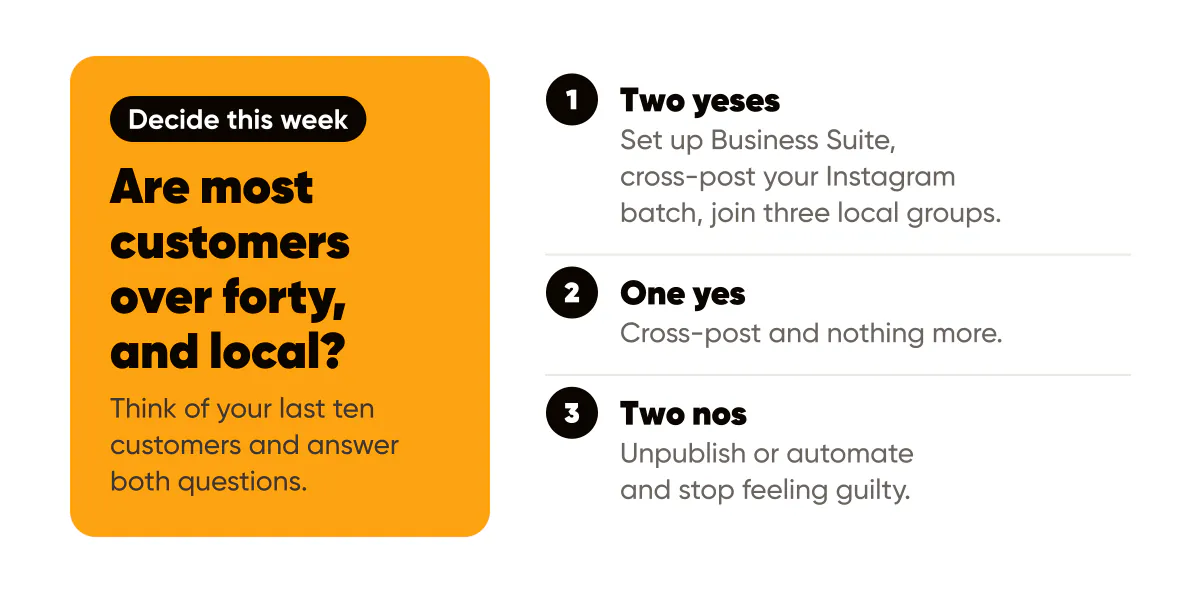
Decide this week
Pull up your customer list, or think of your last ten customers, and answer two questions: are most of them over forty, and are most of them local? Two yeses means you set up Business Suite this week, cross-post your existing Instagram batch, and join three local groups. One yes means cross-post and nothing more. Two nos means unpublish or automate and stop feeling guilty. Whatever you decide, keep the visuals the same across every channel; that consistency is what makes a stranger who sees you in a group recognize you later on Instagram, and the reasoning is in brand consistency on social media.
If your local audience is on Instagram after all, the fastest borrowed reach there is a shared post with a neighboring business, which I walk through in Instagram Collab posts for small brands.
Put it into practice
Turn this into posts designed for your feed
Paste your website or say what you do. Creobee plans, writes and designs your posts about it as one feed in your logo and colors, captions included, and on Autopilot it posts them for you.
How the AI Facebook post generator works